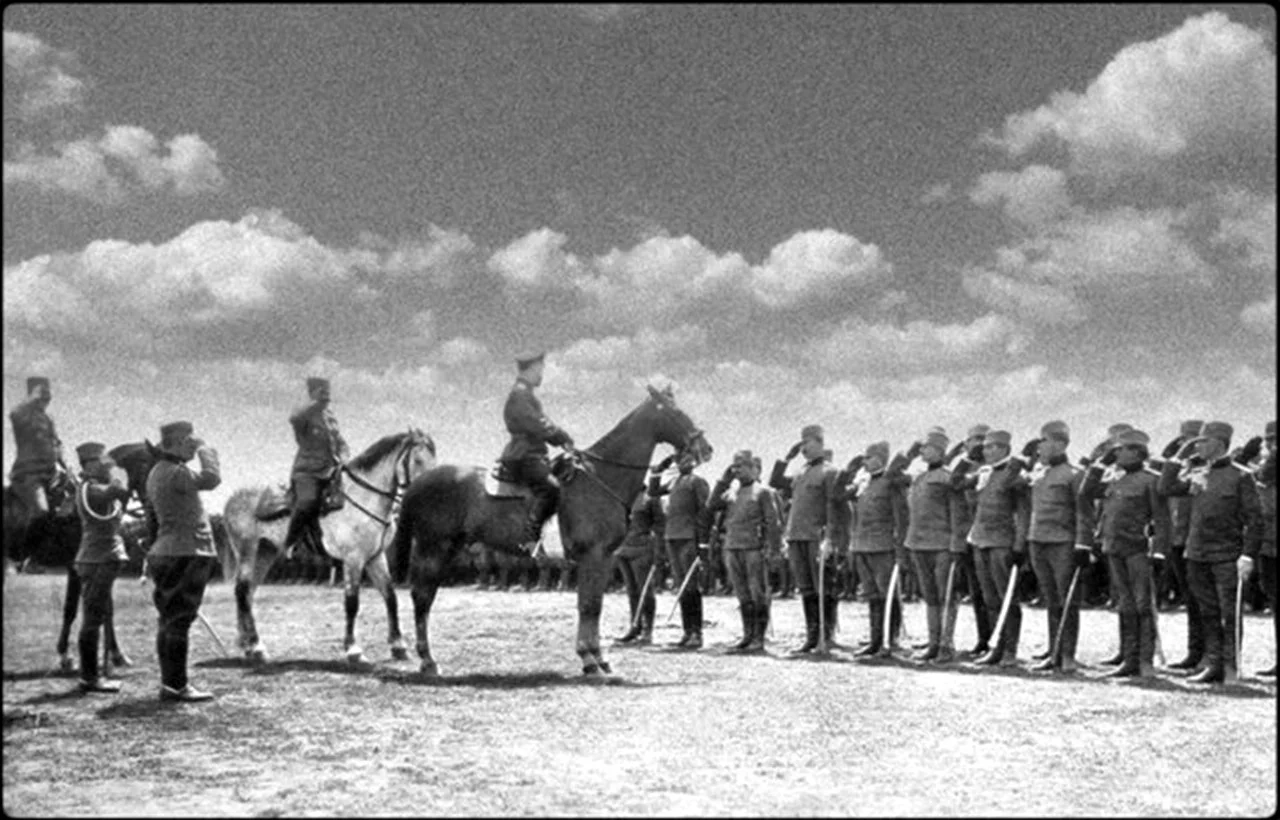

The events of Odessa (October 1916)
During World War I, the Russian Empire held over 200,000 South Slavic prisoners of war (primarily Croats, Slovenes, and Serbs) who had fought for the Austro-Hungarian Army. With permission from the Russian Tsar, the exiled Serbian government established a recruitment center in the Ukrainian port city of Odessa to form the First Serbian Volunteer Division.
The goal was to create a combat force to fight the Central Powers and secure a future unified South Slavic state. However, severe political and national friction inside the camps quickly escalated into open violence.
The Serbian officer core running the division demanded that all volunteers—regardless of their specific ethnic background—take a personal oath of allegiance to the Serbian King Peter I and serve under Serbian military symbols.
A large contingent of Croatian and Slovenian prisoners adamantly refused. They demanded that the unit be designated as a joint “Yugoslav” legion with inclusive symbols, or that they be allowed to remain in the POW camps as guaranteed by international law. They viewed the forced oath as an attempt at political subjugation.
The outbreak of violence (October 23, 1916)
To break the resistance, Serbian officers, backed by local Russian authorities and Cossack detachments, instituted harsh disciplinary measures.
On October 23, 1916, tensions culminated in an armed confrontation at Kulikovo Polje (Kulikovo Field) in Odessa. When a large group of Croatian soldiers openly mutinied and refused to obey orders, Serbian forces opened fire to suppress the dissent.
13 Croatian soldiers were killed instantly on the field.
18 soldiers were severely wounded during the initial clash.
Reprisals at the Kanatni Zavod
Following the shooting, hundreds of dissenting soldiers were rounded up and confined inside a local rope factory known as the Kanatni Zavod.
Inside this facility, the prisoners were subjected to systematic physical abuse, torture, and severe deprivation. Over the subsequent weeks, an unverified number of soldiers—historically estimated at up to several dozen—were executed in secret or died from their injuries. Eyewitness accounts from survivors later asserted that the bodies of those killed during the night were covertly dumped into the Black Sea.
Political aftermath
The violence effectively shattered the unity of the volunteer movement. Following the incident, thousands of men actively sought extraction from the division.
In 1918, the testimonies of the survivors were formally read aloud in the Croatian Parliament (Sabor) by politician Dr. Aleksandar Horvat, sparking a massive public scandal regarding the treatment of Austro-Hungarian prisoners of war and hardening political divisions right before the creation of the first Kingdom of Yugoslavia.
If you would like to know more about what followed, we can look into the official parliamentary transcripts from 1918 detailing the specific torture methods used, or follow the 12,000+ soldiers who walked away from the unit when the Russian Revolution broke out a few months later.
Croatian nationalist sources
Some Croatian sources state that on October 23, 1916, the Odessa Massacre began—a Serbian genocide against Croatian and Slovenian prisoners of war.
It stands as the greatest war crime and act of genocide committed by the Serbian army, and the single largest atrocity on the Southeastern Front. Beginning in October 1916, the Serbian army—supported by Russian Cossacks—murdered over 10,000 prisoners, predominantly Croats, as well as Slovenians and Czechs, who had refused to be forcibly conscripted into the “Yugoslav Legion” or to swear an oath under the Serbian flag and crown.
The killing of the prisoners continued day and night; they were tortured and slaughtered—mostly with edged weapons—and their bodies were cast into the Black Sea. While later Yugoslav historiography would all but suppress this atrocity, it remained alive in quiet, enduring memory. The first person to speak about this crime in the Croatian Parliament and initiate a debate was Dr. Aleksandar Horvat, a leader of the Party of Rights (Pravaši). On this subject, Miroslav Krleža wrote:
“It began in Odessa. In blood-soaked Odessa, at the ‘Rope Factory’ (Kanatni zavod), where massacres were carried out on a vast scale—and where, as the dead were being buried, the gravedigger was told there was no need for him to know who these men were, ‘because they are Croats.’ In Odessa, there was slaughter; bones were shattered, and men drowned…”
Sources
Krleža, Miroslav. Deset krvavih godina: i drugi politički eseji [Ten Bloody Years: And Other Political Essays]. Zagreb: Zora, 1957.
Grlica, George. “Odessa 1917 from a Croatian Perspective.” Cuvalo.net. Published September 11, 2018. https://cuvalo.net/2018/09/11/odessa-1917-from-a-croatian-perspective-george-grlica/.
Jareb, Mario. “Croatian Soldiers in the First World War and the Events in Odessa in 1916 and 1917”. Journal of Contemporary History 45, no. 2 (2013): 251–276.

