
by Marios Dimopoulos
The Anthropological Types of the Greeks
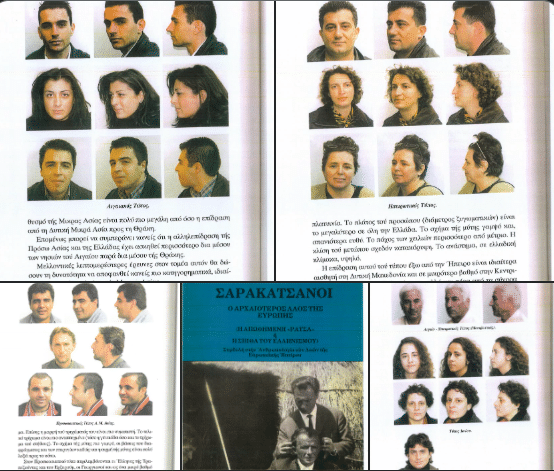
Because some Pontians take offense, or because we hear stupid remarks such as “Albanians don’t look like us,” you apparently have no idea who the Greeks are, and the image you have in your minds is that of Sakis Rouvas. So let me help you get an idea by introducing you to the most authoritative Greek anthropologist, Aris Poulianos. The photographs are from his book The Origin of the Greeks, as well as from his book about the Sarakatsani.
The two indigenous Balkan anthropological types are the Aegean (Mediterranean type) and the Continental (Dinaric type). Most Greeks east of Greece and some of the Slavic Macedonians belong to the Aegean (Mediterranean) type. The Greeks of Epirus, Albanians, Sarakatsani, and a large proportion of the Vlachs belong to the Continental (Dinaric) type.
The Continental-Dinaric type (photo 2) is the oldest anthropological type in the Balkans. That is why these people have coarser, more primitive (“ugly”) features, since they are supposedly a continuation of Paleolithic Homo sapiens. The “uglier” a type is, the more ancient it is, and the more it is characterized by endogamy and a lack of racial admixture. That is why many Albanian and Sarakatsani villagers are “ugly”. In short, Albanians and Sarakatsani are the oldest populations, with the least admixture.
The Aegean-Mediterranean type (photo 1), to which quite a few Greeks belong, is a more recent anthropological type. That is why it is more refined, less primitive, and has experienced more racial admixture.
There are also intermediate anthropological types in the Balkans, such as the Ionian type (photo 5), which represents a mixture of the aforementioned anthropological types.
Finally, Greece also has a West Asian anthropological type (photo 3), to which the Pontians belong. My apologies to the Pontians—no offense intended—but this anthropological type is not indigenous to the Balkans. These are indigenous anthropological types of Asia that arrived in the Balkans after 1912.
Therefore, statements we hear such as “Albanians don’t look like Greeks, but Pontians do” are ridiculous and show that you have no idea about Greece.
If there are people whose appearance makes it obvious from miles away that they look different, it is the Pontians. You don’t realize it because, since 1912, your eyes have become accustomed to seeing them. This is especially true of those of you who live in northern Greece. I live in Attica, and as soon as I go up to Thessaloniki, I can tell right away whether someone is an indigenous Macedonian or a Pontian newcomer. Pontians stand out like a fly in a glass of milk.
Those of us Greeks from Epirus who are indigenous rather than recently arrived immigrants laugh when some people say that Albanians don’t look like Greeks, because you apparently know nothing about Epirus, despite your claims to care so much about its Greek identity. All Epirotes, whether Greek-speaking, Albanian-speaking, or Vlach-speaking, are the same people. You are simply all ignorant buffoons who have no idea what you are talking about.
In image 4, I have included the cover of Poulianos’s book about the Sarakatsani, which shows Poulianos conducting an anthropological examination of a Sarakatsani man. The man’s face resembles that of an Albanian villager. If you saw an elderly villager like this speaking Albanian, it would never occur to you that he was a Greek Sarakatsani. And that is only natural, since both Albanians and Sarakatsani belong to the Continental-Dinaric anthropological type.
Marios Dimopoulos
BIOGRAPHY
I am a classical philologist, linguist, and ethnologist, a naturopath (Doctor of Naturopathy), and an author. I initially studied classical philology, specializing in linguistics, at the School of Philosophy of the National and Kapodistrian University of Athens. Later, because of my interest in natural and alternative therapies, I studied clinical nutrition and naturopathy.
I am the author of books on health, history, and ethnology (47 books in Greek to date). At the age of 18, I began studying the Indo-European question, the origins of the so-called “pre-Greek” peoples, and the origins of the Balkan peoples, with particular emphasis on the relationship between Greeks and Albanians and the theory that they share common Pelasgian ancestry, as well as the origins of the Arvanites and their contribution to modern Greek society.
I work in historical-comparative linguistics, the decipherment and interpretation of ancient inscriptions, the study of ancient Greek civilization and other ancient peoples, and physical (biological) anthropology and genetics.
I had collaborated with Nikos Poulianos, president of the Anthropological Society of Greece and son of the famous Greek anthropologist Aris Poulianos. With Nikos’s help, I was invited to the 21st Congress of the European Anthropological Association, held in Denmark from August 22–25, where I delivered a presentation entitled “An Anthropological Overview of the Populations of the Balkans.”
In that presentation, I argued that a large proportion of the Slavic-speaking inhabitants of the Balkans are not of Slavic origin but rather of pre-Slavic origin—in essence, ancient indigenous populations that were linguistically Slavicized.
In 2017, I wrote a study on the cradle of the human species and on whether humans really originated in Africa, or whether the theories of anthropologist Aris Poulianos concerning the origins of humanity in the northern Balkans (the wider region of Macedonia) might be correct. The anthropologist Nikos Poulianos read the study and advised me on possible corrections and revisions.
I created the ethnological website PELASGIAN STUDIES, the link to which I provide in the first comment.
In addition to my strictly scientific pursuits, I am politically active in Greece. I have previously participated as a candidate in various political formations, most recently in the European Parliament elections.

