
Translation by Petrit Latifi
Summary
The article explores possible linguistic connections between Albanian and Scandinavian mythology, focusing particularly on the names Ask and Embla and their relationship to ancient Albanian vocabulary.
In Norse mythology, Ask and Embla are regarded as the first man and woman, created by the gods. While the meaning of Ask is generally associated with the ash tree, the origin of the name Embla remains uncertain.
The author proposes that Albanian may offer an alternative explanation for Embla, connecting it with the old Albanian word t’aml or t’ambël, meaning “sweet”.
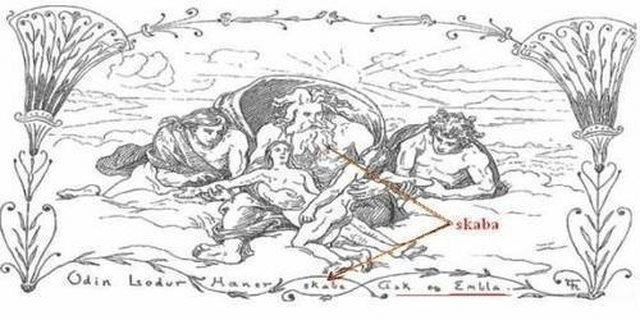
The article also examines an image containing several mythological figures and inscriptions. The author proposes the following Albanian interpretations:
- Embla – associated with e ëmbël (the sweet one), and consequently with beauty and Aphrodite.
- Skaba – connected with the Albanian word shkaba (vulture), interpreted as a symbolic bird associated with Zeus.
- Haner – associated with the Albanian word hëna (the Moon).
- Gek os Embla – interpreted through Albanian linguistic forms as Kek or e ëmbla, referring to sweetness.
The author further suggests that the five figures in the image correspond to six recorded names because Gek os Embla represents a single figure.
The central argument is that Albanian vocabulary, particularly older Gheg forms, may provide alternative explanations for certain names and inscriptions found in Scandinavian mythology.
The article therefore calls for greater consideration of Albanian linguistic traditions when investigating ancient European mythology, names and cultural connections.
A Valuable Discovery Through Social Media
Those interested in Albanian history and language, including people who were not themselves present to document these matters, have nevertheless left us a written record. Unfortunately, due to anti-Albanian political and cultural circumstances, many have not dared to bring these subjects to light.
For readers like us, even a single study by my friend Mili Butka can provide valuable insights and encourage us to learn more about ourselves. “Know thyself” is my motto, and a reminder not to allow others to mislead us.
I have had a conversation with my friend Mili Butka, a genuine exchange of ideas, even if conducted virtually, concerning three subjects that have already been extensively studied. Nevertheless, if we have counterarguments, we can discuss them, add further perspectives, exchange ideas, or simply disagree, even fundamentally.
Mili and I welcome such discussions.
1. Similarities Between Albanian and Other Languages
In Scandinavian mythology, Ask and Embla (from Old Norse: Askr and Embla) were the first two human beings, a male and a female, created by the gods. The pair are mentioned in both the Poetic Edda, compiled in the thirteenth century from earlier traditional sources, and the Prose Edda, written in the thirteenth century by Snorri Sturluson.
What, then, can we say about the two female figures depicted next to the deity named Zeus, referred to as “Gek os Embla”? Their names have not yet received an officially accepted translation.
Numerous theories have been proposed to explain the two figures, drawing on several ancient languages, including Greek and Old Norse. In Old Norse, the word askr means “ash tree”. However, the etymology of the name Embla remains uncertain. Two possible interpretations are “elm tree” and “ash tree”, but both are problematic.
In Albanian, however, we find the expression t’aml, meaning “sweet”. This interpretation requires no complicated explanation and is relatively straightforward, even if the word is written differently from the way it is pronounced today.
The deity named Embla can, in this interpretation, be associated with the goddess Aphrodite, whose beauty is connected with sweetness and love, and with the relationship between the Sun and Zeus.
In this context, and in connection with the Scandinavian mythology discussed above, we can examine the figures identified as Zeus and the two other deities beside him. The central figure, Zeus, is depicted as a large, powerful man with a beard and abundant hair. His appearance is reminiscent of Odin, the chief god in Norse mythology.
At the feet of Zeus are two female deities. One is identified as Haner, meaning “Moon”, while the other appears under the name of her symbolic bird, Skaba, identified as a vulture.
The two figures beside Zeus are therefore referred to as Haner and Gek or Embla. In Albanian, these names are interpreted as Kek or Embla, with kek associated with sweetness.
Is this a genuine linguistic connection, or has there been some form of manipulation?
Notice that the image contains five figures, while six names appear in the interpretation. This is because “Gek os – Embla” is considered to represent a single name, with kek meaning sweet, comparable to the Albanian word keku.
The names can therefore be presented as follows: Odin, Lisdur, Haner, Skaba-Zeus, and Gek os Embla-Aphrodite. The last name is interpreted as referring to beauty, sweetness, and the goddess of love. Other possible linguistic comparisons include caramel and cake.
2. Is the Word Plis of Pure Albanian Origin?
The word plis is associated with wool and with an old Albanian linguistic tradition that is still reflected in regional dialects, including the Korçë dialect.
In Gheg Albanian, pe can be associated with pi, as in the expression “Pi Shkodre jena”. The vowel e in pe may disappear, as occurs in several older written forms in which vowels are omitted.
Following this interpretation, we obtain:
Pe-lesi = P’lisi.
The letter e may also be pronounced as i, as in the comparison between the Albanian erdhi and the Greek irthe. Another example is the city of Lezhë, which appears on several old maps under the name Lisi.
There are numerous other examples in which vowels replace one another, sometimes without clearly established rules, as in the comparison between Albanian molla and Greek milla.
Let us examine the Albanian dictionary entry for the word plis.
Plis II, masculine noun, plural:
A type of textile made from sheep’s wool, which is repeatedly beaten and compressed, moistened with lukewarm water and rubbed with soap until it dries and hardens. The material can be used as a covering or blanket.
The expression bëri plis refers to the process of making this material.
The production process involves repeatedly compressing and compacting sheep’s wool until it becomes firm. This is comparable to the way soil breaks into compact pieces when turned over by a plough.
The word also brings to mind clay bricks that are dried in the sun and known as plithar.
Plis I, masculine noun, plural:
A large piece of soil lifted by a plough during cultivation, or a piece of earth covered with grass that has been cut with a hoe or another tool.
Examples include:
- The fields’ folds.
- Folds covered with grass.
- Breaking or crushing the folds.
- Covering the sides of a road with folds.
The name plis thus preserves the idea of layers, folds and compacted material, whether referring to wool that has been compressed or to soil lifted by a plough.
This leads us to a possible connection between the words lidh, plith and plis, including plithar. The underlying idea is that materials are connected, compressed and dried, possibly through a process involving water.
In the Albanian language, there are also numerous words associated with weaving and binding. One example is lesë, referring to a woven structure used for a hut, yard, enclosure or fence. Such structures are woven and tied together, much like a plafi, a woollen carpet, or pellus.
3. Etruscan: The Representation of Hercules and Zana
In the mirror, the scene clearly depicts Hercules drinking from Zana. This act is interpreted as a symbol of immortality, since it is performed by Zana in his presence.
According to this interpretation, the scene provides an explanation of the meaning of the inscription and leaves little room for doubt about the proposed reading.
The scene depicts the moment when Hercules, following his resurrection, sets out for Olympus. His act is marked by a breast, interpreted as symbolising a new birth (VNIAL), and therefore a transition into the world of the gods.
This interpretation becomes even clearer in the image, where Hercules shakes another figure’s hand. Above them, an inscription appears to contain an Albanian linguistic form resembling the traditional expression LAMTV or LAMTU, meaning “good”.
First, it is important to clarify the proposed relationship between the words ZA, RON and ROJ, which are considered to belong to ancient Albanian. In Gheg, za means “voice” and is also associated with life.
The word Zoi is also cited as a word that has entered the Greek language.
An example of the use of za in Albanian is found in the word zemër, which is associated with the voice and the organ through which human life is sustained, the heart, just as a clock comes to life through its mechanism.
Now let us examine the inscription carefully, bearing in mind that the arrows indicate changes in the characters. The same character may be interpreted as either the letter K or D, while other known sound correspondences are also taken into consideration.
The inscription reads:
ECA: ZOEN: TPAIKNAC: HEDCLE: VNIAL: KVANODA: SCE.
This is interpreted as corresponding to Albanian:
E KA: ZOIN: TE PA IKNAS: HERKULE: U NIAL: KU ANORA SKE.
In modern Albanian, the proposed meaning is:
“He has an unfading life. Hercules has been resurrected and has become immortal.”
The expression unial is interpreted as relating to resurrection or rebirth.
The third figure continues the legend of Hercules. In this image, Hercules appears to be bidding farewell before departing permanently for Olympus, the mountain of the gods.
Once again, the image is presented as evidence that the Etruscans spoke Albanian. Above the figure, the inscription reads:
HEDCLE LAMTV.
This is compared with the Albanian expression LAMTU, which is still used today when someone departs for a long period or leaves permanently.
The proposed interpretation is therefore that the inscription expresses a farewell, connecting the Etruscan representation of Hercules with a linguistic expression preserved in Albanian.
The Albanian Language in Scandinavian Mythology
How Many Coincidences Are There Between Albanian and Other Languages?
“The truth will set us free” and “the truth is concrete.” — Hegel.
Before examining an image from Scandinavian mythology, I would first like to present a comparative table showing the Albanian word i/e ëmbël (sweet) alongside its equivalents in English, Latin and Greek.
This is particularly relevant because the word appears in the image under discussion, where it is regarded as problematic and its meaning is considered unknown by the relevant researchers.
As we shall see, scholars have attempted to connect this word with the modern Greek word ámpelos, meaning “vine”. However, this proposed connection remains uncertain and has not been universally accepted.
For this reason, I would like to introduce Albanian as a possible point of comparison, a language that may simply have been overlooked in these investigations. In my view, Albanian represents one of the earliest languages to emerge directly from the roots of the so-called Indo-European language family.
I would also like to point out that in Old Albanian, as well as in the Gheg dialect still spoken today, the word for sweet was t’aml. The same form was also used in connection with milk: t’am’l or t’ambël.
This is also reflected in standard Albanian words such as mjel, mil, mile and milte, referring to the milking of livestock.
The Albanian word t’aml is, in this interpretation, the linguistic root from which the above-mentioned forms developed. The author also proposes that related forms can be found in other European languages.
Examples include mel and mjaltë (honey), as well as the Greek word ámpelos (vine).
The word e ëmbël, in its older forms t’aml, tamel and tambël, is therefore considered to contain the same linguistic elements found in words such as mel (honey), mjel (to milk) and qumësht (milk).
The author argues that comparable developments can also be observed in English, Latin, Greek and several other languages.
Comparative vocabulary
| Albanian | Older Albanian form | English | Greek | Latin |
|---|---|---|---|---|
| e ëmbël | t’ambël | sweet | glykós | dulce |
| qumësht | klumësht | milk | gala | lac |
| mjel | mil, mile | milk | gala, armégō | lac |
| mjaltë | mel | honey | méli | mel |
| pjergull | pielgul | pergola | klimatariá | pergola |
Ask and Embla in Scandinavian Mythology
In Scandinavian mythology, Ask and Embla (from Old Norse Askr and Embla) were the first two human beings, a male and a female respectively, created by the gods.
The two figures are mentioned in both the Poetic Edda, compiled in the thirteenth century from earlier traditional sources, and the Prose Edda, written in the thirteenth century by Snorri Sturluson.
In both sources, three gods, one of whom is Odin, encounter Ask and Embla and give them various physical and spiritual gifts.
A number of theories have been proposed to explain the origins and meanings of these two names.
In Old Norse, Ask or Askr literally means “ash tree”. However, the etymology of the name Embla remains uncertain.
Two possible interpretations have generally been proposed.
The first is “elm tree”. This explanation is problematic and is derived through the reconstructed forms Elm-la, Almilōn and eventually alr or almr, meaning elm.
The second suggestion is “vine”, derived through the reconstructed form Ambilō, which may be related to the Greek word ámpelos, meaning “vine” or “liana”.
The author proposes that Albanian offers another possible explanation for the name Embla.
The Figures of Skaba, Zeus, Haner and Embla
Let us now examine the image associated with Scandinavian mythology.
At its centre, the inscription clearly reads Skaba, which the author identifies with the central figure of Zeus.
This figure is depicted in a manner consistent with the traditional representation of Zeus: large, powerful, bearded and covered with abundant hair.
One of the other gods is identified as Odin.
At the feet of Zeus are two female deities:
Haner and Gek os Embla.
The author suggests that Zeus is once again represented through the name of his symbolic bird, referred to as Skaba, corresponding to the Albanian word shkaba (vulture).
The author further proposes that the two female deities beside Zeus can be interpreted through Albanian linguistic forms.
The first name, Haner, is connected with the Albanian word hëna, meaning “the Moon”.
The second name, Gek os Embla, is interpreted through the Albanian forms Geg or Embla, and Kek or e ëmbla, meaning “the sweet one”.
The author suggests that this second figure might represent Aphrodite, the goddess of beauty.
According to this interpretation, Albanian provides a particularly meaningful association between Embla, sweetness and beauty.
The name Aphrodite is also associated with the celestial body Venus, one of the brightest objects in the sky and the planet closest to the Sun in the traditional ancient understanding of its appearance and position.
The author then draws attention to an apparent discrepancy in the image.
There are five figures, but six names are recorded.
This is explained by the suggestion that Gek os – Embla represents one and the same name, interpreted as Kek or e ëmbla, meaning “the sweet one”.
The Albanian word keku is also mentioned in connection with sweetness, as are karamelet and keke.
Accordingly, the author identifies the figures in the image as:
- Odin
- Lisdur
- Haner
- Skaba-Zeus
- Gek os Embla-Aphrodite
The last figure is interpreted as the goddess of beauty, sweetness and love.
An Additional Observation
The author adds a further observation outside the main linguistic discussion.
The Albanian expression e ëmbël, written in its grammatically correct form and carrying a clear meaning, is not considered in the interpretation of the image.
The author questions why this Albanian word is not mentioned in the relevant discussion, particularly when its meaning appears to correspond to the inscription Embla.
An equally important question concerns the inscription SKABA, which appears in the centre of the image but is not given an explanation.
The author interprets SKABA as the divine bird, corresponding to the Albanian shkaba, and regards it as a symbol associated with Zeus.
In this interpretation, Zeus is considered an ancient paternal deity connected with the Pelasgian and Illyrian-Albanian traditions.
The author therefore proposes that Albanian vocabulary and its older linguistic forms deserve consideration when examining the names and inscriptions found in Scandinavian mythology.
Article
https://lajmifundit.al/aktualitet/gjuha-shqipe-ne-mitologjine-skandinave-i1194449

