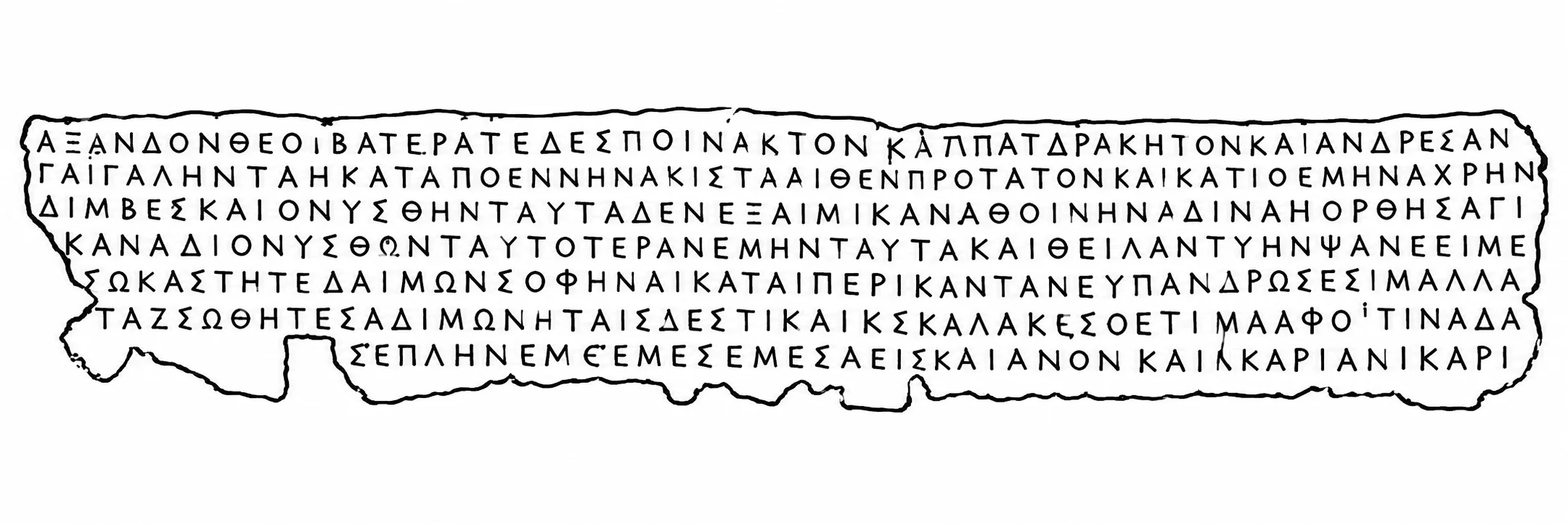

An examination of the ancient Macedonian inscription preserved in the bas-relief and the historical linguistic theory connecting Macedonian with Illyrian and Ancient Greek.
The language of the ancient Macedonians remains one of the important questions in the study of ancient Balkan history. Its classification has been debated by historians and linguists for more than two centuries, particularly concerning its relationship with Ancient Greek, Illyrian and the other Indo-European languages of the Balkans.
One interpretation proposes that ancient Macedonian was an Illyrian-related dialect containing substantial Greek linguistic elements. This position was associated with the German classical scholar Karl Otfried Müller in 1825 and was later revisited by the Italian linguist Giuliano Bonfante in 1987.
The inscription shown here, preserved on a bas-relief, provides an opportunity to examine the written evidence and consider the linguistic background of ancient Macedonia.
1. Karl Otfried Müller and the Illyrian Connection (1825)
Karl Otfried Müller (1797–1840)
In his 1825 work, Über die Wohnsitze, die Abstammung und die ältere Geschichte des makedonischen Volkes, Müller examined the geographical origins, ancestry and early history of the ancient Macedonians.
Müller argued that the ancient Macedonians had an Illyrian ethnic and linguistic connection. He drew attention to similarities between Macedonian and Illyrian customs, physical appearance and dialect. At the same time, he recognised that the Macedonian dialect contained numerous Greek words and linguistic elements.
His interpretation was that the Macedonian population had its own linguistic character, influenced by contact with neighbouring Greek-speaking populations.
This was an important early contribution to the debate over whether ancient Macedonian should be classified as Greek or as a separate Balkan Indo-European language with Illyrian connections.
2. Giuliano Bonfante and the Illyrian Hypothesis (1987)
Giuliano Bonfante (1904–2005)
In 1987, Bonfante returned to the question of the ancient Macedonian language, examining its linguistic characteristics and possible relationship with Illyrian. Bonfante’s position is particularly relevant because he considered the Illyrian connection a serious possibility when examining the linguistic identity of ancient Macedonia.
His work is cited in modern discussions of the theory that Macedonian was an Illyrian-related language or dialect with Greek elements. The Oxford Classical Dictionary identifies Bonfante (1987), alongside Müller (1825), among scholars who looked towards Illyrian when considering the classification of ancient Macedonian.
3. The Bas-relief inscription
The inscription presented in the image is important as a subject for examining the written language of ancient Macedonia. Its lettering and apparent linguistic structure invite questions about the relationship between the Macedonian language and the neighbouring languages of the ancient Balkans.
The central question is whether the language represented in such material can be understood as a mixture of Illyrian linguistic elements and Ancient Greek. Within the Illyrian interpretation, the possibility of a mixed linguistic environment is particularly significant. Ancient Macedonia was situated in a region where several peoples and languages interacted, creating conditions for linguistic exchange and shared vocabulary.
However, the use of Greek letters does not, by itself, establish that an inscription was written in Greek. The alphabet used to write a language and the linguistic identity of that language are two different questions. A reliable classification requires examination of grammar, vocabulary, phonology, names and the historical context of the inscription.
4. The wider linguistic debate
The classification of ancient Macedonian has traditionally involved several competing interpretations:
| Interpretation | Main argument |
|---|---|
| Illyrian-related | Macedonian had an Illyrian linguistic foundation and Greek elements |
| Thracian-related | Macedonian belonged to, or was closely connected with, Thracian |
| Independent Indo-European | Macedonian was a separate Balkan language related to Greek and other Indo-European languages |
| Ancient Greek dialect | Macedonian was a northern or northwestern dialect of Ancient Greek |
These interpretations are documented in modern linguistic scholarship.
5. Why the Illyrian connection deserves examination
The geographical position of ancient Macedonia makes its linguistic history particularly interesting. To the west were Illyrian-speaking populations, to the east Thracian-speaking populations, and to the south and within Macedonia itself, Greek-speaking communities.
These neighbouring populations interacted over centuries through trade, migration, warfare, political alliances and cultural exchange. Consequently, the possibility of shared linguistic features and mixed linguistic influences deserves serious consideration.
The proposals made by Müller in 1825 and Bonfante in 1987 demonstrate that the Illyrian interpretation is not a recent invention, but a hypothesis with a history in European classical scholarship.
Conclusion
The ancient Macedonian inscription shown here should be considered within the wider discussion of the linguistic identity of ancient Macedonia.
The interpretation of Macedonian as an Illyrian-related dialect containing Greek elements was proposed by Karl Otfried Müller in 1825 and received renewed attention through Giuliano Bonfante in 1987.
Their work provides a historical foundation for examining the possible relationship between Illyrian and Macedonian. The question remains important: to what extent did the ancient Macedonian language preserve Illyrian linguistic characteristics while incorporating elements of Ancient Greek?
The answer must ultimately come from the careful examination of inscriptions, vocabulary, grammar and historical evidence. Ancient inscriptions are more than archaeological objects. They are linguistic evidence that can help us reconstruct the languages, identities and cultural interactions of the ancient Balkans.
References
- K. O. Müller, Über die Wohnsitze, die Abstammung und die ältere Geschichte des makedonischen Volkes (1825). Original publication – Google Books.
- G. Bonfante, “Il macedone”, Rendiconti dell’Accademia Nazionale dei Lincei, 1987, pp. 83–85. Bibliographical reference discussed in Hatzopoulos, discussion of ancient Macedonian linguistic theories.
- Oxford Classical Dictionary, “Macedonian Language”. Oxford Academic.
- The Speech of the Ancient Macedonians, VI International Symposium on Ancient Macedonia, 1999. Historical and scholarly discussion.

