
The activity of the Serbian Orthodox Church cannot be separated from the political and social circumstances of the time, but must also be seen in relation to the Serbian political and nationalist processes that have influenced the changes within the Albanian space.
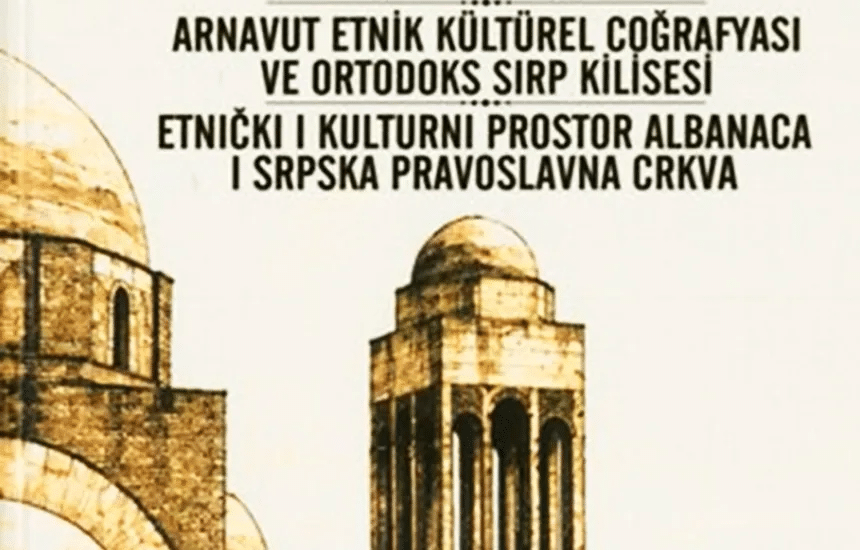
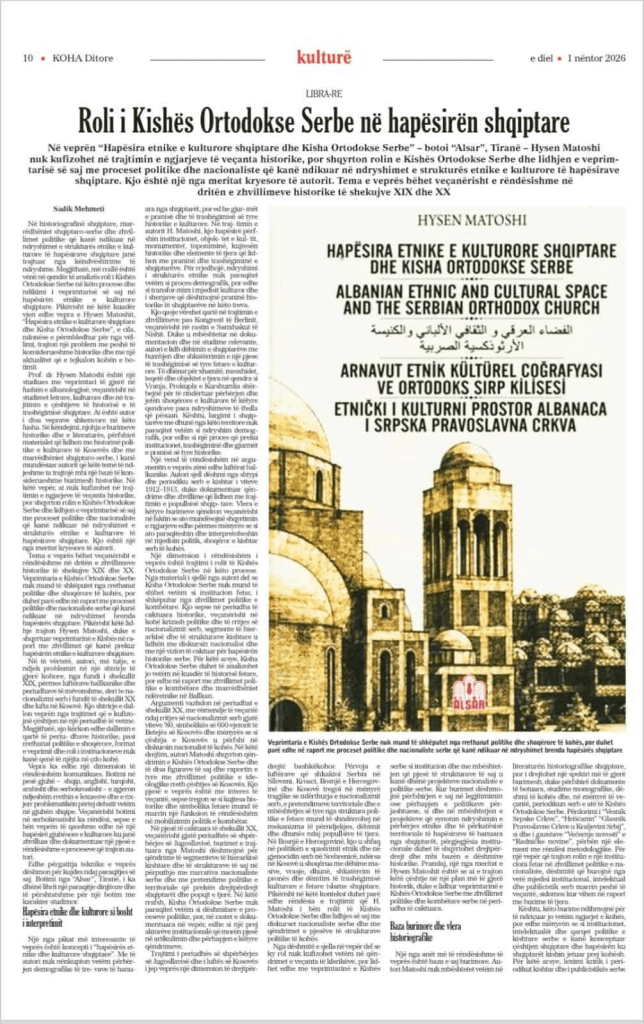
In the work “The Albanian Ethnic and Cultural Space and the Serbian Orthodox Church” – published by “Alsar”, Tirana – Hysen Matoshi does not limit himself to dealing with specific historical events, but examines the role of the Serbian Orthodox Church and the connection of its activity with the political and nationalist processes that have influenced the changes in the ethnic and cultural structure of the Albanian spaces. This is one of the main merits of the author. The theme of the work becomes particularly important in light of the historical developments of the 19th and 20th centuries.
by Sadik Mehmeti
In Albanian historiography, Albanian-Serbian relations and political developments that have influenced the changes in the ethnic and cultural structure of Albanian spaces have been treated from different perspectives. However, the role of the Serbian Orthodox Church in these processes and the impact of its activity on the Albanian ethnic and cultural space has been less frequently put at the center of analysis. It is precisely in this context that Hysen Matoshi’s work, “The Albanian Ethnic and Cultural Space and the Serbian Orthodox Church”, comes into play, which, although summarized in terms of volume, addresses a problem of considerable historical importance and with a relevance that exceeds the time of publication.
Prof. Dr. Hysen Matoshi is a researcher with extensive activity in the field of Albanology, especially in literary and cultural studies and in dealing with issues of Albanian history and heritage. He is the author of several scientific works in these fields. Therefore, the knowledge of historical sources and literature, including materials related to the political and cultural history of Kosovo and Albanian-Serbian relations, have enabled the author to treat this sensitive topic on a considerable basis of historical sources.
In this work, he does not limit himself to dealing with specific historical events, but examines the role of the Serbian Orthodox Church and the connection of its activity with political and nationalist processes that have influenced the changes in the ethnic and cultural structure of Albanian spaces. This is one of the author’s main merits.
The theme of the work becomes particularly important in light of the historical developments of the 19th and 20th centuries. The activity of the Serbian Orthodox Church cannot be separated from the political and social circumstances of the time, but must also be seen in relation to the Serbian political and nationalist processes that have influenced the changes within the Albanian space. It is precisely this connection that Hysen Matoshi addresses, examining the activity of the Church in relation to the developments that have affected the Albanian ethnic and cultural space.
Indeed, the author further pursues the problem over a wide span of time, from the late 19th century, through the Balkan Wars and subsequent periods, to late 20th century Serbian nationalism and the war in Kosovo. This scope distinguishes the work from treatments that limit the issue to a single period. However, it also requires a clear distinction between historical periods, since the political and social circumstances, the forms of action, and the role of institutions have not been the same at all times.
The work also has an important communicative dimension. The publication in five languages – Albanian, English, Turkish, Arabic and Serbo-Croatian – significantly expands the circle of readers and takes the issue beyond the debate in Albanian alone. The publication in Serbo-Croatian is particularly important, because it makes the work accessible in a linguistic and cultural space where an important part of the processes the author addresses have been developed and documented.
Even the technical preparation of the work testifies to the care taken in its presentation. The publication by “Alsar”, Tirana, has given the book a dignified and appropriate presentation for a publication of a scholarly nature.
Ethnic and cultural space as the axis of interpretation
One of the most interesting points of the work is the concept of “Albanian ethnic and cultural space”. By this the author means not only the demographic composition of the territories inhabited by Albanians, but also the traces of their presence and historical and cultural heritage.
In the treatment of the author H. Matoshi, this space includes institutions, cult objects, monuments, toponymy, historical memory and other elements related to the presence and heritage of Albanians. Consequently, the change in the ethnic structure is presented not only as a demographic process, but also as a transformation of the cultural environment and signs that testify to the historical presence of Albanians in these territories.
This approach is clearly visible in the treatment of developments after the Berlin Congress, especially in the case of the Sandzak of Niš. Relying on relevant documentation and studies, the author connects the expulsion of Albanians with the loss and destruction of part of their religious and cultural heritage.
The data on mosques, mesjids, tekkes and other objects in centers such as Vranje, Prokuplje and Kuršumlija serve to reconstruct the composition and social and cultural life of these centers before the profound changes they underwent. Thus, the forced removal of Albanians from these territories is not presented only as a demographic change, but also as a process that affected the institutions, heritage and traces of their historical presence.
The Balkan Wars also occupy an important place in the argument of the work. The author brings evidence from the Serbian and church press and periodicals of 1912–1913, documenting attitudes and developments related to the treatment of the Albanian population. The value of these sources lies particularly in the fact that they enable the examination of events through the way they were presented and interpreted in the Serbian political, social and church environment of the time.
An important dimension of the work is the treatment of the role of the Serbian Orthodox Church in these processes. From the material brought by the author it emerges that the Serbian Orthodox Church cannot be seen only as a religious institution, detached from political and national developments.
This is because in certain historical periods, especially in times of political crises and the growth of Serbian nationalism, segments of the hierarchy and church structures were linked to the nationalist discourse and to a certain vision of the Serbian historical space. For this reason, the Serbian Orthodox Church should be analyzed not only within the framework of religious history, but also in relation to political and national developments and interethnic relations in the Balkans.
The argument continues in the periods of the 20th century, with particular attention to the rise of Serbian nationalism during the 1980s, the symbolism of the 600th anniversary of the Battle of Kosovo, and the way in which the Kosovo issue was included in the nationalist discourse of the time. In this regard, the author Matoshi examines the position of the Serbian Orthodox Church and some of its figures and their relationship to political and ideological developments around the Kosovo issue. This part of the work is of particular interest, because it shows how historical memory and religious symbolism can take on an important function in political and national mobilization.
In certain parts of the 20th century, especially during the period of the dissolution of Yugoslavia, the sources treated by Matoshi testify to positions of segments of the church hierarchy and its structures in line with Serbian nationalist narratives and with political and territorial claims that directly affected Albanians and other peoples. In this respect, the Serbian Orthodox Church is presented not only as a witness to political processes, but, in the cases documented in the work, also as one of the institutional actors that participated in the articulation and dissemination of these positions.
The treatment of the period of the dissolution of Yugoslavia and the Kosovo war gives the work a direct contemporary dimension. The experience of the wars that Serbia caused in Slovenia, Croatia, Bosnia and Herzegovina and Kosovo tragically showed that the combination of Serbian nationalism, territorial claims and their support by the political and religious structure could be transformed into mechanisms of persecution, expulsion and violence against other populations.
In Bosnia and Herzegovina, this was manifested in the policy of ethnic cleansing and the Serbian genocide in Srebrenica, while in Kosovo it was accompanied by mass expulsions, murder, violence, destruction of property and damage to the Albanian Islamic cultural and religious heritage.
It is in this context that the importance of the treatment that H. Matoshi gives to the role of the Serbian Orthodox Church and its connection with Serbian nationalist discourses and with the attitudes of parts of the political structures of the time should be seen.
From the evidence presented in the work, it emerges that this role is not limited only to the specific positions of the clergy, but is also related to the activity of the Serbian Church as an institution and to the support that parts of its structures have given to Serbian nationalist and political projects.
When sources prove its involvement in the legitimization or spread of exclusionary policies, as well as in the support of projects aimed at changing the ethnic composition and territorial affiliation of the areas inhabited by Albanians, institutional responsibility must be examined directly and on the basis of historical evidence. Therefore, one of Hysen Matoshi’s merits is that he treats this issue on a broader historical plane, linking the activity of the Serbian Orthodox Church with Serbian political and national developments in certain periods.
Source base and historiographic value
One of the most important aspects of the work is its source base. The author Matoshi does not rely only on Albanian historiographical literature, but addresses a wider spectrum of sources, including published documents, monographic studies, testimonies of the time and, in particular, the Serbian periodicals and that of the Serbian Orthodox Church.
The use of “Vesnik Srpske Crkve”, “Hrišćanin” “Glasnik Pravoslavne Crkve u Kraljevini Srbij”, as well as the newspapers “Večernje novosti” and “Radničke novine”, constitutes an element of methodological importance. For a work that deals with the role of a religious institution in political and nationalist developments, the evidence that emanates from the Serbian institutional, intellectual and journalistic environment itself takes on special weight, especially when compared with other sources.
Thus, these sources help to illuminate not only the events of the time, but also the way in which Serbian institutions, intellectuals, and political and ecclesiastical circles have conceptualized the Albanian issue and the space where Albanians had long lived. For this reason, the critical reading of the Serbian church periodical and journalism is one of the most important aspects of the work.
In addition, the author uses a wide range of documentary and historiographical literature, as well as works by various authors who have addressed periods and issues related to the work’s problematic. This combination of sources expands its documentary base and enables the author to address some of the issues from different perspectives.
The historiographical uniqueness of the work also lies in the way the author connects the historical material around a specific problem, without intending to write a general history of the Serbian Orthodox Church. Because the author does not deal with its institutional, theological or administrative history as a whole, but focuses on the relationship between the activity of church structures, Serbian nationalist ideas and the processes that have influenced the change in the ethnic and cultural composition of the areas inhabited by Albanians. It is precisely this focus that determines the profile of the work and gives it coherence in dealing with the relationship between the Serbian Church, Serbian nationalism and the Albanian issue.
This is where the work’s significance lies beyond the Albanian case. It raises a broader issue about the relationship between religion, national identity, and politics, especially when religious authority is put at the service of a national and territorial narrative. In the case treated by Matoshi, these consequences are directly related to Albanians, to the shrinkage of their ethnic and cultural spaces, and to the efforts to change the memory and heritage of these spaces.
The writing style should also be noted. Matoshi uses a direct and understandable language, which in some parts even approaches polemical journalism. This is related to the very nature of the topic and the author’s critical attitude towards the events he deals with. For an academic reader, the distinction between the documented fact and the rhetorical way of presenting it remains important.
The documentation used gives the work a basis that goes beyond the character of a purely polemical text and preserves its historiographical interest. The author’s critical language is understandable for a work that deals with such a loaded history, as long as it is based on evidence and does not replace historical analysis.
In conclusion, an important merit of Hysen Matoshi is that he places the role of the Serbian Orthodox Church in relation to the Albanian question at the center of the examination. The work shows that its activity, in certain periods, has been intertwined with Serbian nationalism, with historical narratives and with claims over the areas inhabited by Albanians and not only.
Through an approach based on sources and a wide time span, the author places this problem in a broader historical context, linking it to the political, ethnic and cultural changes that have affected these areas.
Although summarized in volume, the work addresses a problematic of particular importance for Albanian historiography. Its importance lies in the fact that it further opens the discussion on the role of the Serbian Orthodox Church in the history of Albanian-Serbian relations, in the history of Kosovo and in the developments that have influenced the Albanian ethnic and cultural space.
For this reason, in our assessment, the work “The Albanian Ethnic and Cultural Space and the Serbian Orthodox Church” by the author Hysen Matoshi constitutes an important contribution to Albanian historiography and deserves the attention of researchers and readers interested in these issues.
At the same time, it raises the need for further studies on the role of the Serbian Orthodox Church in political developments and armed conflicts in Kosovo and the region, especially in the period of the dissolution of Yugoslavia. Examining this role, in relation to Serbian nationalism, institutional attitudes and developments that accompanied the wars of this period, remains an important issue for deepening historical knowledge and for a more complete understanding of the processes that have influenced the Albanian ethnic and cultural space and the wider region.
Article
https://www.koha.net/shtojca-kulture/roli-i-kishes-ortodokse-serbe-ne-hapesiren-shqiptare?

