
Written by Dr. QAZIM NAMANI
Prishtina, 17. 07. 2016.
Translation: Petrit Latifi
In the 18th century, Russia became stronger, becoming an important factor in the political and military scene of Europe, especially in the Illyrian Peninsula. At the end of the 18th century and the beginning of the 19th century, the Russian government in the Balkans distributed money and sent Russian priests to develop propaganda against Austria and Turkey. Inspired by Russian propaganda at this time, Sava Tekelia and the metropolitan of Karlovci Stratimirović had expressed their aspirations to free themselves from the Ottoman Empire (P.O.) and to establish a Slavic empire in the Balkans.
In 1804, an uprising broke out under the leadership of Karađorđe Petrović. Jovan Tomić in his book on Albanians writes that some Albanians became very well known in the uprising of 1804. Many scholars even agree that the leader of this uprising, the first of the Karadjordjevic dynasty, Karadjordje Petrovic, was of Albanian origin.
In 1806, the Russo-Turkish War began, which lasted 6 years. This war ended in 1812, with the agreement reached in the Treaty of Bucharest. According to Article 8 of this treaty, the Serbs were granted certain privileges. In 1808, a project was proposed for the division of the territories of southeastern Europe between Russia, France and Austria.
After the defeat of Napoleon Bonaparte in 1814 and the establishment of the Holy Alliance at the Congress of Vienna in 1815, initiated by Russia, whose goal was to quell and control the movements of the peoples for independence that had begun in Europe. Favorable conditions were created for Turkey to quell the Albanian pashas.
In 1815, Miloš Obrenović appeared on the scene, who, encouraged by Russia, continued the uprising. Kara Gjorgji, seeing the strengthening of the uprising and the weakening of P.O. returned from Austria with some of his supporters.
Near Belgrade, Miloš Obrenović first raided Kara Gjorgji along with 16 of his supporters and then killed them, cut off their heads and sent them to the governor, who then sent them to the Sublime Porte in Istanbul. In 1820, the sultan granted Miloš Obrenović the title of prince, but Miloš refused it. Later, Miloš regretted having refused the title of prince, so he sent a delegation to Istanbul to renew his loyalty to the sultan.
The sultan allowed Miloš to keep a delegate in Istanbul to represent the Serbs. After the declaration of the American president James Monroe, in 1823 before the American Congress that the principle of America should be followed by Americans, now it was understood that Russia was not threatened by the West. Seeing the favorable circumstances, Danillevski created the Pan-Slavic idea called the “Philoslavic Movement”.
Miloš Obrenović played a two-faced policy and his main goal was to move Albanians from the 6 districts that at that time were outside the borders of Serbia, which gained autonomy in 1830. In 1824, Miloš moved a large number of Albanians from Aleksinci. During these years, many Albanians had moved from Belgrade, Kraljevo, Užice, and other cities of present-day Serbia. In 1826, with the disappearance of the military system of the Janissaries, he was left without regular military forces.
These reforms in the army were opposed by conservative Albanian pashas and others. Mustafa Pasha sought to strengthen ties with the feudal lords of Bosnia. For his stance, he gained support from Russia. Mustafa Pasha sought to strengthen ties with Miloš Obrenović in Serbia. Mustafa Pasha sought the support of Russia through the prince of Serbia – Miloš.
Mustafa Pasha demanded 500,000 grosz from the Serbian prince Miloš, but he, with the advice of the Russians, offered him half of the grosz requested, proposing to Mustafa Pasha that when he took Sofia, Miloš be allowed to take the city of Niš. The first city that Serbia took at that time was Krušeć, which at that time had a large number of Albanian inhabitants. When the Russo-Turkish war began in 1828, Russia, through Prince Miloš, demanded that Mustafa Pasha not join this war with the promise that in case of victory he would make him the owner of all the territories
Albanian.
Mustafa Pasha, not wanting to interrupt relations with Sultan Mahmud II, he sent his troops late to the Russian-Turkish front, arguing to the Sultan that his troops were not properly prepared to enter the war during the winter season and that he would join in the spring. Mustafa Pasha’s late entry into the war enabled the Russian army to penetrate the territory of present-day Bulgaria.
This situation forced Turkey and Russia to conclude a peace agreement. At the peace conference, the Russians did not mention autonomy for the Albanians at all. Mustafa Pasha, revolted with 20,000 soldiers, opposed the Russian army in the vicinity of Arnaut Kalesh on October 4, 1829. Mustafa Pasha suffered defeat and severed relations with Russia.
Russia, seeing the weakening of P. O., requested that the Treaty of Bucharest be reconsidered, in which case some additional privileges were given to the Vlachs and Serbs. Serbia was granted autonomy and was allowed to expand its borders to the detriment of Albanian territories. In 1835, Miloš visited Istanbul, and was forced to resign (1839), giving way to his son Mihail, who was brought to Istanbul and was extremely honored and given decorations and diamonds by the sultan himself.
The Serbs had already obtained the consent of the Ottoman Empire in 1836 to open two primary schools in Prizren. In 1848, the Serbs had also opened schools in Gjakova, Peja, Vushtrri and Gracanica. The Pan-Slavic program drafted by A. S. Homajkov
“For the Old and the New” which was published in 1839, then the project for the establishment of a Pan-Slavic empire drafted by Nikolay Danilevski which envisaged the proclamation of the Patriarch of Moscow as the person representing God on earth, aimed to expand to the detriment of Albanian lands.
These projects were inspired by the Pan-Slavic ideas of Czartoryski and Franjo Zahu about the concentration of the Balkan Slavs in an empire. Based on these projects and ideas, Ilia Garashanin’s “Nacertanja”, the Greek “Megalo idea” of Jani Kola and the program of the Bulgarian “Otočenstvo” were compiled in 1844. With the Nacertanja project, the Serbs propagated that they were not doing anything new, only renewing the lands of their ancestors, and this program was not based on popular or national principles, but on historical right.
Serbia included the northern Albanian territories in its national and propaganda plan after the approval of Garashanin’s “Nacertanje” project in 1844. Archival documents from this time show that after Garashanin’s project, Serbia began to help the renovation of churches, monasteries and schools in northern Albania. Ilia Garashanin sent Stefan Verkovic to the Albanian territories in 1844 to collect data and establish contacts with Albanian personalities. Garashanin had also established contacts with influential people in other parts of the Balkans and one of them was Matija Bani from Dubrovnik who soon became one of the most prominent figures in Serbian political propaganda after Garašanin.
Serbia also established ties with some people from northern Albania. In 1846, contacts were established with the Albanian priest Gasper Krasniqi, Bibe Doda and Naum Sidon, originally from the Dibra district, who had been put at the service of Russian propaganda. Gasper Krasniqi corresponded with Garashanin in Latin. In 1848, the Pan-Slavic Democratic Club was founded in Belgrade, while in 1849 the constitution of the
political propaganda. During the years 1852-53, relations deteriorated.
Serbian-Montenegrin, while on the eve of the Crimean War of 1853-1856 Serbian-Russian relations also deteriorated because Russia interfered violently in the internal affairs of Serbia. Russia dismissed Ilia Garašanin from office and Serbia was forced to accept Russia’s demands. After the Crimean War in 1856, the Treaty of Paris was signed. Russia expressed its intentions to protect the Christian population in the east.
In 1868, the educational council was formed to assist Serbian schools and teachers in Albanian territories that were under the rule of the Ottoman Empire. Serbian secular schools at that time worked according to the curriculum of Serbian schools using the same textbooks, organization, teaching methods and administration. New schools were opened in Albanian territories with teachers Nikolla Mussolini, Milan Kovacevic and Milan Popovic. In these schools, students gained greater knowledge than in some schools in Serbia.
Russia had appointed Ivan Stepanović Jastrebov to important diplomatic posts in Shkodra and Prizren. In Sarajevo, Hilferding, educated in the Russian Pan-Slavic spirit, was appointed as a Russian diplomat. The coordination of political and diplomatic activities between Ignjatev, Hilferding and the Russian diplomat Jastrebov, who operated in Albanian territories, inspired Serbian nationalism during the Eastern Crisis for the occupation of territories inhabited by the indigenous Albanian population.
In 1860/61, the Greek Government approached the Serbian Government to establish a joint alliance for the division of territories in the Balkans. Prince Mihajli of Serbia, until he was assassinated in June 1868, had established ties with several conservative Albanian individuals such as: Naum Sido, Xhelal Pasha Zogu, etc., who had become his tools. Serbia had assigned the Catholic priest Franc Mauri, of Slovenian origin from Gorica, to act among the Albanians of Northern Albania. Mauri learned the Albanian language when he served as Catholic bishop in Shkodër. He was interested in taking advantage of several distinguished Albanian personalities to work in the service of Serbia’s political propaganda.
Mauri claimed among the Albanians that Serbia would help the Albanians to be freed from the P.O. He managed to convince several Albanian leaders to cooperate with Serbia such as: Mirash Hasin, the leader of Hoti, Prenk Staka, the leader of Kelmend, as well as the leaders of Kastrati, Triepshi, Traboina and Gruda. Mauri claimed to the Albanians that Serbia had no bad intentions towards the Albanians, so in 1866 he also benefited from several other leaders.
After his mission, Mauri returned to Belgrade, where he wrote a report in German, in which he highlighted the essence of Serbia’s policy as well as the existing situation among the Albanians. At this time, many Slavic scholars were sent to the Albanian territories, whose task was to describe the traces of ancient culture and civilization. Among them we can mention M.S. Milojevic, who, with the help and company of the old man Zymer, whom he also called “our Zymer”, had written three notebooks which he published in Belgrade in 1871.
In February 1868, to conclude the treaty of During the period of cooperation with Serbia, 5 Albanians went to Belgrade to Mihajli: Kurtaliu i Matit who died 2-3 days after returning and was buried as a “Turk”, Ahmet Çetani from the village of Bederianë, Zahir Isufi from Macukuli, Mer Kalici from Selita, Hasan Bey from Upper Dibra, and at the end of Mihajli’s reign, Leka Plak, his brother and son Prenku from Podgorica went to Belgrade. These Albanians who went to Belgrade pledged to Mihajli that they would not fight against Montenegro, the Bulgarians and the Greeks and that they would cooperate with the Serbs. According to Serbian archival sources, it is noted that Mihajli gave them various gifts, including 250 ducats.
Mark Milani writes about Albanians that practice has proven that you can conquer an Albanian more easily with good than with evil. Mark Milani writes that you must ask for trust from an Albanian, acquire his word of honor with some small gift and position, especially the nobility of the tribe and religion, then he will serve according to your wishes, even against his national interests, he “will go into water and fire for you”.
In reality, these are individuals of the type of Sokol Baci, Ujkici, Ivezici, Kukici and other similar people, who for a handful of grosz and an outdated uniform with colorful flashing buttons of the “Knjazit” gendarmes, have thrown off the white kelesh and put on a black cap over their eyes, thus becoming a blind tool of King Nikola’s chauvinistic politics.
These ties with Belgrade were renewed even after the death of Mihajl, so in December 1868, Xhelal Pasha Zogu went to Belgrade, who also visited Kragujevac and was a guest at the house of Milivoje Blaznović, a well-known Serbian minister at the time. Xhelal Pasha at this time was also holding talks about the situation in the Albanian regions with the Russian general
Ignitatevin.
Xhelal Pasha Zogu
In 1868, Xelal Pasha had severed relations with Turkey and was now fully serving Serbia. In March 1868, Xelal Pasha had signed a contract to enter the service of Serbian propaganda on condition that he be stationed somewhere in European countries. On March 5, 1869, he traveled to Zurich, agreed to change his name and surname and to be called Stanko Ivanov, his apparently Albanian collaborator was named Avram. The Serbian government to these 2 Albanians.
He assigned you another companion, who was named Djordje Dimitrijevic from Sarajevo. Xhelal was tasked with sending letters from Zurich to the address of the merchant Arsenije Lukic in Belgrade, and inside the letter he wrote that the letter should finally be sent to Milovan Vojinovic. Belgrade paid Xhelal 120 ducats a month, while Djordje Dimitrijevic 10 ducats.
In 1870, Austria-Hungary offered the Serbian government a draft proposal for an agreement and alliance against the Ottoman Empire. Serbia also during the years 1871-1874 sought to continue contacts with several volatile tribal and feudal leaders such as: – Xhelal Pasha Zogu from Mati, – Ali Agë Galiqi from Rozaja, – Ibrahim Zajmi from Peja, – Hasan Koka of Mati, – Captain Marku of Mirdita, – Brother of Bib Doda, – perhaps even Leka of Podgorica. On July 8, 1876, exactly 6 days after the Serbo-Montenegrin war against the Ottoman Empire had begun, the Reichstag agreement was signed, formalized with the Budapest conventions of January 15, 1877, which aimed to divide the Balkans. In these circumstances, the Vilayet of Kosovo was formed in 1877 with its center in Prizren.
Based on political circumstances and written sources, the name of the Vilayet of Kosovo was influenced by Russia and the Pan-Slavic policies that Russia implemented through its ambassador appointed in 1864 in Istanbul Nikola Pavlovich Ignatiev, who offered himself so much to the sultan that one day the Shah said: I have no other true friend than the Russian ambassador. Ignatiev for a short time separated the Bulgarians and Serbs from the religious subordination of the patriarchate in Istanbul. Russia had gained the support of the Christians living in the Ottoman Empire, while on the other hand it had also won the political opinion of Europe for itself, so on April 12, 1877 it declared war on P.O.
Serbia, encouraged by Russia, began the war on December 2, 1877. The Serbian army, aided by Russian volunteers, quickly managed to conquer the Albanian territories of the Sandzak of Niš from Pirot, Niš, Prokuplje, Kušumlija, Leskoci, Vranje, penetrating towards the upper Jablanica.
During this expedition, the Serbian army committed many murders, massacres and mass burnings of the defenseless indigenous Albanian population. In addition to the cities, about 700 Albanian villages were displaced during this war. In January 1878, Milan Obrenović had taken control of the city of Niš. Sahit Pasha from Llapashtica e Medvedja, seeing that everything was over on January 22, 1878, abandoned the Turkish army and sought to enter into negotiations with Serbian officers and with Milan Obrenović himself. On January 29, 1878, Sahit Pasha met with Milan Obrenović in the city of Niš.
During the meeting, an agreement was reached that Sahit Pasha would invite the Albanians to cease all fighting against the Serbian forces. The Serbian forces managed to penetrate many other Albanian villages. Sahit Pasha returned to the village of Llapashticë in Medvegja and invited the Albanians of the villages of Llapashticë, Kapit, Tupallë, Dediq, Gjylekreshtë, Siariën, Sfircë, and Gërbac.
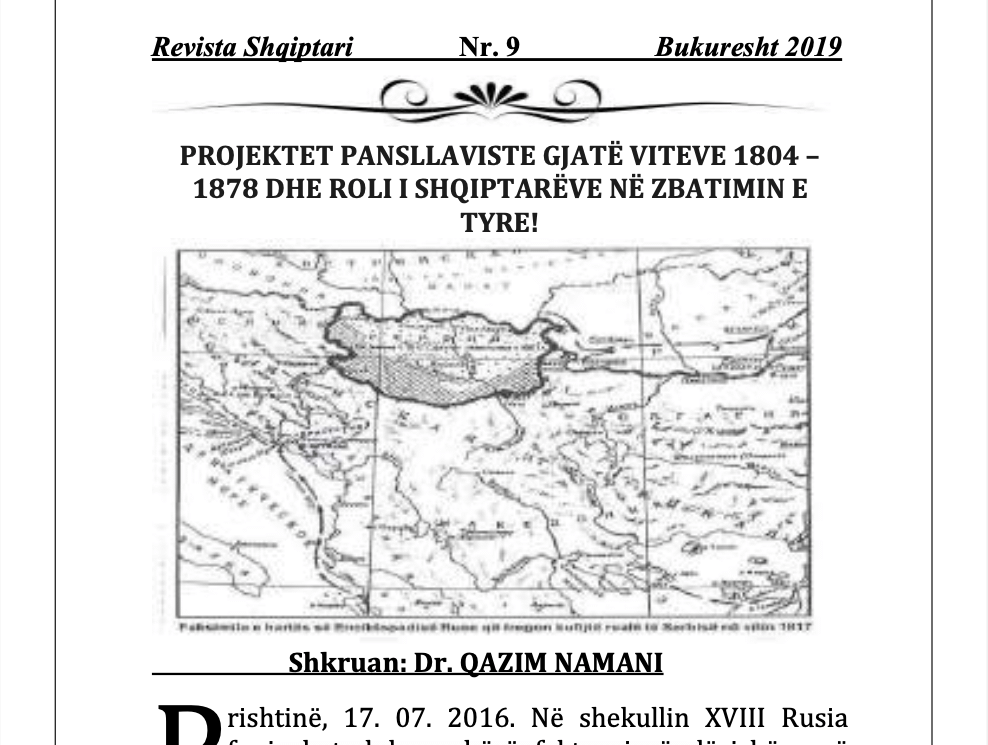
In this war, the Russian army defeated the Turkish army and reached St. Stephen, 9 km west of Istanbul. Seeing the danger from Russia on January 31, 1878, the English fleet arrived in Marmara. The Turkish government was forced to sign a treaty with Russia, where Turkey had to give up Rumelia. The treaty was signed on March 3, 1878 by the delegates from the Turkish side, Safet Pasha and Abdullah Bey, ambassador in Berlin, and from the Russian side, the Russian ambassador in Istanbul, Igniatev and Nelidov. This was a great victory for the Pan-Slavists, because Russia now took control of part of the Mediterranean Sea.
The Treaty of St. Stephen was opposed by England, Germany and Austria, demanding that a new conference be organized. On June 13, 1878, the Congress of Berlin was held. Among the main points of this treaty were: 1. The independence of Romania, Serbia and Montenegro, both of which were allowed to expand their borders to the detriment of Albanian lands. 2. The temporary occupation of Bosnia and Herzegovina by Austria-Hungary. 3.
The formation of Bulgaria as an autonomous principality.
Seeing the danger, on June 10, 1878, delegates from all Albanian territories formed the Albanian League of Prizren. Sahit Pasha from Llapashtica of Medvedja, after managing to protect a small nucleus of Albanians in these villages, became involved in the political life of Serbia. With the formation of new municipalities, he was appointed mayor of Bucë-Ramabajë, and after its abolition, he was elected mayor of Medvedja. After remaining under Serbia, Halil Islami from Sfirca was elected a deputy in the Serbian Parliament during the time of Prince Milan Obrenović.
From what was mentioned above, it can be stated that the Albanians during this period were not sufficiently coordinated among themselves, nor were they properly positioned on the international political scene. The division of the Albanians was very well exploited by their neighbors, but also by Russia and the Ottoman Empire. Thus, the Berlin Congress found the Albanians divided and without a unique national platform, this caused the Berlin Congress to ignore them, declaring that Albania is only a geographical notion and nothing more.
Source
Revista Shqiptari Nr. 9. Bukuresht (Bucharest) 2019.

