
Written by Dr. QAZIM NAMANI
Translation Petrit Latifi
After World War II, unilateral criteria for declaring monuments under state protection were applied in Kosovo using unscientific policies and methodologies. At this time, old civic complexes in all urban cities of Kosovo were demolished, churches and Albanian properties around the churches were appropriated, and new churches were built on the foundations of old medieval churches. Residential buildings of Albanians who had an influence on political and social life during World War II were confiscated, some of them were used as public buildings, while other buildings were used to house families of the war and the communist party of Serbia. During this period, old cemetery complexes of Albanian population. Roads, various buildings, factories and city parks were built on cemeteries.
From these principles, from 1947 to 1999, priority was given to the Orthodox cult objects and the houses of residence of Slavic wartime personalities. This is evidenced by a letter that Milutin Foliqi sent to a military general immediately after the suppression of Kosovo’s autonomy, on March 28, 1989. Letter that Milutin Foliqi sent to the military general of the JNA (Yugoslav People’s Army). The letter reads: “Comrade General, with a great delay I am sending you the text on the history of Kosovo and Metohija, which I have long promised you. I have not discovered anything new about this and its fate in Tito’s Mitrovica, but this does not exclude the possibility of further research. That’s all for now, I hope to meet you in Sutomore if I am released from my obligations this year. Greetings to my beloved, Kirka Novovic, and all of you”. IV. ’89, Milutin, Pristina.
Attached to this letter is a document, where the first eight pages describe the historical and cultural monuments throughout the history of Kosovo, while the last three pages describe the monuments of Communist Party of Serbia established in Kosovo during the 20th century, and the history of Kosovo written in a twelve-page text by Milutin Foliqi. In this document it is clearly observed that the cultural and historical heritage of Albanians in Kosovo has been appropriated as Serbian heritage, while the five-century heritage under the occupation of the Ottoman Empire has been considered as Turkish heritage and with an oriental style of construction. Here the towers of the Dukagjin plain are mentioned only in one sentence, without considering them as the heritage of the Albanian population.
In 1992, during the violent measures, two unknown letters were published, which Todor Stanković sent to Stojan Novaković. These two letters were first published in the magazine “Glasnik Bastina” in 1992, in Pristina. Below we give some published fragments: Stojan Novaković’s property contains two letters with interesting information from 1891, written by Todor Stanković, then Serbian consul in Pristina. Letter 1. Registration of villages between Novo Brdo, Gjilan and up to the border with Serbia through Krivareka. Letter 2. Settlements between the Pristina-Gjilan railway in some villages and beyond the railway line.
Based on these letters, Novaković requested data from Todor Stanković on the villages between Pristina and the then Serbian border, considering this a good opportunity to obtain information about the population, culture, traces of antiquity and geographical position, noting the churches and monasteries with special attention, with the aim of acquiring medieval history.
Through these letters, Todor Stanković collected the notes and sent data regarding the population structure, paying special attention to churches and monasteries.
Stankovic, born on February 13, 1852 and educated in the city of Niš, in 1871, he worked in the printing house of the Vilayet of Kosovo in Prizren as editor of the magazine “Prizreni”, which was printed in Serbian and Turkish until 1875. With the departure of the Vilayet center from Prizren, the printing of the magazine was also discontinued and the work of the printing house was transferred to the city of Manastir and at the end of 1875, at the proposal of Miloš Milojević, Stankovic went to Constantinople with the aim of opening the Serbian printing house.
During the war of 1876-1878, he was very active as the head of the district of towns inhabited by Albanians in the Sandžak of Niš. The case of the displacement of the Albanian population from Toplica, Niš, Leskoci and other regions is also mentioned by Milutin Foliqi in the description of the history of Kosovo that he sent to the army general in 1989.
In 1890, the Serbian consul, Lluka Marinković, was killed in Pristina, and Todor Stanković was appointed in his place. He remained in this position from June 1890 to 1892, when he was appointed consul in Skopje. In 1897/98, he returned as consul to Pristina, where he also kept a diary with data from ethnology and history. His notes regarding the Banjska Monastery would later be used and published by Stojan Novaković. During the Balkan Wars, Stanković, knowing the terrain in the Galab and Llap Mountains well, led the Serbian army to conquer Pristina. According to sources of the time, this army from the border to Pristina had killed and massacred 5,000 defenseless Albanians.
Apparently, Stanković, driven by the Pan-Slavist policy and his guide and teacher Miloš S. Milojevic, in both of his letters provides data on the population structure for the region of Pristina and Gjilan, where he registers the Albanian Christian population as a Serbian population. Stanković’s path during the period between the two world wars is also followed by Anastasije Urošević, who in her book “Novobrdska Krivareka”, one-sidedly describes the structure of the Christian population in that area, calling it as Serbian population.
A Serbian missionary, Mita Rakić, who also visited these regions after the war of 1877/1878, in his book “Iz Nove Serbije”, he writes that Kusumlia was a nest of Albanians, that in Kusumlia the ethnically pure Albanian population lives and rules. He also claims that on the right side of Toplica up to “Petrovo Gora” and in Llap only ethnically pure Albanians lived.
For the spread of Albanians in the central part of Serbia, we find written sources for Kraljevo in Tatomir Vukanović’s book “Naselja u Serbiji”, which writes that in 1784 Kraljevo had 11 Serbian houses and 89 Turkish and Albanian houses. At this time, the number of inhabitants in Kraljevo was 664, of which 592 were Turks and Albanians, while about 72 Serbian inhabitants. Knowing that during this period there was no Turkish population living in the Balkan cities, we can affirm that the vast majority of the inhabitants of Kraljevo were Albanian.
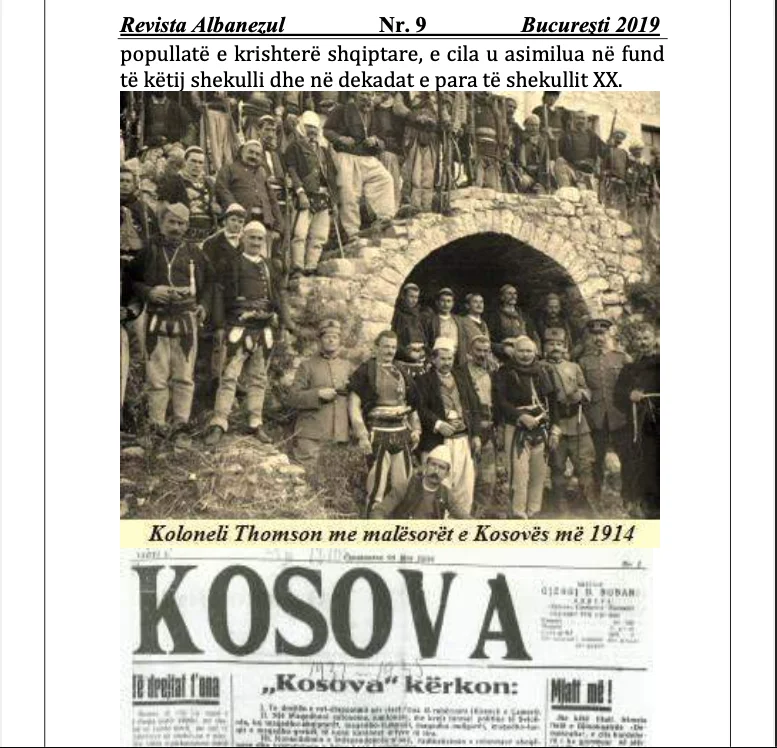
From the field data, even in the present-day territory of Kosovo, it is clearly observed that the present-day Serbian population that had lived in these parts during the 19th century was Albanian Christian population, which was assimilated at the end of this century and in the first decades of the 20th century.

Source
Revista Shqiptari Nr. 9. Bukuresht (Bucharest) 2019.

