
by Dr. Qazim NAMANI and Petrit Latifi
When we talk about the church of the Boletin family in the village of Boletin, we are offered various scientific sources. The data inherited from the indigenous Albanian population speak of a small church, which is known as an Albanian church, but according to later Serbian literature, that church was supposedly built by an unknown Serb in the 14th century. The reality and the data about this church speak quite differently, because it is known that it was a small shrine, abandoned for a time and without its legitimate owner, after the occupation of Kosovo by the Serbian army in 1912 and until 1954.
The Boletini family did not give up their properties and in the thirties of the twentieth century they had started the legal dispute. However, in 1954 the properties of the Boletini family were confiscated, which were donated to this (now Serbian) monastery in 1956, when it was declared an “Orthodox Women’s Monastery”, interfering with the construction of other buildings during the 1990s and until now. The legal dispute between the Boletini family and the Monastery regarding these properties for the descendants of this family is still not closed.
Field data suggests that this shrine was a small church of the Boletini family, and since the mid-19th century it served as a shrine for the Jewish community, which the Boletini family had brought to their village during the 19th century to help them run the well-known business that the Boletini family had at that time.
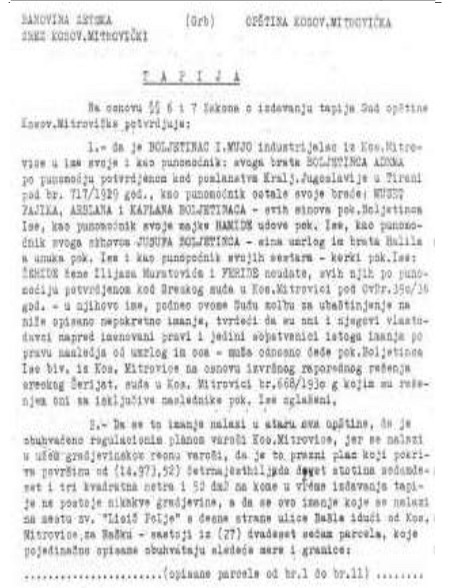
The legal process for one of the 27 plots of land belonging to the Boletini family that lay on the right side of the Mitrovica-Raška road.
During the 19th century, especially after the construction of the railway in the city of Mitrovica, many Jewish families from Prishtina, Artana, Prizren and other cities settled there. Foreign travel writers, who during the 19th century passed through areas inhabited by Albanians, provide us with information about the preservation and maintenance of their churches by the Albanians themselves, even though most of them had now accepted the Islamic religion. Among these travel writers, there are even missionaries supported by the Serbian state, created in 1878. Although these missionaries wrote about objects of worship with the aim of appropriating them, they still could not avoid the truth about the contribution of Albanians to the preservation of churches and monasteries. Todor P. Stankoviqi (Consul of Serbia in Prishtina), traveling from Preševo towards Bujanovac to return to Gjilan, reports that an Albanian guarded a monastery in Pqinje near Vranje. (See Fig. 1, text in Serbian).
Fig.1

Todor Stankovic, born in 1852 in the city of Niš, from 1871 to 1874 worked as an editor of articles in the Serbian language in the newspaper “Prizren”, which at that time was published in Turkish and Serbian in the city of Prizren. During this time he collaborated with the Russian consul Ivan Jastrebov, Miloš S. Milojevic and many Pan-Slavic missionaries who operated in Albanian territories. During his activity he had carried out many important cultural and political tasks in Prizren, Skopje, Thessaloniki, Manastir and Prishtina. His activities
They were mainly in the service of the Serbian state, the Serbian Orthodox Church, by falsifying objects of worship and manipulating the Albanian and Vlach Orthodox population with the aim of assimilating them. Todor Stankovic was appointed consul in Pristina in July 1890, after the assassination of the previous consul Lluka Marinkovic in June of that year. From 1892 to 1895 he was appointed consul in Skopje, and in 1897 he returned as consul in Pristina. Stankovic carried out all his activities under the guidance of his spiritual guide and teacher Miloš. S. Milojević, who instructed him to obtain information about all religious objects, especially those on the left side of the Mitrovica-Gnjilane railway, and to mark them as Serbian Orthodox churches and monasteries.
We also find information about the church in Boleti from T. Stankovic, who visited the church in 1897. He describes the church as small, but says that the church was old, while the altar was a new construction. He writes that the church had been abandoned 40 years ago. It was renovated by a villager from the surrounding villages with the surname Ostojic. Stankovic writes that the residents had told him that the merits for the renovation of the church belong to Fiqa Haxhi Jakiqi and his son Jakov. They, he says, were originally from Prizren, but 25 years ago they had moved to Mitrovica. Jakov still takes care of the maintenance of this monastery, writes Stankovic. (See fig. 2, text in Serbian).

Fig. 2.
As evidence, we can take the Jewish cemetery in Zhazha and the very name of a Serbized Jew named Avram, who had a house near this shrine and had lived in the village of Boletin until 1966. This Jewish family lived very close to the Boletin tower, namely at the “Guri i Tupanit”, a place from which the Buletin family would signal the surrounding residents with a tupan on occasions of holidays or other gatherings.
Todor Stankovic was a Pan-Slavist missionary who, like Miloš S. Milojevic, had made many trips to Albanian settlements and their mission was to falsify the evidence for the churches and objects of worship of the Albanians, registering them as Serbian Orthodox churches and monasteries. Todor Stankovic had visited the church in Boleti at a time when the Serbian church had become quite powerful in the territories of the western Balkans.
In the northern Albanian territories outside the administrative borders of the Serbian state, since 1830, when Serbia had its autonomy, the Serbian Orthodox Church, supported through missionaries and clergy, according to the ideas of Pan-Slavist projects, was against the Greek clergy and the influence of the Patriarchate of Istanbul, who were operating in Albanian territories.
At the same time, Jagosh Gjillas writes that during the 19th century the Patriarchate of Istanbul enjoyed great privileges in the Ottoman Empire. In the Albanian territories, the center of this propaganda had become the Metropolitanate of Prizren, so through the monks and the Vlach population they kept under surveillance the churches in Prizren, Ferizaj, Lipjan and other cities of the northern Albanian territories. The Serbian Orthodox churches in these territories from 1830 to 1896 were in the hands of the Greeks and the liturgy in them was held in the Greek language (See fig. 3, text in Serbian).
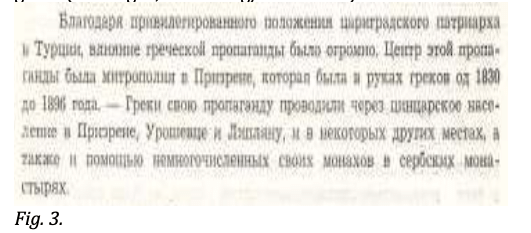
Fig. 3.
Todor Stankovic visited the church in the village of Boletin on August 14, 1897, where he participated in the celebration of the Christian population, which was held on August 15. On this occasion, he unjustly called the population of Mitrovica and the participants from other villages and towns Serbs. After entering the church, he mentioned the cross and the icon inside the church, while in the other room, which he called the women’s room, he noticed a statue made of white marble, representing Saint Mary sitting on a throne holding Jesus Christ. Todor Stankovic, seeing this female statue in the church of Boletin, in his description calls this church for the first time a Monastery. According to sources, it has been proven that the sculptures were mainly found in Catholic churches (See Fig. 4, text in Serbian).
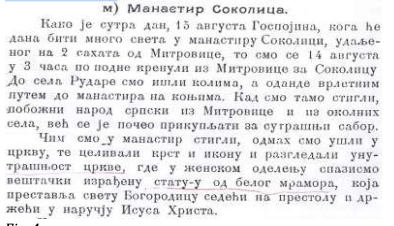
Fig. 4.
In the Sokolica monastery there is a sculpture made of white marble where the Virgin Mary is depicted on a seat holding Jesus Christ in her lap. In Serbian literature it is said that this sculpture was brought to Boletin from the Banjska monastery, supposedly to protect it from the Turkish army. This cannot be true when it was precisely in this church that for centuries it had been a tradition to celebrate the feast of the Blessed Virgin Mary on August 15 by the Albanian Catholic population of the Shala region and its surroundings. The size of this sculpture is 106×67.50 cm, I think this sculpture was made in the early Middle Ages.
The Feast of the Assumption of the Blessed Virgin Mary into Heaven is a holiday dedicated to the mother of Jesus Christ. This holiday is celebrated every year on August 15. This holiday is the atonement of
The Church of Our Lady of Cërnagore, namely Our Lady of Letnica, or Our Lady of Karadak of Skopje, which is known as Karadak in the territory of Viti – Gjilan – Presheva – Kumanovo – Skopje – Kaçanik – Viti. It is the patron of the Parish of the Ascension of Saint Mary to Heaven, which is also celebrated in Zym, which in those parts is known as Our Lady of Has, the Church of Our Lady of Berisha in Dobërdol of Klina, Our Lady of Gruda in Malësia e Madhe, etc. This holiday is also celebrated by the Orthodox, but 13 days later, namely on August 28. From this it follows that the celebration of the feast of Saint Mary in Boletin, which is celebrated on August 15, is evidence that this church was of the Catholic faith and that it was adopted by the Slavic Orthodox.
On the other hand, it should be noted that this holiday is also celebrated by the Orthodox, but 13 days later, namely on August 28, but that the celebration of the feast of Saint Mary in Boletin continues to be celebrated on August 15, thus proving that this church was of the Catholic faith, but was appropriated by the Serbian government after the occupation of Kosovo.
T. Stankovic writes that the church in Boletin lay in the middle of villages with Albanian population and it would be painful to destroy it from any possible attack and from the numerous visitors, but it was protected by the brothers Ahmet and Isa Boletin. Albanians from the village of Boletin guarded Isa Boletin, the church and his properties, where his first house was 800 m away from the church, while the second house was 100 m. (See: Fig. 5 text in Serbian). From this data we understand that until that time this church was under the protection of the Boletin family.
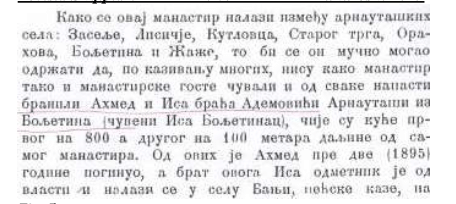
Fig. 5.
Based on the above data, we can affirm that the church in the village of Boletin belonged to the Boletin family and was a Catholic church. The material data and historical sources for the present-day territory of Kosovo and beyond, where the autochthonous Albanian population lived, convincingly prove that the Albanian population, since the separation of the church, namely from 1054, had embraced both denominations, the Orthodox and the Catholic, and had coexisted with them until the 19th-20th centuries, when the believers of the Orthodox faith, under the influence of the propaganda of the Patriarchate of Istanbul, were finally assimilated in the 19th century. We must emphasize that for the Church in Boletin, even in Serbian literature and sources, Serbian authors themselves testify that this object of worship was only officially called the “Women’s Monastery” starting in 1956.
Source
Revista Shqiptari Nr. 9. Bukuresht (Bucharest) 2019.

