
Summary
Philip II of Macedon’s military reforms were heavily influenced by his ten-year hostage stay with the Illyrian king Bardylis. Bardylis pioneered combined-arms tactics using mobile infantry and cavalry, which Philip observed firsthand. After the disastrous death of his brother Perdiccas III in 359 BC at Illyrian hands, Philip professionalized the Macedonian army, creating a standing force of phalangites armed with the long sarissa and integrating cavalry. He then defeated Bardylis by turning these same tactics against him. Without the Illyrian example of multi-ethnic recruitment and combined arms, the army that later enabled Alexander’s conquests might never have existed.
Transcription of the provided magazine pages (Ancient Warfare Magazine – AW XV.6)
By Tim Howe
In the summer of 359 BC, Perdiccas III, king of the Macedonians and older brother of Philip II, was killed in battle by a confederation of hill people, collectively called Illyrians by the Greeks. The fierce clans of Illyria and their wickedly effective cavalry and light infantry had raided the Macedonian kingdom seemingly since its inception, often with disastrous and lasting effects, as Perdiccas learned to his cost. And yet, without the Illyrians and their constant incursions into Macedon, the army that Philip II used to dominate Greece and that Alexander the Great used to conquer Persia may never have come into being.
The Illyrian king Bardylis pioneered many of the techniques that Philip and Alexander would use to such devastating effect, such as the tactics of combined infantry and cavalry. Philip witnessed the evolution of these tactics first-hand during his ten-year sojourn as a political hostage in Bardylis’ household.
In 393 BC, the Illyrians forced Philip II’s father, Amyntas III, to abandon his kingdom at least once. After several resounding defeats, Bardylis commanded Amyntas to surrender his son Philip to him as a hostage. As a result, the young prince would remain in Illyrian custody for ten years, training alongside the other members of Bardylis’ household, until he was transferred from Illyria to Thebes, again as a hostage for Macedonian good behaviour. These ten years in Illyria occurred during the crucial period when Bardylis was consolidating his control over the disparate clans of Illyria and pushing against his Greek neighbours, the Molossians, the kingdom of Alexander the Great’s maternal grandfather. Such a sojourn would have profoundly affected Philip’s thoughts about military development and given him many practical examples of how to unite and maintain a multi-ethnic kingdom as well as how a combination of mobile infantry and cavalry might be deployed against both Greek hoplite armies and the light cavalry of the mountain tribes.
Bardylis the king
The back-to-back foreign residencies would have given Philip the opportunity to compare the innovative military forces of both Illyria and Thebes, as well as the command styles of their leaders, and would have given him a rich experience from which to draw when forming his own ideas about tactics and strategy. For Bardylis was a true innovator. As with the better-documented Epaminondas, Bardylis was an able statesman, a great warrior, and, above all, an effective organizer. For these reasons, he caught the attention of the southern Greeks and was the first Illyrian warlord to be given significant space in the Greek literary sources – Diodorus (16.4), for example, called him a basileus and notes that he was a worthy adversary to his Greek and Macedonian neighbours. Before Bardylis, the Greeks seem to have viewed the Illyrians as a leaderless, and therefore dangerous, nomadic folk, best left alone.
A Phrygian (with the peak of a Boeotian) helmet from the Olanesti treasure, related to a failed expedition against the Scythians. © National Museum of History of Moldova
Dating to the fourth–third century BC, this silver phalera in the shape of a Macedonian star was found along the Black Sea coast at the ancient settlement of Panticapaeum. © State Hermitage Museum
The Alexander Sarcophagus shows an intricate scene of combat involving combined Macedonian cavalry and infantry against Persian cavalry and infantry, suggesting combined-arms armies on both sides. © nathings / Shutterstock
Reconstruction of the Vae Situla, a mid-fifth century BC bronze ritual vessel from Klenik, Slovenia, showing a variety of warriors. © NMS / Wikimedia Commons
(Page number: 28 – Ancient Warfare XV-6)
…crisis, for not only was the Macedonian king lost, but 4000 of his aristocratic Companion Cavalrymen went to Hades with him. The result: a tattered nation army, demoralized and unmotivated to take the field. To make matters worse, Perdiccas’ son and presumed successor, Amyntas, was only a child and could not provide the necessary leadership; the Paeonians, another hill folk to the east of the Illyrian territories, were plundering Macedonian border territory to the northwest; and the Thracians were supporting a rival claimant to the Macedonian throne.
Lessons learnt
In the face of these impending crises, Perdiccas’ younger brother Philip, then aged 23, stepped in and turned things around by focusing on the reasons behind the recent Macedonian defeats – the Illyrian strategy of combined arms. Philip needed a military like Bardylis’ that was mobile enough to face cavalry but heavy enough to face infantry.
To increase the size of both infantry and cavalry, Philip followed Bardylis’ example and took the important step of recruiting from all ethnicities and classes of people in his kingdom, offering land and resources to equip those who had none and expanding the lands of those who already possessed some property. With these innovations, Philip converted the Macedonian volunteer levies of infantry and cavalry into a professional standing army whose only occupation was to fight and train year-round. In short, Philip reformed the Macedonian army much as Bardylis had done to his army when Philip was his hostage.
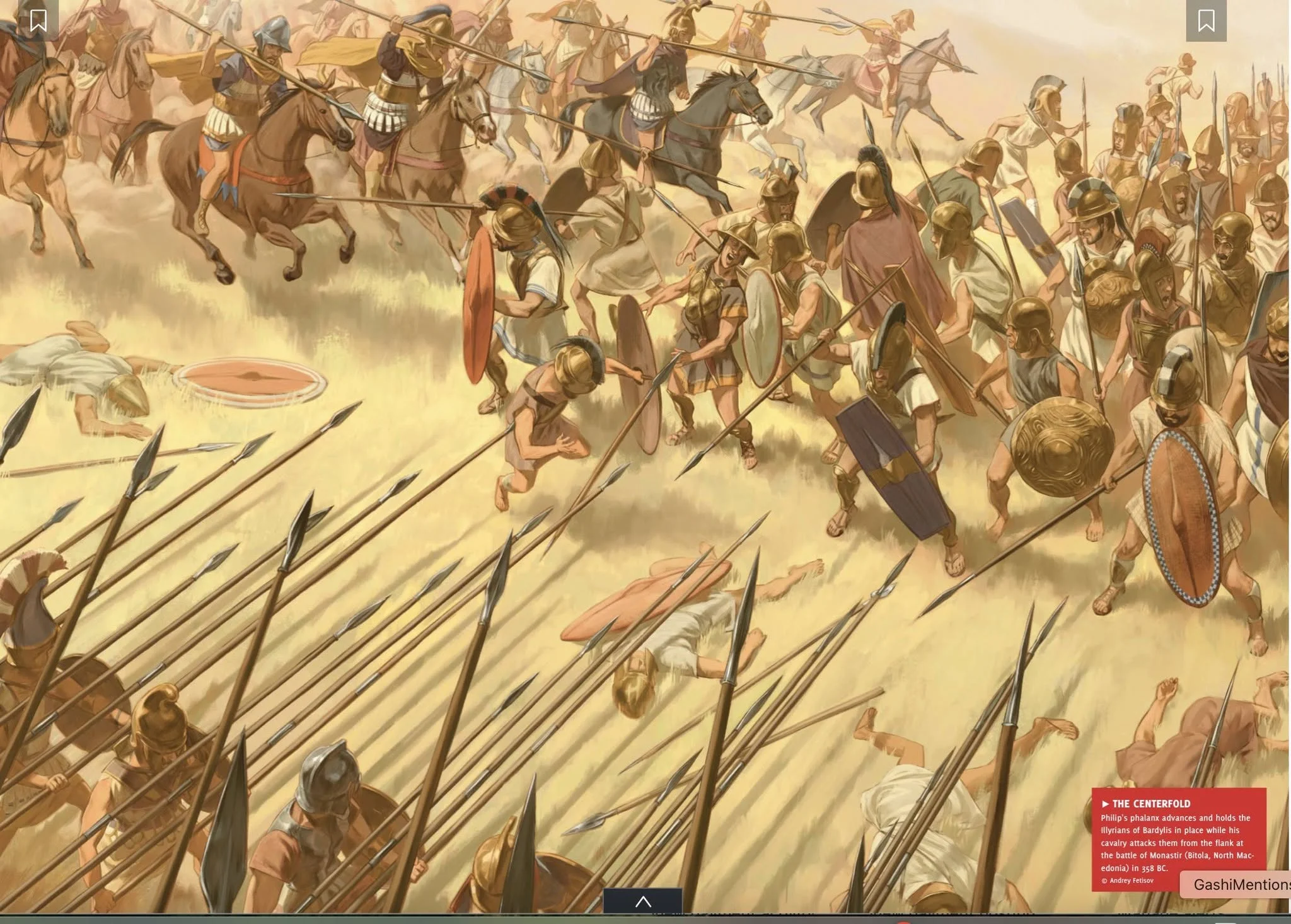
Once the new Macedonian army was ready, Philip then faced Bardylis and his Illyrians in the field. Diodorus’ account of the battle (16.4.4–6) is the earliest detailed description of the Macedonians in battle and asserts, quite graphically, that Philip’s resounding victory over Bardylis was due to the coordinated use of cavalry and infantry:
Bardylis, the king of the Illyrians, having learned of the presence of the enemy, first dispatched envoys to arrange for a cessation of hostilities on the condition that both sides remained possessed of the cities that they then controlled. But when Philip said that he indeed desired peace but would not, however, agree to anything if the Illyrians did not withdraw from all the Macedonian cities, the envoys returned without having accomplished their mission.
Then Bardylis, confident in his previous victories and the excellence of the Illyrian army, came out to meet the enemy. He had 10,000 picked infantry soldiers and about 500 cavalry. The armies approached each other and, with a great shout, commenced battle. Philip, commanding the Macedonian right wing composed of the best of the Macedonians serving under him, ordered his cavalry to ride past the ranks of the barbarians and attack them on the flank, while he himself hit the enemy in a frontal assault.
The Illyrians courageously formed themselves into a square. For a long while the combatants were evenly matched, because of the exceeding skill displayed on both sides, and as many were slain and still more wounded, the fortune of battle vacillated first one way then the other, being constantly swayed by the valorous deeds of the combatants. Finally, though, as the Macedonian cavalry pressed on the Illyrian flank and rear, and Philip with the best of his infantry courageously [hit the front], the majority of Illyrians broke ranks and fled.
— Diodorus Siculus 16.4.4–6
The implications of this defeat were profound. Philip had turned Bardylis’ tactics of combined arms back on him – the Illyrian forces were boxed up into a square by Philip’s infantry and cavalry working in tandem. To signal this new military reality, Philip married Audata, Bardylis’ daughter (or granddaughter), and Bardylis’ Illyrian confederation fell apart.
While Philip’s new military reforms undercut the Illyrian advantages, and Bardylis and his Illyrians did withdraw from Macedon, the Macedonians and the Illyrians did not remain at peace. During Philip’s reign, the Macedonian army was forced to respond to various incursions from the tribes who had broken free from Bardylis’ control – Parmenion is reported to have won a great victory over a group of Illyrians led by an otherwise unknown Grabus on the very day of Alexander’s birth.
It was not until the campaigns of Alexander in 335 that the Macedonians devised a more permanent solution, again modelled on Bardylis’ example. After a series of victories in Illyria during his first two years on the throne, Alexander enrolled Illyrian soldiers into the Macedonian army that would travel to India and back.
While it is clear that in the beginning the Illyrians were the dominant military power, it is equally clear that the Macedonians learned well from their Illyrian enemies. Without the Illyrians and the example set by their successful victories over Molossia and Macedon, the army used by Philip II to dominate Greece and by Alexander the Great to conquer Persia may never have existed.
Philip’s reforms
Diodorus tells us (16.3.1–2) that Philip reformed the Macedonian army as soon as he (unexpectedly) came to the throne in 359, holding assemblies and organising the men, equipping them and training them in manoeuvres: he “was the first to organise the Macedonian phalanx.” Each phalangite was equipped with a long sarissa pike, effective against both infantry and cavalry, helmet, armour, greaves and shield. They were organised into six taxeis (sing. taxis) from regions of Macedonia, each taxis consisting of six syntagmata (sing. syntagma) of 256 men (organised into sixteen files of sixteen men, each led by an officer). The phalanx therefore consisted of 9,216 men.
DID YOU KNOW?
Although phalangites are often described as using the smaller pelte shield, they are often depicted using the typical, traditional aspis shield. Perhaps there was a transitional phase?
A gold gorgon head attachment from a cuirass. Found in the tomb of Philip II at Aigai (Vergina, Greece). © Mary Harrsch / Wikimedia Commons
(Illustration of a Macedonian warrior with red cloak, helmet, shield, and spear)
A series of necklace pendants from Amphipolis, Greece in the shape of warriors (with Macedonian shields and swords). © Livius.org
(Top) Facade of the tomb of Philip II at Aigai, the ancient Macedonian capital (Vergina, Greece). Several similar tombs have been found. Their decoration and contents have advanced our understanding of ancient Macedon immensely. © Guillén Pérez / Flickr
(Bottom) An Illyrian shield dated to the fourth century BC. Found at Apollonia, Illyria (now Albania), such shield designs became associated with Macedonian forces. © Carole Raddato / Flickr
Transcription of the provided magazine page (Ancient Warfare Magazine – AW XVII.3)
…at the other side
– that’s how Jona Lendering, editor of Ancient History at Livius.org, qualified the situation years ago. When it comes to sources — texts, inscriptions, archaeology — all put together, we mainly know lots of details about the bolts of the Roman army and the ancient armed force. That even for Rome, we are short of data to reconstruct the motivations.
A group of those questions concerns the enemies of Rome. The list is long, as they say, and we may have archaeological information and what the Romans tell us about these foes, with all possible consequences of their biased viewpoint.
And yet, it is, of course, worth trying to create a picture of Rome’s enemies anyway based on the available records. Just changing the perspective around is helpful. It alerts us to the fact that we see most of Rome’s history solely through Roman eyes, and that Rome’s enemies weren’t always just a speedbump to be overcome in search of land, loot, and glory. That our knowledge is limited is just the usual burden we bear.
Jasper Oorthuys
Editor, Ancient Warfare
Exeter’s Roman army past
Digging Exeter Cathedral’s Green in England have uncovered mid-Roman-period structures under the city. The Roman remains of an early street, a townhouse wall, later foundations of medieval buildings contemporary with those uncovered in 1971.
John Allan, Cathedral Archaeologist, said: “The street and early timber buildings date from circa AD 50-75 and formed elements of the Roman legionary fortress which underlies central Exeter. They probably represent part of a long barrack building which extended towards the giant stone bathhouse exposed under the Cathedral Green in the early 1970s. The later stone wall is part of a previously unknown town house of the 3rd and 4th centuries.”
The small Roman fortress was established by Legio II Augusta in around AD 50 when it was active during the campaign to conquer Southwestern Britain. When called to assist in the counterinsurgency operations at the time of the revolt of Queen Boudica in AD 60/61, its praefectus castrorum Poenius Postumus refused. Disgraced, he committed suicide. The legion was moved to South Wales around AD 74.
The unearthed townhouse wall from the 3rd and 4th centuries also adds to our knowledge of Roman Exeter as the civilian settlement of Isca Dumnoniorum.
The archaeological work coincides with Exeter Cathedral’s project to construct a new Cloister Gallery, replacing the medieval cloisters demolished in 1656. This gallery will be built on the medieval foundations, linking the cathedral with its Chapter House and Pearson buildings.
(Top) A section of the Roman city wall of Exeter (Isca Dumnoniorum) occupied by Legio II Augusta in the 50s-70s AD.
© Allie_Caulfield / Flickr
(Bottom) A Roman brick with legionary stamp (believed to be of Legio II Augusta but the numeral is missing).
© Wolfgang Sauber / Wikimedia Commons
Sixth-century BC ‘Illyrian-type’ helmet found in Croatia
Archaeologists working in the ‘Gomila’ area of Zakotorac on Croatia’s Pelješac peninsula have unearthed a 2,500-year-old ‘Illyrian-type’ helmet. The newly discovered bronze helmet has been dated to the 6th century BC. The helmet, damaged at the top, may have been a votive offering. It was uncovered in a dry stone-walled addition to a grave.
The find follows the discovery of a similar helmet in 2020 by the same team just 10 metres from the new findspot. That piece of equipment is typical of 4th century BC Greece and Illyria. It likely belonged to a warrior as it was found in a grave alongside iron weapons.
“What is very interesting is that two different types appear here in the same place, which speaks of a continuity of power of the respective community. These helmets have always been a symbol of some kind of status and power,” said Professor Hrvoje Potrebica from the Department of Archaeology of the Faculty of Philosophy in Zagreb.
This new discovery, along with various clothing, jewellery, and burial artefacts unearthed since excavations began, enhances our understanding of Illyrian funerary practices in the latter half of the first millennium BC in the Western Balkans. Interestingly, despite the name, most Illyrian helmets have been found in the Peloponnese.
Recently discovered Illyrian-type helmet, found in a dry stone-walled addition to a grave in the Gomila area of Zakotorac, Croatia.
© Dubrovnik Museums
Another, fifth century BC, Illyrian bronze helmet shows remarkable continuity with the new discovery.
© The Metropolitan Museum of Art
Bronze Lucanian belt with hooks from Campania, ca. 400-300 BC, now in the Rijksmuseum van Oudheden. Similar belts had been in use for centuries.
© Lauren van Zoonen
Grave from an Iron Age cemetery in the Telesina Valley
While several layers of activity from prehistory to late antiquity were discovered during the site’s excavation, the best-preserved archaeological evidence concerns a sizable burial area that was observed between the end of the Iron Age and the advanced Orientalizing period (from the third quarter of the 8th century BC to the second half/end of the 7th century BC).
The discovery in the Telesina Valley was made in advance of a planned electric power plant construction project, about 50 kilometres (31 miles) northeast of Naples. The municipality of Amorosi plans to build a museum to exhibit the finds.
(Partial text visible on left column about “boons” / collections appears cut off in the image and is incomplete.)
(Page number: Ancient Warfare XVII-3 – page 5)
Author note:
Dr. Tim Howe is Professor of History and Ancient Studies at St. Olaf College, Minnesota (US).


Source
Howe, Tim. “Philip II and Bardylis the Illyrian.” Ancient Warfare

