by Marios Dimopoulos
Albanian nationalists reportedly approached Greece with a proposal for Albania to unite with Greece.
Major General Chrysochoou, who conducted the negotiations, wrote that Albanians had historically maintained close ties with Greeks and that many regarded the creation of the Albanian state as a political development that had separated two historically connected peoples. According to his account, following Italy’s occupation of Albania, some Albanian nationalists reconsidered their political position and, in 1944, sought union with Greece.
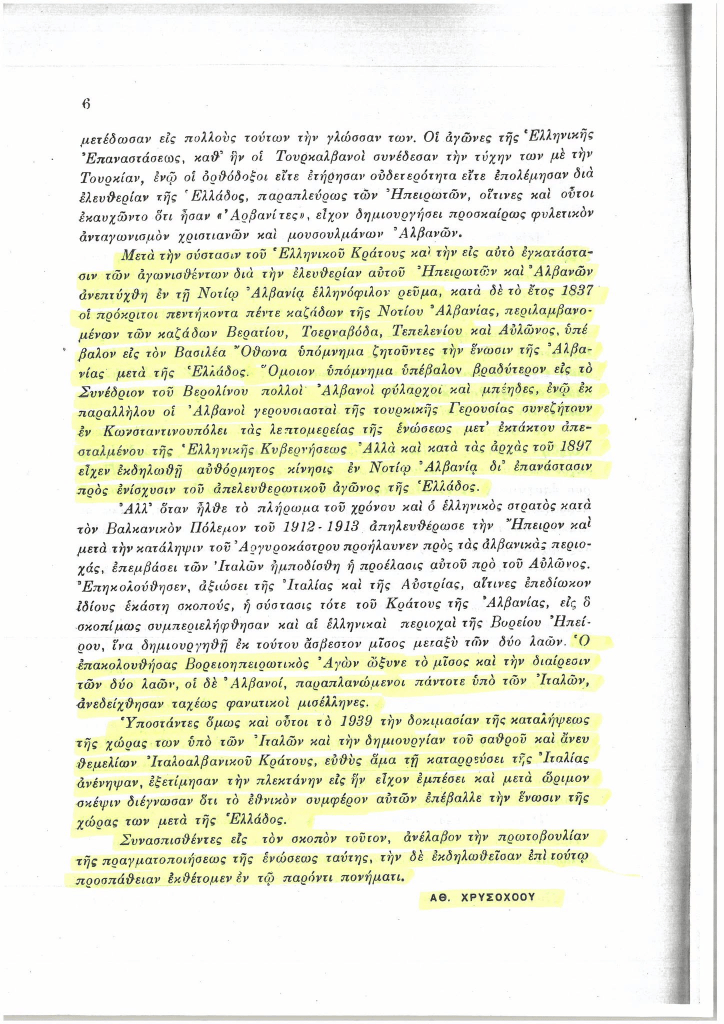
I am presenting scanned pages from Chrysochoou’s book, entitled THE GREEK-ALBANIAN UNDERSTANDING OF 1944 FOR THE UNION OF ALBANIA WITH GREECE.
Chrysochoou writes:
“Since ancient times, ties have existed between the Greeks and the Albanians and their ancestors, the Illyrians. The Greek myth concerning Illyrius, son of Agenor and grandson of the legendary King of Thebes, Cadmus, is indicative of the racial bond between the Greeks and the Illyrians.
Furthermore, from the most ancient times, the Illyrians, Epirotes, and Macedonians were considered sister peoples.
The Byzantine state … incorporated the Albanian tribes from Shkodra to Berat into the Theme of Dyrrhachium … Within the framework of the Byzantine state, the bonds of friendship with Greece were maintained.
The friendly intermingling of Albanians and Greeks, which took place during the 14th century AD, should be attributed to these existing ties. This occurred, on the one hand, through the migration of groups of Albanians who settled in Epirus and Central Greece, and, on the other hand, shortly afterward, through the invitation extended by the Despots of Mystras to thousands of Albanian families, who settled in the depopulated countryside of Attica, Boeotia, and the Peloponnese.
These settlers were undoubtedly regarded as Greek-speaking foreigners, since those among them who later converted to Islam during Ottoman rule were considered, until the Greek Revolution, and were even characterized by Theodoros Kolokotronis himself, the commander-in-chief of the Peloponnese, as Islamized Greeks.
Following the establishment of the Greek state and the settlement there of the Epirotes and Albanians who had fought for its freedom, a pro-Greek movement developed in southern Albania. In 1837, the notables of 55 districts (kazas) in southern Albania, including the districts of Berat, Tsernavoda, Tepelena, and Vlora, submitted a memorandum to King Otto requesting the union of Albania with Greece.
A similar memorandum was subsequently submitted to the Congress of Berlin by numerous Albanian tribal leaders and beys. At the same time, Albanian senators in the Turkish Senate were discussing the details of union in Constantinople with a special envoy of the Greek government.
Moreover, at the beginning of 1897, a spontaneous movement had emerged in southern Albania calling for a revolution in support of the liberation struggle.
The subsequent Northern Epirus struggle intensified the hostility and division between the two peoples. Many Albanians, influenced by Italian political policies, subsequently adopted strongly anti-Greek positions.
However, having themselves experienced the ordeal of their country’s occupation by the Italians in 1939 and the creation of the Italo-Albanian state, they came to reconsider their political position following Italy’s collapse. They recognized the circumstances in which they had found themselves and, after mature consideration, concluded that their national interests could be served by the union of their country with Greece.
Having united around this objective, they took the initiative to bring about this union. The efforts undertaken toward this end are described in the present work.”
The negotiations of 1944 and the Northern Epirus question
According to the account presented, as the parties were preparing to sign an agreement with the Greek government, representatives of the Greek community of Northern Epirus reportedly expressed reservations.
Their position was that they wished to see Northern Epirus liberated and incorporated into Greece, rather than support an agreement involving the union of the whole of Albania with Greece.
This disagreement contributed to delays in the negotiations. Subsequently, the communists came to power in Albania, arrested several Albanian nationalists involved in the initiative, and the proposed union did not materialize.
In the epilogue of his book, Chrysochoou writes:
“Kotsio Kotta and Xhavit Leskoviku, who were in Thessaloniki for the Greek-Albanian understanding (Selim Borja having escaped to Athens), were arrested by the EAM-communists. They were transported in chains to Albania and imprisoned in the same prisons where the regents who had been arrested in Albania, party leaders, politicians, tribal chiefs, and others who had actively participated in the Greek-Albanian union movement were also being held.
All these individuals were brought to trial in March 1945 on charges of high treason and, after being sentenced to death, their sentences were commuted to 101 years of imprisonment. Those who have not already died in prison are wasting away there.
Many of the leading figures in this movement, however, managed to hide in the mountains or escape abroad.
For all these people, as well as for every nationally minded Albanian, the collapse of Albania’s communist regime and its union with Greece now undoubtedly represent the only hope for freedom and civilization.
Undoubtedly, when the sun of freedom rises once again over Albania, the effort will be repeated and will be crowned with success, because no nationally conscious person will oppose the interests of the two peoples.”
Historical significance and consequences
The events described by Chrysochoou raise important questions about the political relations between Greece and Albania during the Second World War.
The failure of the proposed agreement had significant consequences for both countries. Albania subsequently remained under communist rule for approximately 45 years, while the possibility of a closer political relationship or even territorial union with Greece disappeared.
The disagreement over the future of Northern Epirus appears to have been one of the factors complicating the negotiations.
These events represent an interesting and relatively little-known episode in the history of Greek-Albanian relations and deserve further historical investigation.
It should also be noted that a protocol concerning a Greek-Albanian federation was reportedly signed in 1907. Later, Greek leader Pangalos entered into discussions with Albania’s King Zog concerning the possible establishment of a Greek-Albanian state.
PELASGIAN STUDIES
Visit my ethnological website, PELASGIAN STUDIES (PELASGIANS – GREEKS – ALBANIANS – ARVANITES), available in three languages (English, Greek, and Albanian), to read my articles and books about the common roots of Greeks and Albanians, as well as broader subjects concerning linguistics, prehistory, ethnology, physical anthropology, genetics, history, and geopolitics in the Balkans.
The link to my website is in the comments.
BIOGRAPHY
I am a philologist, linguist, ethnologist, naturopath (Doctor of Naturopathy), orthomolecular therapist, and author.
I was born in 1975 in Piraeus. I initially studied philology, specializing in linguistics, at the School of Philosophy of the National and Kapodistrian University of Athens.
Subsequently, because of my interest in natural and alternative therapies, I studied clinical nutrition and naturopathy. I received training in natural medicine at the British Institute of Homeopathy (New Jersey, USA), Trinity School of Natural Health (Indianapolis, USA), and Quantum University (Honolulu, USA).
I am the author of books on health, history, and ethnology (to date, 47 books in the Greek language).
At the age of 18, I began studying the Indo-European question, the origins of the so-called “pre-Greek” peoples, and the origins of the Balkan peoples, with particular emphasis on the relationship between Greeks and Albanians and the theory of their common Pelasgian ancestry, as well as the origins of the Arvanites and their contribution to modern Hellenism.
My research interests include historical-comparative linguistics, the decipherment and interpretation of ancient inscriptions, the study of ancient Greek civilization and other ancient peoples, physical (biological) anthropology, and genetics.
I have collaborated with Nikos Poulianos, president of the Anthropological Society of Greece and son of the famous Greek anthropologist Aris Poulianos. With Nikos Poulianos’s assistance, I was invited to the 21st Congress of the European Anthropological Association, which took place in Denmark on August 22–25, where I delivered a presentation entitled:
“An Anthropological Overview of the Populations of the Balkans.”
In this presentation, I argued that the Slavic-speaking inhabitants of the Balkans are, to a considerable extent, not of Slavic origin but of pre-Slavic ancestry, and are essentially ancient indigenous populations that underwent linguistic Slavicization.
In 2017, I wrote a study on the cradle of the human species and on whether humanity really originated in Africa or whether the theories of anthropologist Aris Poulianos concerning the origin of humanity in the northern Balkans (the broader region of Macedonia) are valid.
This study was read and reviewed by the anthropologist Nikos Poulianos, who advised me on possible corrections and modifications.
Regarding the origins of Greeks and Albanians, in 2012 I created a website dedicated to this subject. I subsequently compiled its articles into a book, which I published in 2014 under the title The Origin of the Albanians, as well as in the book Albanian Kosovo and Serbian Propaganda.
This year, I created the ethnological website PELASGIAN STUDIES.
In addition to my scientific pursuits, I am politically active in Greece. In the past, I have participated as a candidate in various political formations, with my most recent participation being in the European Parliament elections.