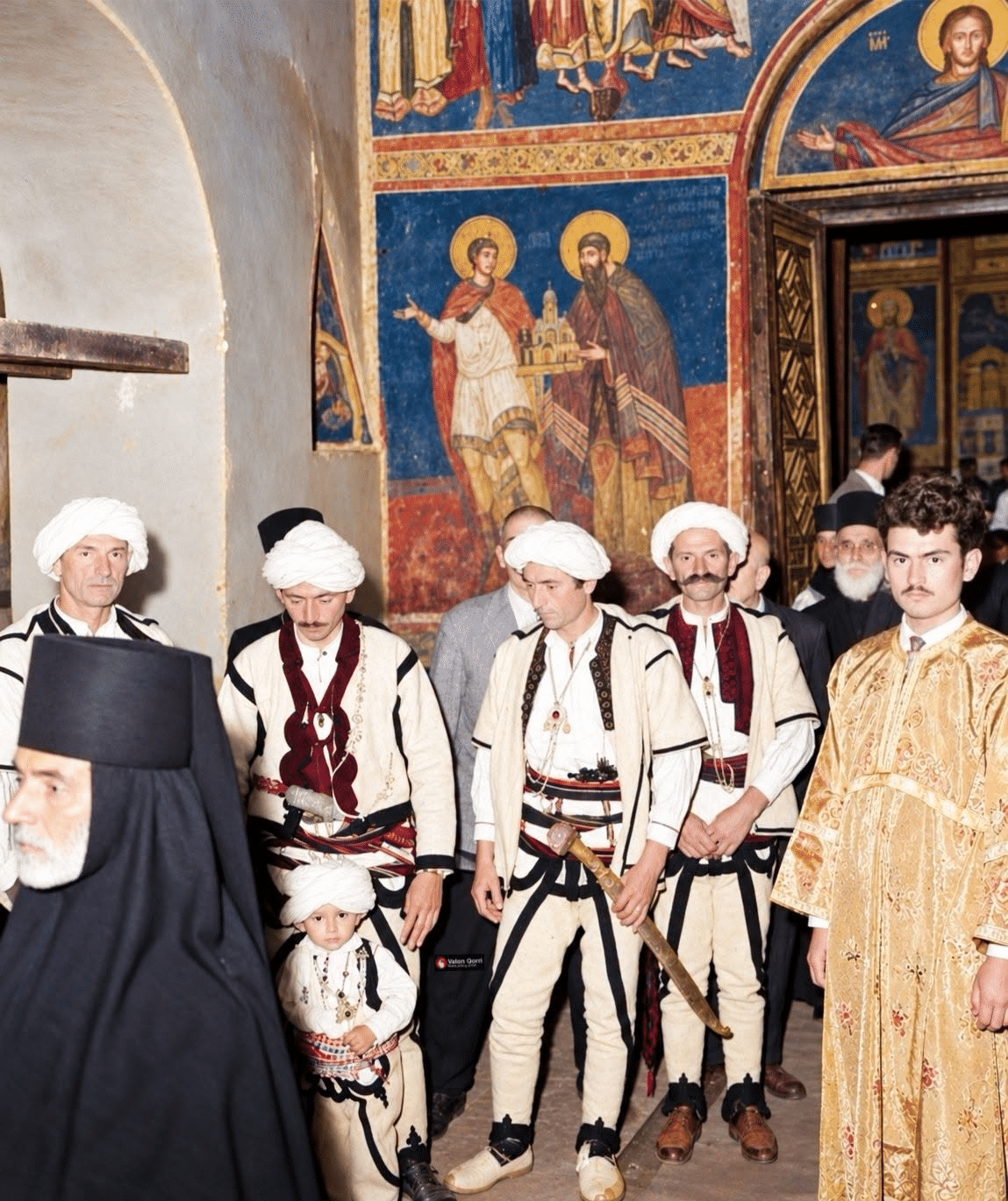

For decades, Serbian national narratives have presented the Deçan Monastery, alongside the Gračanica Monastery, as inherently and exclusively Serbian heritage. These claims are frequently invoked as evidence of an alleged uninterrupted Serbian presence, historical continuity and indigenous ownership of Kosovo.
However, the historical record calls for a more nuanced examination of these assertions. In particular, an archival document dated 28 September 1639, associated with the Congregatio de Propaganda Fide (the Congregation for the Propagation of the Faith), raises important questions about how Orthodox populations in the region were classified and understood during the seventeenth century.
The terminology used in this document challenges the assumption that religious affiliation and modern national identity were interchangeable concepts.
1. How Did Rome Categorise the Serbian Population?
The 1639 document refers to certain Orthodox communities using the following terminology:
“Illyrians called Vlachs, or Vlach Uskoks, or schismatic ‘Servs’ [Serbs] of the Greek rite.”
This wording deserves particular attention. It places the term Servs within a broader ecclesiastical and administrative classification of Orthodox communities, alongside references to Illyrians and Vlachs.
The document therefore illustrates the complexity of seventeenth-century identity classifications. Religious affiliation, regional origins and communal designations frequently overlapped, and terminology used by ecclesiastical authorities did not necessarily correspond to the national categories familiar today.
Consequently, the historical use of the term Serv cannot automatically be interpreted through the framework of modern Serbian national identity.
2. What Does This Mean for the Historical Interpretation of Deçan?
A central argument in Serbian national historiography is that the Deçan Monastery represents Serbian historical ownership because it was commissioned by a Serbian medieval ruler and constructed within the political and ecclesiastical framework of the medieval Serbian state.
Yet the historical significance of a medieval religious institution must be distinguished from the question of modern national ownership.
The 1639 document, written approximately two centuries after the construction of the Dečani Monastery, provides evidence that Roman ecclesiastical authorities described Orthodox communities in the region through a complex combination of religious and communal terminology.
It does not establish that a clearly defined modern Serbian national identity existed throughout the territory, nor does it provide evidence of exclusive ethnic ownership of the monastery.
Had national ownership been a recognised legal or administrative category at the time, it would require specific historical documentation. The terminology in this particular document, however, reflects a different conceptual framework.
3. A Medieval Monastery Is Not a Modern National Title Deed
The political and social realities of the Middle Ages cannot be interpreted exclusively through the national categories that emerged in later centuries.
Medieval monasteries were religious, cultural, economic and political institutions. Their construction was frequently sponsored by ruling dynasties, and their activities were connected to the ecclesiastical structures and political authorities of their time.
However, the patronage of a monastery by a particular dynasty does not, by itself, establish perpetual ethnic ownership or confer exclusive national property rights upon a modern nation-state.
The same historical distinction applies to the Gračanica Monastery. Its medieval ecclesiastical origins and historical significance must be understood within the political, religious and cultural environment in which it was established, rather than automatically equated with the concept of exclusive national ownership.
Historical heritage, religious affiliation and contemporary territorial sovereignty are separate matters and should not be conflated.
4. Serbian National Identity and the Problem of Historical Continuity
Modern Balkan national identities developed through historical processes that became particularly influential during the nineteenth century.
Projecting these modern national concepts backwards onto the medieval period risks distorting the historical record.
The 1639 document illustrates that religious affiliation, communal identity and ethnic terminology were not necessarily equivalent. Orthodox populations could be described through overlapping categories, reflecting the administrative and theological perspectives of contemporary authorities.
This does not prove that Serbian communities did not exist in the region. Rather, it demonstrates that historical identities cannot simply be reduced to the national classifications of the modern era.
Claims of uninterrupted ethnic continuity and exclusive national ownership therefore require considerably more evidence than the existence of medieval monasteries or references to particular religious communities.
Conclusion: Historical Heritage Is Not Proof of Exclusive Ethnic Ownership
The Deçan Monastery is an important historical and religious monument. Its medieval origins deserve serious historical study and preservation. However, its existence cannot, on its own, be treated as proof of exclusive Serbian ethnic ownership of Kosovo.
The 1639 archival document offers a valuable perspective on how Orthodox communities were classified during the seventeenth century. Its terminology reflects a historical reality in which religious affiliation, regional identity and communal designations often intersected.
The distinction is essential: the medieval religious world was not organised according to the same national principles that shape political discourse today.
Deçan and Gračanica should therefore be understood as part of the complex historical and cultural heritage of the Balkans, rather than used as unquestionable evidence of exclusive modern national ownership.
A monastery is a historical monument, not an ethnic title deed.
Photograph: Valon Qorri

