
Written by Fahri Xharra
The Philistines were an ancient people who lived along the southern coast of Canaan between the 12th and 6th centuries BC. They are known for their biblical conflict with the Israelites. The most compelling evidence regarding their origins is archaeological, pointing toward the Aegean Sea.
Although the Egyptians speak of their arrival from the north (see map), linguistic traces also confirm their Aegean origins. Many linguists consider the Philistines to be identical to the Pelasgians (who are also mentioned in the Iliad). Regardless of the ongoing scholarly debate over whether or not they were of Pelasgian origin, it is certain that they originated from the Aegean region.
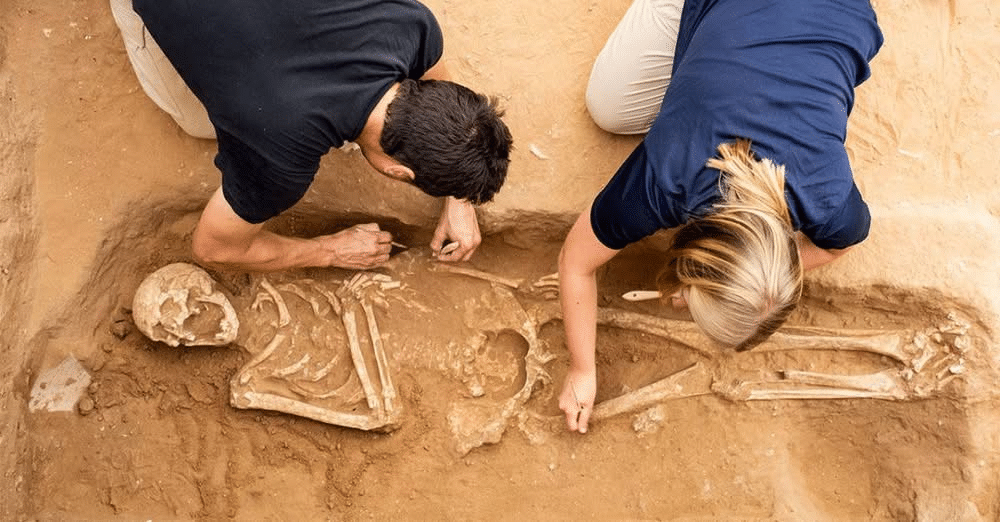
Genetic analyses of skeletons discovered in the ancient coastal city of Ashkelon—dating to the Bronze and Iron Ages—reveal that the Philistines of those periods possessed a component in their genome not found in the remains of other peoples from the same era and region.
According to researcher Michel Feldman of the Max Planck Institute, this portion of the genome originates from European populations.
The prominent historian Mathieu Aref includes the Philistines within the broader ethnolinguistic family of the Pelasgians.
In the book Albanian, the Mother of Languages by Giuseppe Crispi (1831), we read: “To understand the origins of the Albanian language, we must also consider another language that emerged during that same period: Hebrew. When God bestowed language upon us, it was imperfect and limited—consisting of short words—much like Hebrew, where the roots never exceed three consonants.”
One point of similarity between Albanian and Hebrew, beyond the existence of monosyllabic words, is the use of the letter “ë.” Thus, while the Philistines were already known from the Bible, we now know their origins with certainty thanks to DNA analysis of skeletal remains conducted by archaeologist Michael Feldman and his team.
Philistine stone carving (britannica.com)
In fact, among ten skeletons unearthed in the ancient Philistine city of Ashkelon, three date back to the Late Bronze Age—3,600 years ago. Six of the skeletons belonged to children from the Iron Age, while the others date to the late Iron Age.
The Philistines are mentioned in the Bible and are known for their conflicts with the Hebrews. We know that in the war between the Philistines and the Israelites, the Philistines had Goliath, while the Israelites had Samson—who, through his cunning, managed to take Goliath’s sword and cut off his head.
DNA analyses will reveal how much truth there is to the claim that Goliath was of such immense size (given that the era of giants had already passed).
We also know that Delilah was a Philistine; Samson fell in love with her, and she deceived him into revealing the secret behind his superhuman strength. Delilah then alerted the Philistine army, lulled Samson to sleep, and they managed to cut his hair.
A map of ancient Philistia.
The Philistines believed in many gods, whereas the Israelites believed in one. According to the Hebrews, the Philistines were uncouth, uncultured, aggressive, and disagreeable. The Philistines were masters of the arts; they possessed their own culture and architectural traditions, and their pottery was identical to the Mycenaean pottery of the Aegean.
(Some scholars used this evidence to suggest that the Philistines of the Old Testament were actually the descendants of seafaring people from the Aegean who settled down along the coastal plain in Canaan. What new evidence is revealing is that this theory may be correct.)
In other words, the Philistines were Aegean people who inhabited the coastal plain of Canaan. The Egyptians also described the Philistines as a “sea people” and identified them as Mycenaean. Furthermore, DNA analyses indicate that they were a Mediterranean people.
Another point is that their burial rites differed from those of the Egyptians and other neighboring peoples; they were buried with a vessel—likely for aromatic substances—placed near their heads.
Map of the Philistine era.
The distinction is that Palestinians are Arabs, whereas the Philistines were Pelasgians from the Aegean.
Traces of the Philistines disappear in the 6th century BC.
Alternatively, there is a theory that they were an indigenous people; it is said that Abraham and his son—who lived several centuries earlier—had contact with the Philistines.
Philistine stone carving.
This relief indicates that the Philistines were a seafaring people.
A distinction must be made between the Philistines and the Palestinians, as they share no genetic connection. While the Philistines were Pelasgian, the Palestinians are Arab. The difference is that the Palestinians are Arab, whereas the Philistines are Pelasgians from the Aegean.
Referencs
Fan S. Noli – “Israelites and Philistines” – Rilindja, Pristina, 1968
Giuseppe Crispi – “Albanian, the Mother of Languages” – Plejad, Tirana, 2009
https://sciencesensei.com/dna-reveals-the-origins-of…/18/
https://www.jpost.com/…/www…/topic/Philistine-people
https://www.nationalgeographic.com/…/ancient-dna…/
https://www.livescience.com/55429-philistines.html
https://www.smithsonianmag.com/…/ancient-dna-sheds-new…/
https://www.quora.com/How-does-Philistine-and-Palestine…
https://www.haaretz.com/…/.premium-why-are-palestinians…

