
by Marios Dimopoulos
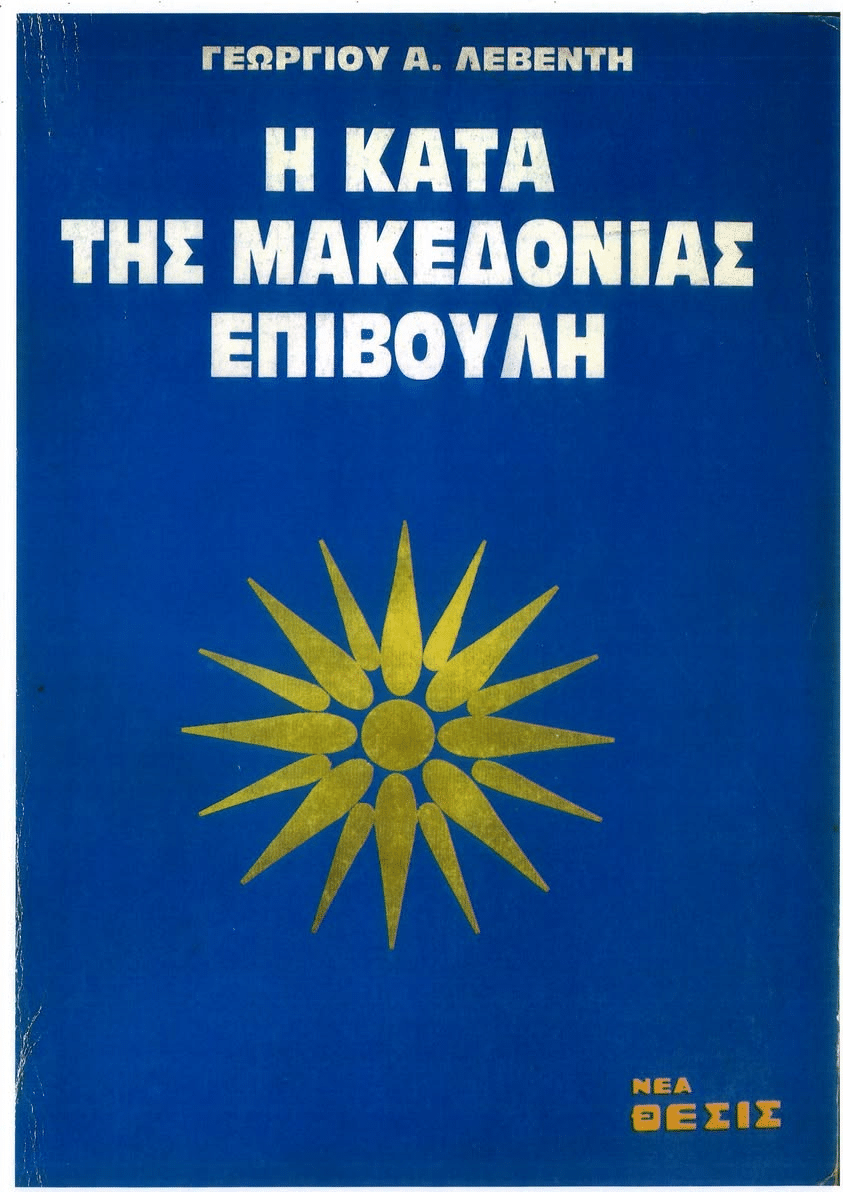
A book by General Georgios Leventis, published by the nationalist/far-right publishing house “Nea Thesis,” which was the publisher responsible for publishing the books of Kostas Plevris. The book demonstrates the anti-Greek role played by the Serbs and Russians, our supposedly Orthodox brothers, in the Macedonian Question. Had they prevailed, Greece today would begin at Lamia, and Macedonia would have been divided between the Serbs and Bulgarians, with the blessings of Mother Russia.
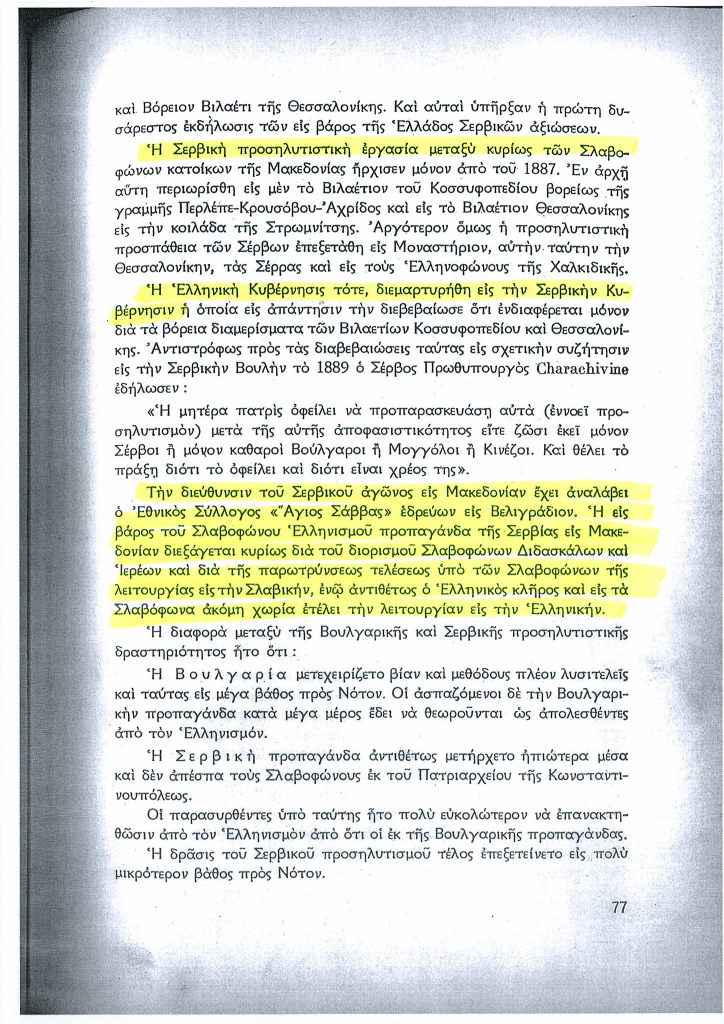
In the second image/page that I have highlighted for you, General Leventis writes the following about the anti-Greek role of the Serbs:
“The Serbian proselytizing campaign, primarily among the Slavic-speaking inhabitants of Macedonia, began in 1877. The Greek government protested to the Serbian government at the time. The direction of the Serbian campaign in Macedonia had been undertaken by the National Society of Saint Sava, based in Belgrade. Serbia’s propaganda in Macedonia against the Slavic-speaking Greek population, etc., etc.”
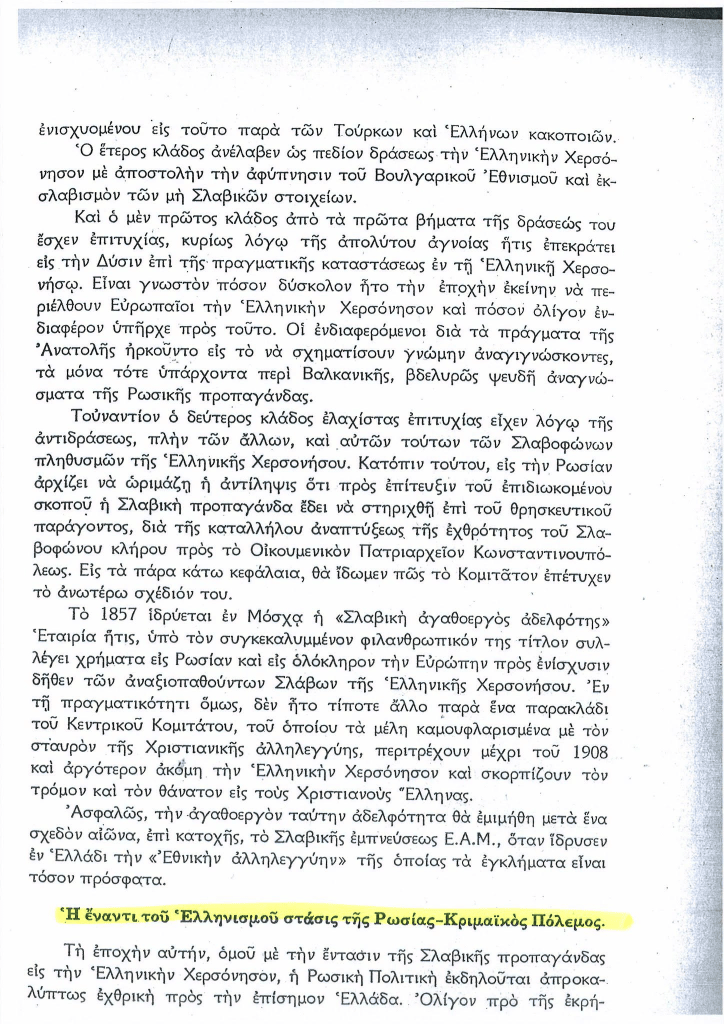
In the third image/page that I have highlighted for you, General Leventis writes about the anti-Greek role of the Russians:
“Russia’s attitude towards Hellenism – The Crimean War.”
I am also presenting evidence of the anti-Greek role of the Serbs from an earlier book of mine. But when you are ignorant of history and a conspiracy theorist, you regard your anti-Greek enemies, the Serbs, as friends and brothers.
THE MYTH OF GREEK-SERBIAN FRIENDSHIP
The Serbs tried to steal Greek Macedonia from the Greeks and turn Macedonia and Thessaloniki into Serbian territory. The Serbs were the ones who drove the Greeks out of Monastir and de-Hellenized the Greek region of Northern Macedonia. Brutal genocides against Albanians were committed by the Serbs in 1913. The Serbs now pretend to be friends of the Greeks so that the Greeks will support them against Albania. The Serbs are a Slavic Orthodox people with no racial or ethnological kinship whatsoever with the Greeks.
The Serbs pretend to be friends of the Greeks solely to have them as allies against the Albanians, whom they hate so much. The Greeks consider the Serbs their brothers because they are Orthodox. But this is nonsense, since the people of Skopje and the Bulgarians are Orthodox too.
The Serbs are a people whose only culture is the Byzantine Orthodox tradition, a people of saints and miracle-workers, genocidal perpetrators and criminals.
As far as the Greeks are concerned, the Serbs played an anti-Greek role, since they attempted to steal our Macedonia, just as the Bulgarians had also attempted to do.
Therefore, through this article, Greeks will see that the Serbs are not our brothers. (What do we really have in common with them, a Slavic Orthodox people?)
I dealt with the issue of the Serbs in 1999, when the Kosovo issue was in the news. At that time, I wrote an article in the magazine Daflos entitled “Yugoslavia: The Other Side.” Let us look at some of what I wrote then:
“The Serbs are once again being called our brothers, as slogans such as ‘Greece-Serbia: Orthodoxy’ have become particularly popular. The Serbs are considered our friends because we are peoples of the same faith.
It is forgotten or ignored that the Serbs have always had their eyes turned towards the Aegean. Their dream is ‘Greater Serbia.’
The massacres of Greeks by Stefan Dušan were brutal. He had extended the Serbian state as far as Farsala. Simeon Uroš (1357), through massacres, imprisonments and persecutions, sought to Slavicize the Greeks. The Greeks had to either abandon their homes or become Serbs.
During the last two centuries, the Serbs coveted our Macedonia, hence their extremely popular song ‘Naš Selanik’ (‘Our Thessaloniki’).
Furthermore, the Serbs were the creators of the state of Skopje and the first to recognize it under the name Macedonia.
The Greek mass media adopted the argument of Serbian nationalists that Kosovo is the cradle of the Serbian people — something reminiscent of Turkish nationalist propaganda claiming that the thoroughly Greek coasts of Asia Minor are Turkish.
We will simply remind readers that the Serbs appeared only in the 7th century AD and established their state definitively only in the 12th century, having settled upon an indigenous Greco-Pelasgian substratum. The Albanian-speaking inhabitants of Kosovo, meanwhile, are mostly descendants of the Dardanians, one of the most important Greco-Pelasgian peoples.
Five years ago (1994), the great philosopher Cornelius Castoriadis criticized Greece’s pro-Serbian policy and denounced the myths surrounding the supposedly ‘good’ Serbs.
He said the following:
‘From 1918 to 1998, the Serbs played in Yugoslavia the role that the Russians played in the Soviet Union. It was therefore to be expected that, as soon as circumstances permitted, the various ethnic groups of the former Yugoslavia would seek independence. It was also to be expected that minority issues would arise.
It was difficult to predict the provocative barbarity and brutality of the Serbian minority in Croatia. There, the Serbian minority, armed by the Serbian army, razed Vukovar to the ground, destroyed the historic city of Dubrovnik (a little Venice) through bombardments, and committed many other atrocities.
And when Bosnia declared its independence following a referendum, the fanatical nationalist faction of the Serbian minority there, encouraged and assisted by Milošević, engaged in barbarities and atrocities on a much greater scale and of an even more appalling nature, if I may put it that way: murders and torture of civilians, mass rapes of Muslim women, concentration camps, etc.
All these events have been documented and repeatedly confirmed by the international press…
Indeed, from what I have understood, almost all of this is concealed in Greece by an insolent, continuous campaign of lies and propaganda, which portrays our “brother Serbs” as victims of the intrigues of the Vatican, the Germans, etc.
In my eyes, Greek politicians, journalists, media personalities and other individuals responsible for this misinformation are moral accomplices to Serbian crimes in Croatia and Bosnia.’
We would add that they are also moral accomplices to Serbian crimes in Kosovo, expanding upon Castoriadis’s remarks.”
Why, historically, the Serbs are not our brothers and friends
Let us now examine why the view that the Serbs are our brothers and friends is historically unfounded.
General Georgios A. Leventis, in his book The Threat Against Macedonia, writes the following revealing passages concerning our supposedly friendly Serbs and their anti-Greek role in the Macedonian Question:
“Despite its political defeat (with the Treaty of Berlin after 1878), Russia did not abandon its intentions and began an intensive campaign to Slavicize the region south of the Balkan Mountains. From that point onwards began the suffering of Hellenism in Macedonia and Eastern Rumelia.”
And yet, historically ignorant modern Greeks claim that the Russians are our brothers because they are Orthodox.
The general continues:
“In 1912, Greece, Serbia, Bulgaria, Romania and Montenegro formed an alliance and declared war against Turkey.
The Greek army captured Servia, Kozani and Thessaloniki and reached the mouth of the Strymon River. The Greek commander-in-chief was forced to deploy almost all his forces towards Thessaloniki. Consequently, due to a lack of available forces, he was unable to advance towards the thoroughly Greek region of Monastir-Krushevo, which the Serbs managed to occupy first, despite there being practically no Serbs there.
The Bulgarians, who possessed the strongest army in the Balkans, after capturing Serres, Drama, Kavala and Adrianople (note by Marios Dimopoulos: namely, regions that were purely Greek), concluded a treaty with the Turks and turned against their former allies in order to realize the dream of Greater Bulgaria as envisioned by the Treaty of San Stefano.
Greece and Serbia resisted the Bulgarians, and on June 18, 1913, the Greek army launched a counterattack…
Serbia, however, at this critical moment, prematurely concluded a separate agreement with the Bulgarians.”
As we can see, our “friends,” the Serbs, betrayed us in a rather underhanded manner. But do not think that this was all they did. Read what General Leventis writes next:
“After the end of the war, the Serbs settled in the region of Monastir and, through organized measures, forced the greater part of the Greek population of the region to abandon their homes and seek refuge in Greece.”
Thus, according to the author, the Serbs, our supposedly good friends, bear the main responsibility for Northern Macedonia ceasing to be Greek.
General Leventis continues:
“The Serbian proselytizing campaign among the primarily Slavic-speaking inhabitants of Macedonia began only in 1887.
Initially, it was confined, in the Kosovo Vilayet, to the area north of the Perlepe-Krushevo-Ohrid line, and in the Thessaloniki Vilayet to the valley of Strumica.
Later, however, the Serbian proselytizing effort expanded to Monastir, Thessaloniki itself, Serres and even the Greek-speaking inhabitants of Halkidiki.
The Greek government protested to the Serbian government, which responded by assuring it that it was interested only in the northern districts of the Kosovo and Thessaloniki Vilayets.
Contrary to these assurances, during a relevant discussion in the Serbian Parliament in 1889, the Serbian Prime Minister Charachivine declared:
‘The motherland must prepare these things (meaning proselytization) with the same determination, whether the people living there are exclusively Serbs, pure Bulgarians, Mongolians or Chinese. And it will do so because it is obliged to do so and because it is its duty.’
The direction of the Serbian campaign in Macedonia had been undertaken by the National Society ‘Saint Sava,’ based in Belgrade.
Serbian propaganda against Slavic-speaking Greek Hellenism in Macedonia was conducted primarily through the appointment of Slavic-speaking teachers and priests and by encouraging Slavic-speaking inhabitants to conduct church services in the Slavic language. By contrast, the Greek clergy conducted services in Greek, even in Slavic-speaking villages.
An indication of the scale of the Serbian effort to Serbize Macedonia is the fact that, in 1887 alone, the sum of 4,000,000 gold francs was entered into the public Serbian budget for the expenses of the Serbian Committee for Macedonia.
The Serbs also benefited from Turkish resentment against Greece following the war of 1897. As a result of Russian pressure, the Sultan made concessions to the Serbs in the Ohrid-Monastir region and even in Thessaloniki itself.
It is regrettable that the Ecumenical Patriarch of Constantinople, Anthimos VII, was influenced in favor of the Serbs in 1895 and permitted the Serbian language to be taught in Greek schools serving Slavic-speaking Greek communities in Macedonia.
Efforts by the Serbs, with the approval of Patriarch Anthimos, to introduce Serbian-language church services in churches in Thessaloniki, Edessa, Veria and Pelagonia failed because of resistance from the inhabitants.
In the Polyani-Strumica region, however, Serbian propaganda achieved some successes. Many students were recruited from there to attend the newly established Serbian school in Thessaloniki.
In 1896, with the tolerance of the Patriarchate and despite opposition from the Greek community, the Serbs took possession of the great Greek church in Skopje.
During the same period, the Serbian government refused to recognize the newly elected Greek Bishop of Skopje, Ambrosios.
Following the increasing pressure from Bulgarian committees against both Greeks and Serbs after 1897, negotiations began in Athens in March 1899 between the Greek and Serbian governments to jointly confront the Bulgarians.
A plan for the division of spheres of influence between Greece and Serbia in Macedonia was considered.
The negotiations began on the basis of the Greek proposal, according to which Greek influence would extend northwards to Nevrokopi, Melnik, Perlepe, Krushevo and Struga, while Serbian influence would extend southwards to the line of Rodovitsa, Veles and Debar.
The Greek government undertook to mediate with the Ecumenical Patriarchate of Constantinople for the appointment of Serbian bishops in Skopje, Prizren, Veles and Debar.
In return, the Serbian government would abolish its consulates in Southern Macedonia, particularly those in Serres, Thessaloniki and Monastir. Correspondingly, Greek schools would cease operating in the Serbian sphere of influence, and Serbian schools in the Greek sphere.
These negotiations are highly indicative of the views prevailing at the time concerning the northern boundaries of Hellenism in Macedonia.
However, while the negotiations were progressing well and the signing of agreements was imminent, Serbia succeeded, in the summer of 1899 and without Greek mediation, in replacing the Greek Bishop of Skopje with a Serbian one.
During the same period, through Russian intervention, Serbia and Bulgaria moved closer together in a joint effort to Slavicize Macedonia.”
The Serbs, therefore, just like the Bulgarians, were trying to steal what is described as “Aegean Macedonia” from Greece.
They also presented fabricated statistics to support their claim that the majority of Macedonia’s inhabitants were supposedly Serbs.
General Leventis presents a Serbian statistic from 1900, compiled by the Serbian ethnologist Coptchevitch, concerning the three vilayets of Thessaloniki, Monastir and Kosovo, according to which the majority of the inhabitants were Serbs.
Let us examine the statistics:
| Population group | Number |
|---|---|
| Bulgarians | 57,000 |
| Greeks | 212,000 |
| Serbs | 2,048,000 |
He also presents a Bulgarian statistic from 1900, compiled by the Bulgarian ethnologist V. Kantchoff, concerning the same three vilayets, according to which the majority of the inhabitants were Bulgarians.
| Population group | Number |
|---|---|
| Bulgarians | 1,184,036 |
| Greeks | 214,329 |
| Serbs | 700 |
General Leventis comments:
“In the two aforementioned statistics compiled by Slavic ethnologists, each of whom is regarded as an authority in his own country, we can clearly see, on the one hand, the characteristic anti-Greek falsehoods of the Slavs and, on the other, the rivalry between Serbs and Bulgarians in Macedonia.”
All of this appears to show that Serbia, like Bulgaria, was attempting to annex Macedonia.
The difference between the Bulgarians and the Serbs was that the former used violence, whereas the latter used diplomacy.
Whatever the case, the Serbs were anything but friends of the Greeks.
Similar information about the anti-Greek activities of the Serbs is revealed by Major General D. Zaglis in his book Aegean Macedonia and the Yugoslavs (published in 1975).
Let us see what he writes:
“The conduct of official Serbia was unbelievably hostile and anti-Greek after the Asia Minor Catastrophe of 1922, writes the historian K. Amantos (K. I. Amantos, Historical Relations Between Greeks, Serbs and Bulgarians, Athens, 1949, p. 81).
Serbia denounced the ten-year Greek-Serbian alliance of 1913 (despite Article 10 stipulating that it could not be denounced before the expiration of ten years, etc.).
It demanded that Greek refugees from Asia Minor not be settled in the Florina region, where many Slavic-speaking inhabitants lived, and demanded implementation of the promises concerning a free Serbian zone in Thessaloniki.
The latter demands became unreasonable, as the Serbs requested an independent Serbian zone within Thessaloniki.
The government of General Pangalos, wishing to secure Serbian neutrality in the event of complications with the Turks and Bulgarians — given that the political situation at the time was extremely unstable and our relations with Turkey and Bulgaria were in a critical state, and that a conflict with Bulgaria eventually did occur, albeit a localized one (the invasion by the Sixth Division into the Petrich region) — ultimately accepted the Serbian demands in 1926.
This was despite the fact that the Serbian zone in Thessaloniki served only 3% of Serbian trade and only the region of the Axios River, not that of the Morava.
The Pangalos agreement provoked such strong opposition in Greece that it was never ratified.
After Eleftherios Venizelos came to power in 1928, he traveled to Serbia and, during his meeting with King Alexander in Bled, succeeded in securing the cancellation of General Pangalos’s agreements.
Following the opposition that arose in Greece over the agreements of the Pangalos government, and consequently after the Serbian efforts to absorb Thessaloniki had failed, Serbian propaganda against Greece intensified.
Thus, the magazine of the national Yugoslav organization ‘Narodna Odbrana,’ whose honorary president was King Alexander, wrote the following in 1926:
‘The ethnographic boundary of our national element to the south is the Aegean Sea, beginning at the mouth of the Aliakmon River, west of Thessaloniki, and extending along it and the right-hand watershed line as far as the Albanian border and Epirus.
Throughout this entire area of Greek Macedonia, up until the Balkan Wars, not even one thousand Greeks by nationality lived there, while 310,000 of our compatriots constituted the dominant element among Turks, Jews, Gypsies, etc.
In order to achieve the Hellenization of Macedonia as easily as possible, the Greeks introduced 700,000–800,000 people into the region: their refugees from Asia Minor, placing them among our population.’”
In other words, the Serbs claimed that there were very few Greeks in Greek Macedonia and that the majority of its inhabitants were Serbs, and that the Greeks had made Macedonia Greek by transferring refugees from Asia Minor.
There you have it: the Greeks’ Serbian friends.
The claim that Greeks constituted the majority of the population in the Macedonian region is confirmed, according to the author, by two statistics: a Turkish statistic from 1905 and a European statistic from 1904.
According to the Turkish statistic of 1905, the three vilayets of Thessaloniki, Monastir and Kosovo had the following populations:
- Greeks: 647,000
- Bulgarian-speaking inhabitants: 527,000
- Serbs: 167,000
Most of the Bulgarian-speaking inhabitants lived in the Kosovo Vilayet, which, according to the author, means that the Greek element constituted the majority in the Thessaloniki and Monastir Vilayets.
The same is confirmed by the European police statistics of 1904.
In the Thessaloniki and Monastir Vilayets, excluding the Albanian provinces of Debar and Elbasan, there lived 652,000 Greeks and only 355,000 Bulgarian-speaking inhabitants.
Let us now see what else Major General Zaglis writes about the anti-Greek activities of the Serbs:
“The year 1926 was particularly fertile in chauvinistic Serbian demonstrations and political pressure against Greece.
It was the final year of the political turmoil in Greece that had continued since 1922, and our Serbian friends and allies had to take advantage of the situation.
Apart from the various publications, intellectual leaders of the Serbian community also undertook, through lectures, to make their imperialist ambitions clear.
Thus, the Serbian professor at the University of Belgrade, Milojevitch, delivered a lecture at the University of Belgrade, a summary of which was published by the Belgrade newspaper Politika on January 5, 1926.
But let us give the floor to the historian K. Amantos, who writes the following in his book Historical Relations Between Greeks, Serbs and Bulgarians (1949 edition, p. 83):
‘A summary of Professor Milojevitch’s lecture, “On the Serbs in Macedonia,” came to my attention rather late.
Mr. Milojevitch wishes to support Serbian claims on geographical and anthropogeographical grounds. For this purpose, he argues that the valleys of the Morava and Axios rivers constitute a geographical unity.
The conclusion of this theory would be that both valleys should belong to the same state, namely Serbia.
The unity of the Morava-Axios valleys was first advocated by the well-known Serbian geographer Gvijitch, in greater detail in his book La Péninsule Balkanique in 1918, when the Serbs had begun thinking about annexing Thessaloniki.
The propaganda conducted in favor of this theory aims to annex Macedonia and direct the Bulgarians towards the Thracian coast.
If the Bulgarians accept this theory, Serbian-Bulgarian rapprochement will be achieved.’”
Major General Zaglis continues:
“Milojevitch managed to persuade the ‘Omladina’ Council, that is, the national youth organization, to declare Macedonia and Northern Albania Serbian provinces at its congress.
This is how the first Serbian movements for the expansion of Serbia into the territories of Macedonia and Albania were created.
Indeed, an original approach — genuinely Slavic.
In 1873, Milojevitch published a map through which he extended Serbia westwards as far as the Adriatic, southwards along the Drin River and the lakes of Macedonia as far as Mount Olympus, and eastwards as far as Burgas on the Black Sea.
In this way, three-quarters of the Balkan Peninsula became Serbian.
Politically and historically, this map has exactly the same historical value as the Bulgarian maps, particularly those of Rozof, which similarly characterize three-quarters of the peninsula as Bulgarian.”