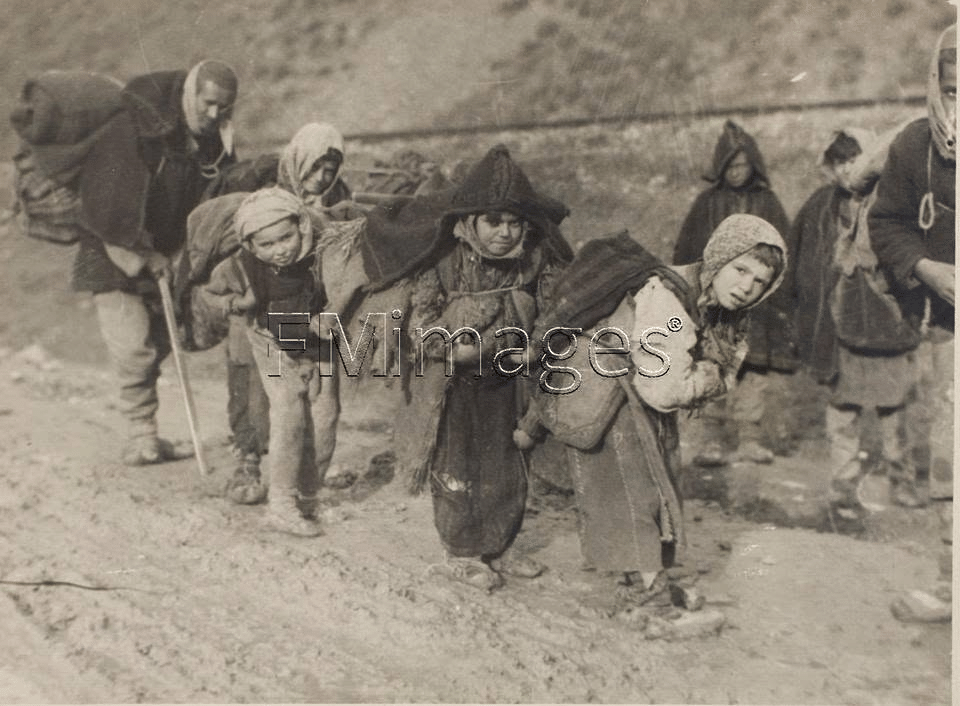

It is the winter of 1877. In the mountains between Niš and Kosovo, thousands of people walk in this snow. Men, women, old people , and children. Some in carts, most on foot. They leave behind their homes, fields, mills, mosques, and graves of their ancestors. A Serbian teacher from Leskovac who saw them with his own eyes later wrote that along the way he had seen the bodies of children and elderly people frozen from the cold. Those people were the Albanians of Toplica, Morava and Niš.
Within a few weeks, hundreds of Albanian villages were empty . Those who survived reached Kosovo, where people called them by a name that has remained to this day, the Muhajirs. Today we will follow this story on the map. We will see where the Albanians of the Niš Sandžak lived, how they were expelled in the winter of 1877 and 1878, where they went, and why they never returned. And how this wound has remained in the names of thousands of Albanian families to this day.
If you open a map of southern Serbia today , you will see names like Niš, Prokuplje, Kuršumlija, Leskovaci, and Vranje – Serbian cities with Serbian populations. Few people know that a century and a half ago, Albanian was spoken in many of these countries . In the valleys around them were hundreds of Albanian villages. There were mosques, mills, bazaars, and families who had lived there for generations. In Prokubull and Kuršumlija, the language of the city was Albanian.
Within one winter, all of this disappeared from the map, not from an earthquake or an epidemic, but from a political decision. This history is less well known than that of Chameria or Kosovo. In Serbian textbooks, the wars of those years are mentioned, but the expulsion of Albanians is not. But for the families of the Muhajirs in Kosovo, this history was never forgotten.
To understand this story, we must first look at the map of the Balkans around 1875. At that time, Serbia was a small, semi-independent principality with Belgrade as its capital. Its southern border was located much further north than today, just below the city of Aleksinac. Everything south of this border was still part of the Ottoman Empire. Just south of the border was the Sandzak of Niš, an Ottoman administrative unit centered in the city of Niš. The Sandzak included the cities of Niš, Pirot, Leskovac, Vranje, Prokuplje and many other places, as well as the valleys of the southern Morava and Toplica. It was a strategic area.
The main road connecting Belgrade with Sofia and Istanbul passed through Niš. The same route that the Romans, Byzantines, and Ottomans had previously used . Whoever controlled the Niš controlled the gateway to the Central Balkans. Who lived in this sanjak? The answer depends on the country. In the rural valleys, especially in Toplica, Kosanicë, Pustarek and Jablanica, the population was predominantly Albanian and Muslim, in compact villages.
Serbs lived mainly near river mouths and on mountain slopes. There were also Albanians in the southern Morava valley, in Masuria and around Vranje. Albanians have been in these lands since at least the late Middle Ages. Serbian and Albanian historians still debate how old this presence was and how much it grew during the Ottoman centuries. But in 1877, the Albanians of Toplica and Morava were a local population with villages, lands, and graves of their ancestors.
Many of them were Muslims like the majority of Kosovo Albanians at the time, and this would determine their fate in the coming war. Even the cities each had their own character. Niš and Pirot were cities where Turkish was mainly spoken. In Leskovaca and Vranje, Turkish and Albanian were spoken. While in Prokuplje and Kuršumlija, the everyday language of the city was Albanian.
Prokuplje was the center of Toplica, a trading town in the valley of the river of the same name, where Shumlia was higher. on the road leading to Kosovo, between the Kopaunik and Radan mountains. Muslim Roma also lived in these cities, and Circassian refugees from the Caucasus, expelled from Russia, settled near Niš in the 1860s. It was a mixed world like many Ottoman cities in the Balkans, mosques and churches, bazaars with traditional crafts, inns for travelers, and villages all around.
A world that within a few months would change forever. By the mid-1870s, the Balkans were awakening. In 1875, a Christian uprising broke out in Herzegovina against the Ottoman Empire. It quickly spread to Bosnia and then to Bulgaria, where the Ottomans suppressed it with great violence. News of the massacres in Bulgaria shocked Europe. Serbia and Montenegro saw an opportunity to expand. They targeted Ottoman lands in the south and had the sympathy of Russia, which saw itself as the protector of the Slavs and Orthodox of the Balkans.
In June 1876, Serbia and Montenegro declared war on the Ottoman Empire. For the Albanians of the Sandzak of Niš, the Serbian border was only a few hours away. The war would take place right on their doorstep. The first war did not go well for Serbia. The Serbian army led by Russian General Mikhail Chernyaev was disorganized and unprepared. In the fall of 1876, the Ottomans defeated him near Gjilan and threatened the route towards Belgrade. Serbia was saved by Russia.
The Tsar sent an ultimatum to Istanbul and the Ottomans were forced to stop. In February 1877, peace was signed and the borders remained as before. In this first phase, the border of the Sandzak of Niš did not change. The Albanians of Toplica and Morava remained in their homes, but something had changed. Now everyone knew that Serbia was targeting precisely these lands.
During the 1876 war, some Llapi Serbs in Kosovo also fled to Serbia. The movement of populations in both directions had begun. The peace did not last long. In April 1877, Russia declared war on the Ottoman Empire. Russian armies cross the Danube and enter Bulgaria. For months they stood in front of the Pleven castle, where the Ottomans resisted tenaciously. But on December 10, the pleveni fell.
The road to Istanbul was open. Russia asked Serbia to re-enter the war. This time Serbia was not alone. Behind her was the largest army in Eastern Europe, and the Ottoman Empire was collapsing on all fronts. In Belgrade, Prime Minister Jovan Ristić saw this as a great opportunity. He didn’t just aim for the Niš, he aimed for a greater Serbia and, according to historians who have studied his politics, a Serbia without Muslims. On December 15, 1877, the Serbian army crossed the border.
The plan was simple and clearly visible on the map. Part of the army would attack towards Niš, the capital of Sandzak. Another part would block the road between Niš and Sofia so that the Ottomans could not send for reinforcements. This meant that the Serbian army would pass right through the Toplica and Morava valleys, exactly where the Albanian villages were . The Toplica Valley starts from the mountains near Kuršumlija, descends eastward, passes through Prokuplje and joins the southern Morava just south of Niš.
Whoever controlled this valley controlled the road between Niš and Kosovo. Therefore, it would be among the first places the army would enter . It was the middle of winter. The surrounding mountains were covered with snow and the roads were difficult. For a winter army it was a hindrance. For a civilian population that would be forced to flee, it was death. Prokuplje fell on the third day of the war.
The Albanians of the city and surrounding villages did not wait. They fled in a hurry towards Pasjača Mountain in the south, leaving behind their livestock and all their wealth. In winter conditions, a peasant family without livestock and without grain had nothing left. We can imagine the scene of those days. Houses with still warm fireplaces, barns full of grain, empty stables, doors left open, families who didn’t know if they would return in a week, a month, or never.
The city that until a week ago spoke Albanian found itself in the hands of the Serbian army. Its mosques, according to Ottoman sources, were destroyed on the map. This is the moment when the first large dot changes color. Prokuplje, the heart of Toplica, crosses into Serbia and from this moment the waves of refugees begin to move south, towards Kosovo. A few days later, Kuršumlija, the southernmost town of Toplica, on the road leading to Kosovo, also fell.
The refugees from Prokuplje had meanwhile reached the southern slopes of Kopaonik. Some of them tried to resist, but were scattered across the surrounding mountains. Now the Toplica valley was all in the hands of the Serbian army, but the Ottomans did not give up. They tried to send troops from the south through Toplica to help the besieged town.
Thus the valley turned into a battlefield. Villages that were in the path of the armies were burned or emptied, and the inhabitants who had still remained, hoping that the war would pass without affecting them, realized that there was no longer any room for them. What happened in Toplica also happened in other valleys. The Serbian army took the villages one after another.
Most of them remained empty . In the Radan and Majdan mountains, southwest of Leskovac, Albanian villages were taken one by one. The refugees retreated further and further south, towards the border with Kosovo. An early 20th-century Serbian historian , Jovan Hadži Vasilijević, wrote openly that the goal of these actions was to create a pure Serbian nation , by cleansing the area of non- Christians. The road was filled with abandoned carts and loot left in the forest.
Those who had animals took them with them, those who didn’t only took what they could carry in their arms. In the middle of winter with small children, this was not enough. Meanwhile, the Serbian army had surrounded the village. The city was protected by the large fortress that the Ottomans had built in the early 10th century on the Nišava River, and the Ottoman garrison resisted for several weeks.
On January 10, 1878, the Ottoman garrison surrendered Niš. Most of the city’s Muslims, Turks and Albanians, left. They fled towards Pristina, Prizren, Skopje and Thessaloniki. The Albanian neighborhood of Niš was burned down . Niš had been an Ottoman city for centuries, with mosques, hammams, and bazaars. Within a few years it would turn into a completely Serbian city.
Before 1878, Serbs were less than half of the population of Niš. Six years later it was 80%. On the map, with the fall of Niš, the entire northern part of Sandžak changes color. After the battle, the Serbian army continued south into the Morava valley. At the Gërdelica Gorge and in Veternica, Albanian refugees tried to defend the road. The Gërdelica Gorge is a narrow passage between the mountains where the Morava River passes through the rocks. It was the last place where the army coming from the north could stop, but their resistance did not last.
The Serbian army crossed the gorge and took Vranje. The city’s Muslims had already left. Here too, according to Ottoman sources, the mosques were destroyed. Just like in Leskovaca and Prokuplje. In the east, the Serbian army also took Pirot, the city that Albanians and Turks called Shehirqoj. The Turks of Pirot fled towards Kosovo, Macedonia and Thera. In a few weeks, the entire sandjak of Niš from Pirot in the east to Kuršumli in the west was in the hands of Serbia.
This was an expulsion in the middle of winter, and winter in the Balkan mountains is unforgiving. Josif Kostic, a schoolboy in Leskovac, was one of the Serbian witnesses of these days. He wrote that the refugees had little clothing and that along the road there were the bodies of children and the elderly, frozen from the cold. Many families never arrived in Kosovo.
Those who arrived came exhausted, hungry, and sick. They had no food, no shelter, no nothing. We don’t know how many died along the way. There are no records of those who remained in the mountains, but many immigrant families in Kosovo have preserved stories for generations about that winter, about children buried in the snow, about the elderly who could not bear the journey, about the houses they saw burning behind them.
If we follow the refugee routes on the map, we see a large movement from north to south. From Toplica, they climbed towards the mountains of Pasjaca and Kopaonik. Others crossed the Radan and Majdan mountains. All of these roads led in the same direction towards the Gallap Mountains on the border with Kosovo. There in the Gallap Mountains their retreat stopped.
On January 31, 1878, Russia and the Ottoman Empire signed an armistice. The fighting ceased and the Serbian army did not advance further. Approximately where the Serbian army stopped, the new border between Serbia and the Ottoman Empire would pass a few months later. A border that separated the Albanians of Kosovo from the lands where many of their brothers had lived until a few weeks ago . This was not simply a consequence of the war, it was political.
Prime Minister Jovan Ristić wanted a homogeneous state, without Muslims. He also saw the Albanian territories as a basis for Serbia’s further expansion towards Kosovo and Macedonia. General Kosta Proti, one of the main commanders of the army, said that Serbia should not have its own Caucasus, in his words. He was referring to Russia’s long war with the Muslim peoples of the Caucasus.
For Proti, an Albanian minority within Serbia was a security threat. Even Prince Milan, the ruler of Serbia, agreed with the expulsion. So do most of the senior army officers. Serbian authorities viewed Muslims as untrustworthy and undesirable and thought they should be replaced with other residents. Revenge for the treatment of Christians by the Ottomans was also used as an excuse, but those who paid were not the Ottomans, but the Albanian villagers of Toplica.
However, not everyone agreed and this part of the story deserves to be told. General Jovan Belimarkov was the commander of part of the Serbian army in the south. When he received orders from Belgrade to crush the Albanians of Masurica, a province near Vranje, he refused. The Albanians of Masurica had not resisted the Serbian army and Belimarkov refused to expel them from their homes.
He even offered to resign. Something similar happened in Jablanica . Shahid Pasha, an Albanian commander from Jablanica, negotiated directly with Prince Milan and managed to get some of the Albanians in the province to remain in their homes. These were exceptions, but they show that expulsion was not inevitable. It was a choice and some people even on the Serbian side refused to make it.
What was happening in Toplica did not remain a secret. Gerald Gult, the British diplomatic representative in Serbia, wrote to his government in London, Lord Salisbury, that the peaceful and hardworking inhabitants of these lands had been mercilessly expelled by the Serbs. He also wrote that the refugees were starving. Gult demanded that the refugees be allowed to return to their homes.
For a time, Great Britain pressured Serbia about this. The Austro-Hungarian consul Jelinek, who was in Kosovo, also sent reports on the situation of the refugees. He also noticed something else, the great anger of the Muhajirs towards the Serbs. An anger that would have consequences. The great powers knew what had happened, but for them the Albanians of Toplica were just a small detail in the great game for the Balkans. How many Albanians were expelled from the Sandzak of Niš?
This is the question that historians still debate today. For almost a century, Serbian historiography accepted geographer Jovan Cvijić’s figure of around 30,000. But this figure is now outdated even for Serbian historians. In 1998, Serbian historian Miloš Jagodić, studying Serbian archives, concluded that the number was much higher. According to him and another Serbian historian, Đorđe Stefanović, about 49,000 Albanians were expelled from at least 71,000 Muslims.
Albanian historians Emin Pllana and Skënder Izaj speak of 60 to 70,000 refugees in Kosovo alone. British historian Noel Malcolm estimates that around 110,000 Albanians lived in this area . Sabit Uka, who dedicated four volumes to this topic, calls this figure minimal, and American historian Justin McCarthy, using Ottoman data, calculates that 131,000 Muslims lived in the Sandzak of Niš in 1877. Six years later, only 12,000 remained.
Most of the emigrants went to Kosovo, which was then the Ottoman vilayet of Kosovo. The map clearly shows where they settled, mainly in Eastern and Southeastern Kosovo, in the areas bordering the new Serbia, in Llap and Gallapa, around Pristina, Podujevo, Vushtrri, Gjilan and Ferizaj. They settled in more than 30 villages in central and southeastern Kosovo and many were dispersed throughout the cities.
Some went further. In April 1878, Consul Jelinek reported about 5,000 refugees in the Prizren district and 2,000 in Gjakova. Others settled in Drenica. Some continued towards Skopje and Macedonia, where Western diplomats reported thousands of Muslim refugee families in extreme poverty, and some ended up in Anatolia, in the Samsun area, on the Black Sea coast.
In 1881, the Ottoman governor of Kosovo estimated that there were about 65,000 refugees in his province . Kosovo was not ready to welcome them. The Vilayet of Kosovo was itself a poor province, weakened by war.
The Ottoman administration had neither food, nor shelter, nor enough money for tens of thousands of people arriving at once in the middle of winter.
The Muhajirs took shelter wherever they could, in mosques, inns, in the homes of relatives, in hastily erected huts . Many local Albanian families welcomed them into their homes, but the need was much greater than the possibilities. In April 1878, Consul Jelinek reported that typhus had broken out among refugees in Kosovo. The disease spread quickly through crowded places with people weakened by hunger and cold.
So after the winter and the journey through the mountains came the third plague, disease. For many families, the first year in Kosovo was the most difficult of their lives. Meanwhile, the great powers were deciding the fate of the Balkans. On March 3, 1878, Russia imposed the Treaty of San Stefano on the Ottoman Empire , in a village near Istanbul. The treaty created a greater Bulgaria stretching from the Danube to the Aegean and gave Serbia and Montenegro new territories.
On the map of San Stefano, other Albanian lands were also given to neighbors. Montenegro took Albanian lands in the north such as Plav, Gucin, and the area around Podgorica. Greater Bulgaria included Korça and Dibra as well as parts of Macedonia where Albanians lived. For Albanians, this was an alarm bell. What had happened to the Muhajirs of Toplica could happen to them too.
If their lands were given to neighboring states, the same story could be repeated, village after village. Thus, on June 10, 1878, Albanian representatives from all over the country gathered in Prizren. The Albanian League of Prizren was born. Figures such as Ilijas Bash Dibra and Abdyl Frashëri were placed at its head. The League demanded that Albanian lands not be given to Serbia, Montenegro, Bulgaria, or Greece.
It was the first time that Albanians, Muslims and Christians from the north and south spoke with one voice about their land. Many Muhajireen supported the alliance. They knew better than anyone what losing land meant. They had experienced it themselves a few months ago. On the map, Prizren and Toplica are only a few days’ journey apart , but between them was now a border and a wound.
And this very wound was one of the reasons why Albanians rose up to defend the rest of the homeland. A month later in Berlin, the great powers of Europe gathered to review the Treaty of San Stefano. On July 13, 1878, the Berlin Congress decided. Serbia became a fully independent state and its border was moved south. Niš, Pirot, Leskovac, Vranje, Prokuplje and many others became part of Serbia. precisely the lands where the pilgrims were from.
On paper, the treaty allowed Muslims to retain property in the annexed lands even if they lived outside Serbia. But no one demanded the return of the Muhajirs and their lands were given to the settlers. Berlin gave Montenegro the Plava and the Kuca. This time the Albanians did not leave. The forces of the League of Prizren defended them with weapons, and the great powers were later forced to give Ulcinj to Montenegro in their place. It was the difference between an unprepared people and a people that had begun to organize. For the refugees, Berlin sealed what the army had done.
Their villages were now officially part of another state and no one in Europe had any intention of giving them back. Serbia called the new lands the new provinces and immediately began populating them with new people. Serbs from central and eastern Serbia, as well as Montenegrins, settled in the empty villages of Toplica and Morava. The Albanian lands were given to them.
The remaining houses were occupied, the others were rebuilt. The few Albanians who remained in the cities, especially the merchants of Niš, were forced to leave after several murders. Their properties were sold at very low prices. In 1879, the refugees of Leskovac sent a petition to the Ottoman authorities. They wrote that their homes, mills, and mosques had been destroyed.
Within a few years, the ethnic map of the Sandzak of Niš was unknown. Where there had been hundreds of Albanian villages, there were now Serbian villages with old names and new people. Not all Albanians left in the winter of 1877. In some areas, especially in Masurice, Jablanica and some villages in Toplica, a small number of Albanians were allowed to remain in groups of villages controlled by Serbian authorities.
General Belimarkovi’s refusal and Shah Pasha’s agreement also had an impact here, but even those who remained did not have peace. In the years that followed, most of them were forced to flee, mainly towards Kosovo. Only in one place did their descendants survive , in the Jablanica valley, around the town of Medvedja. Even today, Albanians live in the municipality of Medvedja.
Together with Presheva and Bujanovac, it is part of the Albanian lands in present-day Serbia. They are the last remnants of a world that once stretched to the gates of the Niš. On the map today we see only small dots. In 1876 it was an entire region. Could the Muhajirs return? For a while this seemed possible. Great Britain pressured Serbia to allow the refugees to return, but the pressure quickly weakened.
The great powers had other problems. The Ottoman Empire was not very interested in their return either. The Muhajirs strengthened the Muslim presence in Kosovo at a time when the Ottomans feared that Kosovo would also be taken from them and Russia actively worked against the return. Russian Vice Consul Ivan Yastrebov advised the governor of Kosovo, Nazif Pasha, not to allow the refugees to return to Serbia.
Thus, the walls remained in Kosovo forever. Their houses in Toplica now belonged to others and the border in the Kallap mountains, which for them had been just an artillery line, became the state border. Such a large wound could not be closed without consequences. In the spring and summer of 1879, groups of Albanian refugees crossed the border and attacked the areas from which they had been expelled to the new Serbia.
Sometimes the Ottoman authorities let them operate. Meanwhile, in Kosovo, the Muhajirs entered into conflict with the locals over land and scarce resources. They also became a group opposed to the Ottoman government that had left them at the mercy of fate. There is also a more difficult part of this story that must be told honestly. Some Muhajirs, angry at what they had lost, took revenge on the Kosovo Serbs who were not to blame for their expulsion. Consul Jelinek had foreseen this.
Thus began a cycle of violence between Albanians and Serbs that would continue for more than a century. Even in Serbia, there were people who saw what this policy would bring . Serbian journalist Mano Đorđević openly condemned the expulsion policy and called for reconciliation between the two peoples. Jurist Živoin Perić wrote in 1900 that if Albanians had been treated fairly, the hostility between the two peoples could have been avoided. And Janik Popov wrote that after these wars, Albanians’ hatred of Serbs tripled.
These voices were few. Belgrade’s policy did not change, but they are important because they show that even then in Serbia itself there were people who understood that the expulsion of Albanians was not a victory, but the beginning of a long conflict. Today, many historians, both Serbian and foreign, consider the 1877–1878 expulsion as one of the roots of the modern Serb-Albanian conflict.
But the history of the Muhajirs did not remain only in books, it remained in the names of people. Many Muhajir families in Kosovo did not take their surname from their grandfather or father, as was customary. They took him from the village where they had lived before the deportation to Toplica or Morava. Thus were born surnames that are common in Kosovo today.
Pllana, Gjikolli, Shulemaja, Rretkoceri, Huruglica, Hergaja, Byçmeti and a surname that tells the story itself. Nišliu, the one who comes from Niš. Every time a Kosovo Albanian introduces himself with one of these surnames, he is unknowingly saying the name of a village that is now in Serbia. It is a living map that no treaty could erase. On our map, we can connect these surnames with the places they come from, from Kosovo, towards the North, beyond Gallap, towards Toplica and Morava.
Today, the descendants of the Muhajirs of Niš are an important part of Kosovo Albanian society. In many villages in Eastern Kosovo, in Llap, Gallap and Ana Morava, a good part of the families originate from the Sandzak of Niš. Researchers note that they are particularly active in politics and economics. They have created associations that preserve the culture of their regions of origin, songs, customs, and family memories.
The Association of Muhajirs of Kosovo has also published studies on the property rights of expelled families. Many families still preserve the stories of their grandparents, the name of the village, the location of the house, the water source, the graves of their ancestors who remain across the border.
There are also broader assessments. According to some researchers, 1/3 to 1/4 of today’s Albanians in Albania and Kosovo have Muhajir ancestors. This figure includes all the waves of migration of the 19th and 20th centuries , not just that of Toplica, but shows how deeply this history has affected the Albanian people. The Muhajirs never returned to their homes, but they never forgot where they came from; for a long time this history was written mainly from one side.
In Serbia, Cvijić’s figure of 30,000 deportees remained official for almost a century. Even today, Serbian textbooks mention the wars of the 1870s, but they do not mention the expulsion of Albanians. On the Albanian side, the most comprehensive studies were conducted in Kosovo. Historian Emin Pllana published his studies on the Muhajirs in the 1880s.
Sabit Uka dedicated his entire life to this topic and in 2004 published four volumes on the expulsion of Albanians from the Sandzak of Niš, the most complete study that exists to date. Over the past few decades, both Serbian historians like Miloš Jagodić and foreign historians like Noel Malcolm have revised this history, acknowledging its true scale. Little by little, the lost map is returning to Libra.
The expulsion of 1878 was not just a closed event. It was a model that would return. In 1937, Serbian academic Vaso Čubrilović presented a memorandum to the Yugoslav government titled The Displacement of the Arnauts, that is, the Albanians. In it, he proposed measures for the removal of Albanians from Kosovo and as an example of success, he mentioned the expulsions of 1877 and 1878.
Meanwhile, the Balkan Wars of 1912 and 1913 had come, when Serbian and Montenegrin armies entered Kosovo and Macedonia and thousands of Albanians were killed or expelled. In the 1950s, tens of thousands of Albanians from Yugoslavia moved to Turkey, and finally came the massive expulsion of 1999 when hundreds of thousands of Kosovo Albanians were forced to leave their homes.
When we see these events on a single map, we realize something important. Toplica was not just the end of the world. It was the first chapter of a long story. Let’s now put the two maps side by side. In the first, the year 1876, the border of Serbia is located north of Niš. To its south, in the valleys of Toplica, Kosanica, Pustarreka, Jablanica and Morrava, hundreds of points indicate Albanian villages.
Prokuplje and Kuršumlijaa speak Albanian. In the second, in 1878, the border of Serbia reached the Gallap Mountains. The villages are still there, but the names of the residents have changed. Of the 131,000 Muslims, according to McCarthy’s calculations, 12,000 remain. And in Kosovo, south of the new border, dozens of new points, villages and neighborhoods of migrants are appearing.
Only two years have passed between the two maps, but the difference we see there remains even today after a century and a half. What remains today of the Albanians of Toplica? Surnames remain in Kosovo, family stories remain, and some Albanian villages remain in Jablanica around Medveđa. Documents remain in the Ottoman, Serbian, British and Austrian archives, and there are books by historians who did not let this history be lost.
There is still one lesson left. When a people has no state, it has no voice at the tables where borders are set, its land can be divided and its inhabitants can be mixed without anyone asking. This happened to the Albanians in 1877–1878 and for this very reason, 34 years later, in 1912, the Albanians declared their own state in Vlora. The Muhaxhirs of Toplica did not see that day, but without their pain, the Prizren League and the entire national movement that followed it would not have been the same.
Often when we talk about Albanian lands outside Albania, we think of Kosovo, Chameria, Presheva, North Macedonia or Montenegro. We rarely think about Niš, Prokuplje or Toplica. The reason is simple. There are no more Albanians there to remind us of them. Their story ended in one winter, and their descendants live in Kosovo today with surnames that few people associate with the places they come from.
But memory matters. A people who do not know their history do not understand the present either. And the story of the muajjirs helps us understand many things. Why was the Prizren League born? Why did Kosovo become the way it did? Why are relations between Albanians and Serbs so difficult? And why are the Balkan borders where they are? In the winter of 1877, tens of thousands of Albanians crossed the Gallap Mountains with what they could carry on their backs.
They lost their homes, lands, and the graves of their ancestors, but they kept the village name, language, and care with them. The next time you meet someone with the surname Pllana, Gjikolli or Nišliu, remember that behind that name is a village in Toplica and a winter that should not be forgotten.
Source
https://www.youtube.com/watch?v=SBQXXwqpN_c