
20 FACTS
www.shqiptarja.com
Sunday, 10 June 2012
RILINDASI
Weekly supplement | SHQIPTARJA.com
SETTLEMENTS | HISTORICAL
by Arben Llalla
For several years now, studies surrounding the origin of the villages in Greece that claim they were inhabited by Orthodox Albanians and Muslims have intensified. In the past and today, many authors have treated these issues, but the majority of them have been assimilated, declaring themselves Greek. Today the truth is that these cities are completely Greek, but the veins and roots of ADN and the Albanian language that still exist in the intermarriages of the population do not erase the origin of the true truth.
In recent years, studies and research have been done by Albanian and Macedonian historians on the Orthodox Albanians of Macedonia who, in the last century, have been distorted in the practice of Albanian identity by the pressure or privileges that were offered by the Slavic-Macedonian state.
The research on the origin of some of these villages in Greece that were inhabited by Albanians, and also some serious ones by Bulgarian, Serbian, Greek and French sources that describe the villages that were inhabited at the beginning of the 20th century by Muslim and Orthodox Albanians. Today it is not only the villages in Macedonia that are listed, but there are also villages that were inhabited by Orthodox Albanians.
Researchers and authors who have been consistent and have published the exact registration of the population at the beginning of the years 1900, who have made the descriptions that the population spoke the Albanian language on the basis of the faith they professed. Many times the identity of Muslim Albanians was as Turkish, while Orthodox Albanians as Greek, Vlach, Bulgarian or Slavic-Macedonian. Nevertheless, today the facts that the Bulgarian population that was registered and studied in the 20th century are not hidden, but the Macedonian Geographic.
Orthodox Albanians of Reka
Special research has been done on the Orthodox Albanians of Reka in Macedonia of that century who were assimilated due to the pressure that the majority exerted that they did not speak their mother tongue.
Historically the first who wrote about the intellectual and madman Josif Bagari who lived in the village of Nistrovo in 1870, the village that was then under the rule of Sanjak of Dibra.
In the last two years, two other Orthodox Albanians have done descriptions of intermarriages and mixed Albanians who declared themselves Slavic-Macedonian. One is Branko Manojlovski who lived until 1941, in the village of Kicinis of Reka with his grandmother Zafira from Manojl.
In the years 1913 and until 1969, Branko Manojlovski and his member Tanashevic, who were Slavic-Macedonian, changed into Tanashevic and Manojlovski. According to the testimony of dr. Baki Ymeri in a writing of those facts about Matej Danili (1909–1993) who was from the village of Shtirovica of Reka.
In 1912, the Danili family emigrated to Bucharest in Romania. Derisa [While] his father Matej Danili knew the origin of the Orthodox Albanians of Reka who were from the villages that preserved the traditional Albanian figures of clothing of that time, Shtirovica…
Another figure of the Academy of Orthodox Albanians is also the researcher of Macedonia, Mate Matevski, for whom all historians who have studied Albanians of Macedonia in their works in the cafes of Orthodox Albanian villages, for whom it is not more serious than the studies of scholars for the intermarriages in the light of this Academy that has the truth of the families of that time is the Albanian language and blood.
I think that the time has come that we take more seriously the studies of the right of Orthodox Albanians who are Catholics of the Albanian language and the roots of the ather that is still alive and not lost.
Names of the villages of Reka that were inhabited until 1900
Thus it is seen that Orthodox Albanians lived only with Muslim Albanians in the same villages that did not have a pure population and other non-Orthodox, Vlachs, Bulgarians, Greeks etc., as is known for the Albanians of Greece and Macedonia of that time.
On the basis of the registrations that were made by the Bulgarian prefectures of the state at the beginning of the years 1900, there are 2861 Orthodox Albanians and 2262 Albanians of the Muslim faith in the villages of Reka. Interestingly, the fact is that Reka has the villages that are inhabited by Orthodox Albanians such as ZLVAJSKO, KICENICA, BELICA. And the villages that were inhabited only by Muslim Albanians such as STIROVICI, 400 Albanian Muslims, STROJE, 300 Albanian Muslims and TANUSHANE with 350 Albanian Muslims. For Shtirovica we have the testimony of Matej Danili (1909–1993) who lived in this village and described the Orthodox Albanian faith, which according to the Bulgarian data of that time were only Muslim Albanians.
Except for Reka, the Orthodox Albanians declared we have a village in Manastir, NIZO POLE (DZINDZO POLE), inhabited by 250 Orthodox Albanians, 1,590 Vlachs Orthodox and 190 Bulgarian Orthodox.
In the region of Kavadarci we have the villages that were declared some inhabited by Albanians such as KONOPISTA, 18 Orthodox Albanians, 710 Bulgarian Orthodox and 14 Romanians, MREZICKO, 6 Orthodox Albanians, 425 Bulgarian Orthodox.
And the conclusion is that these villages that existed at that time of the Albanian and the national institutions, that still have those pure Orthodox Albanian populations and those that these villages may be the places where the pure Albanian population of Geographic Macedonia was preserved more.
Photo captions:
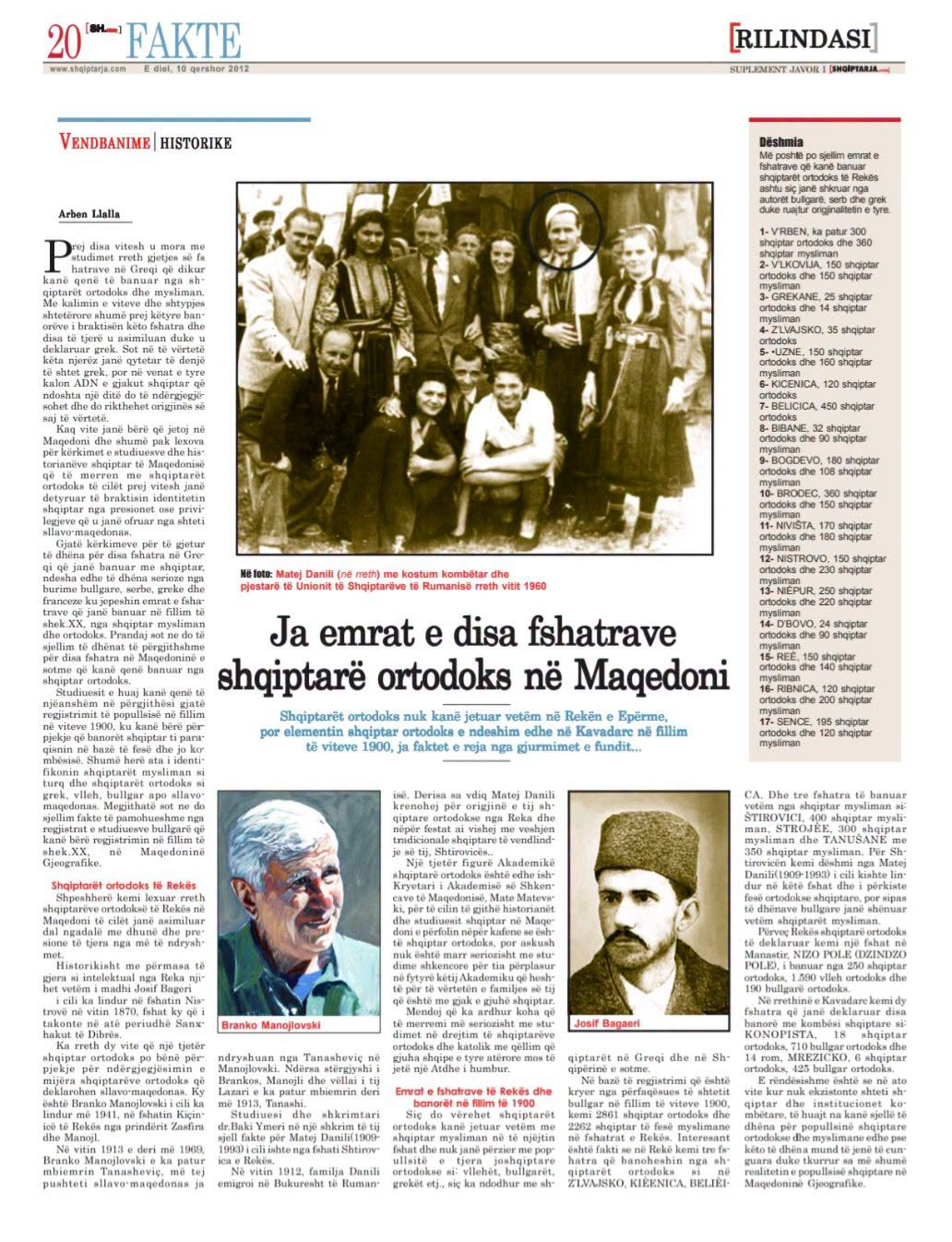
- In the photo: Matej Danili (in the circle) in national costume and members of the Union of Albanians of Romania around the year 1900.
- Branko Manojlovski
- Josif Bagari
Sidebar – Testimony
Below we list the names of the villages that were inhabited by Orthodox Albanians of Reka as they were written by Bulgarian, Serbian and Greek authorities according to the original of the time.
- VRBEN, has 300 Orthodox Albanians and 360 Muslim Albanians
- VLKOVUA, 150 Orthodox Albanians and 150 Muslim Albanians
- GREKANE, 25 Orthodox Albanians and 14 Muslim Albanians
- ZLVAJSKO, 35 Orthodox Albanians
- UZNE, 150 Orthodox Albanians and 150 Muslim Albanians
- KICENICA, 120 Orthodox Albanians
- BELICA, 450 Orthodox Albanians
- BIBANE, 32 Orthodox Albanians and 90 Muslim Albanians
- BOGDEVO, 180 Orthodox Albanians and 108 Muslim Albanians
- BRODEC, 360 Orthodox Albanians and 150 Muslim Albanians
- NIVISTA, 170 Orthodox Albanians and 180 Muslim Albanians
- NISTROVO, 150 Orthodox Albanians and 230 Muslim Albanians
- NEPUR, 250 Orthodox Albanians and 220 Muslim Albanians
- D’BOVO, 24 Orthodox Albanians and 90 Muslim Albanians
- REE, 150 Orthodox Albanians and 140 Muslim Albanians
- RIBNICA, 120 Orthodox Albanians and 200 Muslim Albanians
- SENCE, 195 Orthodox Albanians and 120 Muslim Albanians

