
by Jusuf Buxhovi
Summary
Jusuf Buxhovi argues that the so-called “Code of Dušan” (Zakonik Cara Dušana) is a 19th-century fabrication, not an authentic medieval document. Serbian historiography used it (along with other forged or manipulated sources) to invent a powerful “medieval Serbian empire” under Stefan Dušan in order to justify modern hegemonic claims over Kosovo, Montenegro, and Bosnia.
He states that the Code was pieced together in the 1800s from scattered, unreliable fragments collected in Prizren, Struga, Russian monasteries, and elsewhere, then edited and promoted by scholars linked to the Viennese Slavist school and later by Stojan Novaković. The text mainly copies Byzantine church laws (Nomocanon) rather than reflecting an original Serbian state law.
According to Buxhovi, this myth—supported by the Serbian Orthodox Church and later by the Serbian Academy of Sciences—continues to distort history and influence politics. He calls on Albanian academic institutions to critically re-examine and reject these falsifications.
The hegemonic Serbian policy of Belgrade continues to operate with the notion of “Serbian lands,” referring to the so-called “medieval Serbian state of Dušan,” thereby raising hegemonic claims against Kosovo, Montenegro, and Bosnia. Albanian historiography has failed to demystify this deception, despite the fact that, in accordance with meritorious arguments, the dynasty of Raška is treated as an independent hegemonic feudal formation within the political and social formations of a disintegrating Byzantium, in continuous alliances with the Progons, Kastriots, Balshas, Komneni, Topias, and others.
The disintegration of Byzantium through other autonomous social and political formations (fiefs, županates, and dynasties), such as the “Despotate of Epirus,” the “Despotate of Arta,” and the “Regnum Albaniae” of 1272–1296, and others up to the 15th century when this empire finally collapsed, in those dramatic and highly unstable circumstances regarding social and political realities, brought to the fore, on the one hand, the local factors upon which the interests of East and West for greater influence were perceived and constructed, mainly through the church factor, as was the case with the Catholic Empire of Constantinople after the Fourth Crusade (1204–1264) and the “Despotate of Epirus,” and on the other hand, the claimants to the Byzantine throne, among whom the Nemanjić dynasty of Raška must be distinguished. During the time of Stefan Dušan (1331–1355), it succeeded in becoming the main force of Byzantium, which was also called “Illyricum Magnum.”
Naturally, the Raška factor, viewed in accordance with the realities of the time and outside the interpretations and appropriations by Serbian historiography, Russian historiography, and the Viennese school of Slavists in the 19th century, is freed from the burden of this misinterpretation—that is, of the unscientific appropriation that presents it as the “foundation of the medieval Serbian state”—and likewise strips the Serbian Orthodox Church of the right to appropriate Orthodox Christianity with the liturgy in Old Church Slavonic.
Outside these anti-historical appropriations, Raška and the Nemanjić dynasty regain their historical image, together with the other social and political factors in the space of Dardania, Macedonia, and Epirus, as a hegemonic force in the developments that accompanied Byzantium from the 12th to the 15th century, when it finally collapsed.
The construction of the medieval Serbian state upon the dichotomy of unscientific factors—church and nation—while ignoring the Slavic core from its appearance to its expansion (which is least connected to their historical geography as presented by the Serbs), and at the same time appropriating Slavism as an ethnic conglomerate and converting the ancient peoples—the Triballi, Dardanians, Celts, and others—into Serbs in accordance with the fantasy of the Priest of Duklja from the “Gesta Regum Sclavorum” (Kraljevstvo Slovena) of Orbini, constitutes the spectrum of arguments for overthrowing the falsifications that for a long time were accepted precisely because of the lack of a critical and objective scientific approach toward them.
To argue these distortions, mystifications, appropriations, and the most varied falsifications on the basis of a great-state platform and a Slav-Orthodox hegemonic ideology that appeared from the Načertanije of 1844 up to the programs of the Serbian Academy of Sciences and Arts of 1937, 1944, and most recently of 1986, the focus falls on the reflection of the falsification of medieval documents by the Serbian Orthodox Church in accordance with the great-state and hegemonic concepts projected in Russia from the mid-18th century.
The starting points are those of Byzantine authors, then the hagiographic literature, with particular emphasis on the efforts to present the Nemanjić dynasty and Raška as the “foundation of the medieval Serbian state” outside the temporal contexts and outside the social and political relations of those circumstances, while the Church of Raška is allegedly given autocephaly from the Middle Ages.
Although it was a matter of a temporary separation (autonomy) from the Bishopric of Ohrid, to which it would soon be reattached, and to which the liturgy in the Serbian language is even attributed—even though it is known that this was an old Church language (“Staro crkveni jezik”—an amalgam between Slavic and Bulgarian)—because a Serbian language would only emerge in the second half of the 19th century after Vuk Karadžić formed it with the help of the Viennese Slavist school.
Of this nature are also many of the “monographs” on Serbian church life as well as the biographies concerning the life and work of the Nemanja dynasty, rewritten or falsified, always with the unscientific justifications of their “processing,” in accordance with hegemonic positions.
Among these narratives based on hagiography (church literature), the publications Sveti Sava – Sabrana Dela published by T. Jovanović (Belgrade, 1998), Stevan Prvovenčani – Sabrana dela by Georgievski-Jovanović, then Životopis Svetog Save by Teodosije Hilandarski, as well as the work of Konstantin the Philosopher Povest slovena – Žitije despota Stefana Lazarevića (Belgrade, 1989) stand out. It is accepted that these were fabricated in Odessa in the 18th century according to some accounts of local priests!
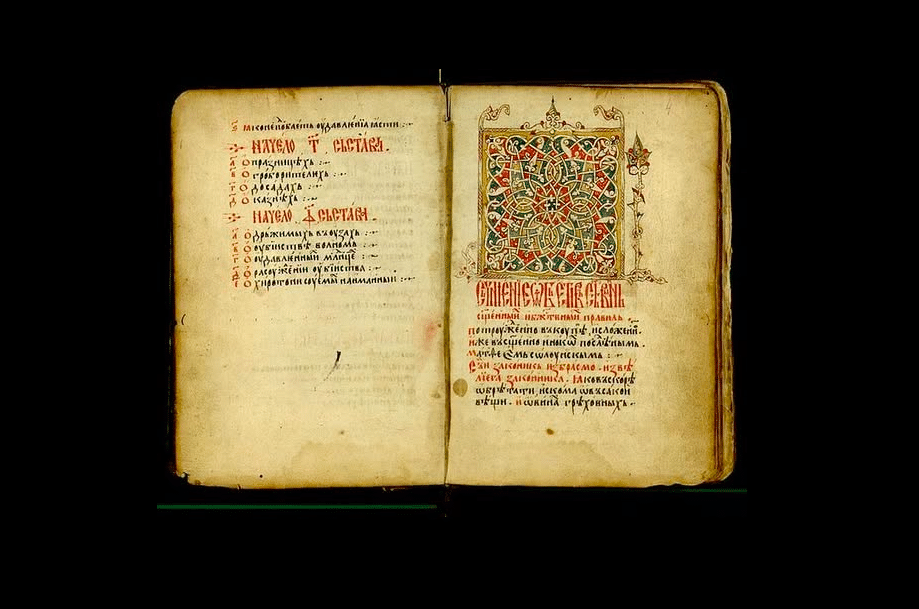
Something similar happens with the “emblematic” work of S. Novaković, Zakonik Cara Dušana, cara srpskog 1349–1354 (Belgrade, 1870). In its preface it is admitted that “the medieval Code does not exist, but it has been pieced together from accounts in the 19th century in Prizren and its surroundings, as well as from some texts from churches in Wallachia and Russia (St. Petersburg), which Šafárik connected in Vienna in 1859.”
The way this work was elevated to the level of a state and legal “testament” of Stefan Dušan’s “Empire” in the service of creating the ideological and political platform of the medieval Serbian state for political needs in the 19th century—which would precede its acceptance on the political map of Europe at the Congress of Berlin in 1878—its translation into several languages and distribution through the main European centers, best shows the interconnection of many external and internal factors in its construction through the fabrication of supposedly scattered documents without scientific credibility.
This form of patching together “documents” “hidden” in churches and “forgotten” libraries is best reflected in Novaković’s work. The author, nevertheless, wishing to demonstrate the “antiquity” of this work—which he clearly knows is missing—relies on several layers of fabrications and processings of texts that aim at “bringing to light” “authentic documents” by constructing the “lost parts”!
As stated earlier, the basis for this work were the workshops of various churches, primarily those at Hilandar and others in Russia, in order to distribute the processed and retouched documents to Vienna, to the well-known school of Slavists, from where the “meritorious documents” were then treated by various scholars to create the “dossiers” such as Monumenta slavica and later Monumenta serbica and others amputated into all the “medieval documents” with which the histories of the Serbs, Bulgarians, and Russians were fed with “authentic documents.”
The author of the Zakonik, in the preface, reveals the technology and infrastructure of the processing and falsification of documents when he deals with the “history” of the Code, which necessarily connects with Vienna and the work of the scholars there, primarily the Slavic or Serbian ones.
Thus, the starting point of the Zakonik begins with J. Rajić in 1859 in the publication Istorija slovenskog naroda, then is transferred to Miklosich, who presents it in German as Lex Stepani Dušani (Vienna, 1856), from where it reaches P. J. Šafárik, who includes it in the book Památky drevního písemnictví jihoslovanského (Prague, 1860).
Šafárik did not present the text integrally, because it did not exist, but presented it in 9 different manuscripts with the claim that they are “fragments discovered in various monasteries (Ravanica, Rudnik, Kazan, and others)” allegedly from 1350 to 1700, among which an important place is occupied by the text from St. Petersburg of N. Nadezhdin, known from the Bistrica monastery in Wallachia.
These texts, neither linguistically nor in content, form the entirety of a code, something that Šafárik himself admits. But Novaković, in his edition, connects Šafárik’s fragments with two “authentic” texts from the 19th century. One from Struga, collected by a Russian priest, and the other from Prizren, also collected by a priest named Sime.
The text from Prizren, allegedly from the 15th century, was sent to Belgrade by the teacher from Smederevo, Nikola Maslin, from where, after being processed in Vienna, it was handed over to Novaković to bring it to light. Naturally, Novaković tried to reflect the documentary “credibility” of the work with Šafárik’s texts in Old Church Slavonic mixed with Serbian.
In the preface, Novaković explains the origin of the texts and their collection from hand to hand, which according to him complete the Code and its spirit. Thus, the 165 leaves (listina) come from 16 different collectors whose names are unknown, except that it is said that a large part of them were rewritten by 6 clerics and two deacons in Prizren.
Since the first edition of 1870 had many inconsistencies and as such did not sufficiently meet the basic criteria to be taken seriously, Novaković, after being appointed president of the Royal Serbian Academy in 1886, appears with the second “supplemented” version of the “Code” with some “rediscovered” fragments of the Struga version from the 14th century and the Prizren version from the 15th century.
It includes 106 articles, which represent nothing other than a direct transfer (copying) of Byzantine church legal acts (Nomocanon), which were part of Roman-Byzantine law in accordance with Justinian’s Code, but which regulated property issues in the relations of the church with the Empire, where it participated in the administration of church and local properties.
To these articles from the Byzantine code are added other parts where relations with church rites (with Catholics) are amputated, and where some decrees appear that determine the behavior of churches, and where demographic registers of the population are not lacking, in which, alongside the majority “Serbian” population, as a minority appear the “Arbanas katuns” (arbanaski katuni) and the “Vlach katuns” (vlaski katuni).
It is not surprising the scenario of the “demographic picture” of the population of “Dušan’s Empire,” where at that time there was no national affiliation but only ecclesiastical: of the Orthodox rite (with the language of the Old Slavonic and Greek church liturgy) and of the Latin rite (with the language of the Latin church liturgy)! But it is surprising that this anti-historical and anti-scientific construct, fabricated by the Serbian Orthodox Church and 19th-century Serbian historiography for hegemonic purposes, has been accepted “as scientific truth” and has almost served all the designs of supposedly national relations in the imagined medieval Serbian state, where there were also some “Arbanas katuns” (Catholic) and Vlach ones.
Thus, this falsified dictate of the so-called “medieval Serbian state,” thanks to the “verification” by the historians, linguists, and ethnographers of the well-known Viennese school of Slavists, has been accepted by a good part of world historiography.
Even in the work of the historian Noel Malcolm, Kosovo: A Short History, in the Middle Ages the Albanians in Kosovo appear “as a minority population,” while the Serbs are the majority—a ratio that would change somewhere in the 18th century after the Great Serbian Migration! This anti-historical discourse, transferred also to the ideological historiography of former Yugoslavia, continues to be fully copied even by Albanian historians (on both sides of the border).
Although the fall of former Yugoslavia, with the emergence of the independent states of Croatia, Slovenia, Macedonia, Bosnia and Herzegovina, Montenegro, and finally Kosovo, changed the state realities, whereby among many of these peoples the deconstruction of the “matrix of Yugoslavism” based on the platform of Garašanin’s Načertanije and its “historical” epicenter—the Medieval Kingdom of Dušan—began, nevertheless among the Albanians, on both sides of the border, the dictate of Greater Serbian historiography continues to a large extent—a dictate that, with the reactivation of the syntagm of the “Serbian world,” continues to hold Kosovo (and also Albania) politically and culturally hostage.
Therefore, the academic scientific institutions in both Albanian states have the burden of undertaking organized research-scientific steps to free themselves from the dictate of the falsifications of hegemonic Serbian historiography. Although this, based on hundreds of works of this nature created by the Serbian Academy of Sciences over the last century, is not easy work, nevertheless the drafting of a clear platform for the revision of history in accordance with scientific truth is necessary.
Source
(Excerpt from “Dardania – Antiquity, Middle Ages,” published by “Faik Konica” – Prishtina and “Jalifat Publishing” – Houston, 2020)