
Albanian traditional singing includes powerful northern mountain calls (often popularly called “throat singing”) and the better-known southern iso-polyphony. These are distinct regional vocal practices rooted in landscape, community, and oral transmission.
Albania’s vocal traditions divide along geographic and dialect lines. In the south (Tosk and Lab regions), iso-polyphony is the dominant form: a multipart a cappella style built around a sustained drone (iso). In the north (Gheg highland areas, including Rugova in Kosovo and the northern Albanian mountains), singers practice high-powered monophonic or call-and-response mountain songs known as kângë majekrahi (“songs over the arm”) or kângë malësorçe (“highland/mountain songs”).
Northern Mountain Singing (Majekrahi / “Throat Song”)
This tradition is primarily monophonic (or antiphonal call-and-response) and functional. Singers historically used it to communicate across mountain slopes: announcing deaths, warning of strangers or enemies, signaling weddings or movements of flocks, or exchanging epic or heroic verses.
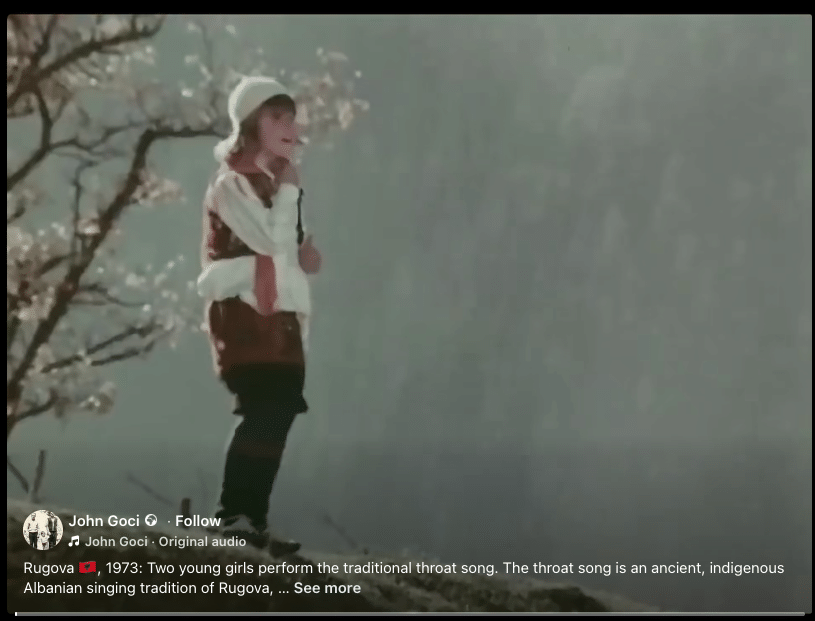
Performers often stand on high ground, raise an arm, place a hand or finger near the ear or cheek (to focus hearing and control pitch/timbre), and project a high, penetrating, melismatic cry that can include falsetto, free rhythm, ornaments, interjections, and extended tones.
Rugova highland examples (including archival footage of young performers) are frequently presented online as “traditional throat song” precisely because of this long-distance, throat-powered projection from slope to slope.
Southern Iso-Polyphony
UNESCO-listed (Masterpiece 2005; Representative List 2008), this is the multipart tradition of southern Albania (Labëria, Toskëria, Çamëria, Myzeqe).
Typical structure:
- A lead voice (marrës / “taker”) begins the melody.
- A second voice (kthyes / “turner”) answers or counters.
- Optional higher ornamental or “throwing” voice (hedhës).
- A group holds the continuous or rhythmic iso drone.
Songs are usually performed without instruments at weddings, funerals, harvests, and festivals.
Analysis of a Facebook Video
The Facebook video is associated with Albanian traditional vocal performance. Related Rugova footage shows northern-style mountain singing: high, piercing, sustained or melismatic vocal lines projected across open spaces, often with characteristic posture and free rhythmic delivery.
Video of Albanian throat singing in Rugova
https://www.facebook.com/reel/2403225187164598
Relevant terminology:
Projection and resonance: Strong vocal projection with nasal or throat resonance.
Melisma and ornament: Extended notes with slides, microtonal inflections and vocal ornaments.
Spatial aspect: Call-and-response singing that uses natural echoes and distance.
Functional aesthetics: The sound prioritizes emotional force and carrying power.
Embodiment: Posture and hand placement help singers monitor pitch and volume.
Albanian traditions illustrate intense, resonant vocal practices. The northern mountain style and southern iso-polyphony stand as distinct contributions rooted in signaling, lament, and communal song. Both continue to be performed, recorded, and safeguarded, remaining living links between voice, place, and identity.