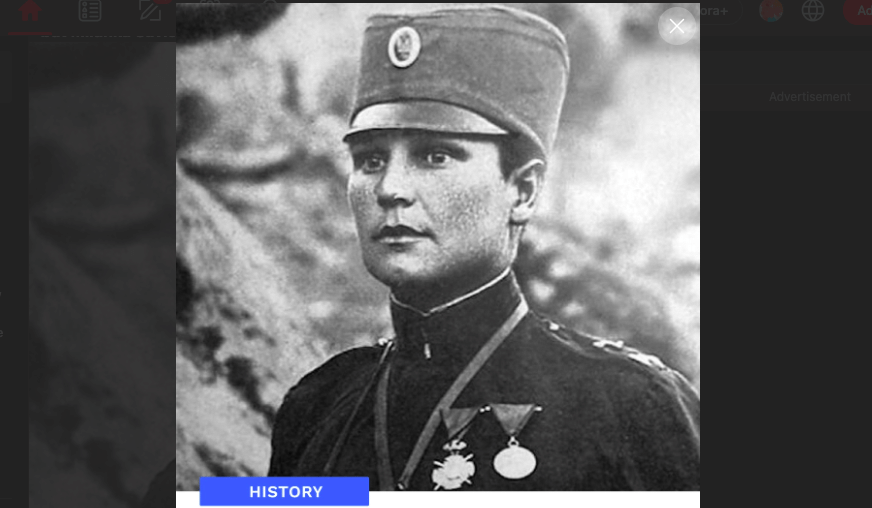

A recent popular history piece celebrates Milunka Savić as the “Serbian Mulan,” a woman who cut her hair, disguised herself as a man, took her brother’s place, and became a highly decorated combatant in the Balkan Wars and World War I. The text dwells on her battlefield exploits, medals, the moment her gender was discovered yet she was allowed to continue fighting, and the respect she allegedly earned even from enemies. It frames her as a special case of female martial valor in an era when most women soldiers were expelled once discovered.
Methodologically, this is classic nationalist historiography. It isolates an individual’s courage and turns it into national myth while systematically excluding the political purpose, scale of civilian suffering, and expansionist character of the wars in which she fought. The result is not balanced history but a curated performance of national virtue.
The Balkan Wars: Expansion, Not Abstract Heroism
The First Balkan War began in 1912 when the Balkan League—Serbia, Montenegro, Bulgaria, and Greece—attacked the Ottoman Empire to seize its remaining European territories. Serbia was a central actor pursuing territorial enlargement under the banner of national unification and Greater Serbia. These were wars of conquest, not pure self-defense. The Second Balkan War followed immediately as the former allies turned on one another over the division of the spoils.
During and after these campaigns, large-scale violence was directed against Muslim civilian populations (Turks, Albanians, and others). Demographic reconstructions, including work by Justin McCarthy drawing on Ottoman records, estimate hundreds of thousands of Muslim deaths in the conquered regions—figures on the order of 600,000 or more when disease, starvation, and massacre are combined—along with massive forced exile.
Focused estimates on Albanians put the death toll in the Balkan Wars period at least around 120,000, with many sources citing higher numbers for the broader 1912–1915 window of Serbian and Montenegrin operations in Kosovo, northern Albania, and adjacent areas. Villages were burned, populations expelled, and demographic engineering pursued to secure newly claimed territories.
The celebratory text about Savić never mentions this. Instead of confronting the civilian catastrophe that accompanied Serbia’s territorial gains, it invites readers to admire a young woman cutting her hair short and throwing grenades.
Personal bravery is real and documented; elevating it into uncomplicated “heroism” while erasing the imperial and often genocidal context of the campaigns is an act of selective memory. It is the nationalist habit of declaring soldiers—especially photogenic or exceptional ones—heroes of wars that killed large numbers of non-combatants belonging to other groups.
World War I and the Continuation of the Pattern
The same pattern repeats with World War I. The text treats Savić’s further service, decorations, and single-handed captures as further proof of heroism. Serbia’s role in the outbreak is more complex than a simple claim that “Serbia started” the war: the assassination of Archduke Franz Ferdinand by a Bosnian Serb linked to elements of the Serbian Black Hand provided the spark, Austria-Hungary issued an ultimatum and declared war, and alliance systems then engulfed Europe. Once invaded, Serbia fought a desperate defensive struggle and suffered catastrophic losses relative to its population.
Yet the broader trajectory remains continuous with the Balkan Wars: Serbian state and nationalist aims involved expansion and the subordination of other populations in the region. Celebrating individual combat performance without addressing the political project or the parallel civilian suffering (including continued violence against Albanians in occupied areas) again privileges national self-regard over comprehensive accounting.
Narcissistic Selection and National Chauvinism
What the original text exemplifies is an extreme form of narcissistic historical selection. Nationalist writers across many societies do this: they extract acts of personal courage by “our” soldiers, especially women who defy gender norms, and present them as the moral essence of the nation.
The surrounding reality—wars of territorial aggrandizement, mass civilian deaths among Muslims and Albanians, demographic transformation of conquered lands—is treated as incidental or invisible. The focus stays on the Serbian woman who fought “for her country,” never on the scale of the tragedy inflicted in the name of that same project.
This is not unique to Serbian historiography. Parallel practices exist in almost every national tradition that has conducted expansionist or ethnic wars. The methodological failure is the same: heroism is defined internally, by the standards of the combatant’s own side, while the justice of the war, the agency of the state in initiating aggression, and the bodies of the defeated civilians are pushed outside the frame. The result is a sentimental nationalism that converts chauvinism into virtue and turns selective memory into moral capital.
A more rigorous approach would hold both truths at once: an individual soldier can display remarkable personal courage, and the wars she fought in can still have been expansionist projects that produced large-scale civilian catastrophe. Refusing to separate the two is how nationalist writing manufactures heroes while shielding the historical record from scrutiny. The story of Milunka Savić, stripped of context, is not neutral celebration. It is a choice about whose suffering counts and whose does not.