
Discovery by Artur Vrekaj.
Summary of “Dedicated Relief Worker or Con Man?” by William H. Waggoner
Philatelist William H. Waggoner, a collector of U.S. Consular Service Fee stamps, acquired a large 1915 U.S. passport (and related French military visa annex) issued to William Willard Howard. The documents, covered in stamps, visas, and notations, document Howard’s wartime travels and prompted the author to research the man behind them.
Howard’s passport, issued 13 October 1915 in Washington, D.C., authorized travel to Italy en route to Albania for “Relief Work.” It was later amended and extended. His itinerary (reconstructed from the markings) took him from Liverpool (October 1915) through France and Italy to Albania (where a December 1915 New York Times report described him distributing flour in Durazzo as secretary of an Albanian Relief Fund), then via Switzerland, France, and Spain before returning toward the United States in April 1916.
Earlier research showed Howard as a writer and occasional adventurer: late-19th-century magazine pieces, a dramatic 1895–96 failed attempt to deliver relief in Armenia (he turned back after ambushes and threats), and a 1914 letter appealing for Albanian aid after the Balkan Wars. He later appeared associated with Balkan relief efforts in New York.
A darker episode emerged in 1926–27: after a major Florida hurricane, Howard ran the “Florida Relief Service” from New York and Connecticut addresses. The Florida State Chamber of Commerce publicly warned that it appeared to be a commercial venture selling goods (supposedly made by hurricane victims) with little or no actual relief activity; charitable oversight groups declined to endorse him. Howard dismissed the criticism and continued.
His 1933 New York Times death notice called him a retired newspaperman who had done Red Cross work in Syria—claims that conflict with the available record (including his age). Residences also do not fully align.
Waggoner leaves the central question open: Was Howard a sincere (if imperfect) relief worker, a con man who exploited charitable causes, or something more enigmatic? The author notes that the fragmentary, contradictory record would make a compelling mini-series.
As a longtime collector of U.S. revenue stamps, I have a particular interest in the Consular Service Fee issues (Scott RK class). I also exhibit these stamps and am always on the lookout for documents bearing them to include as examples of their use. Passports are among the more useful types of such documentation because they can involve a variety of consular services for which the official charges were receipted with cancelled fee stamps.
Some time ago I acquired two documents—a World War I-era U.S. passport and a related French annex—that I intended to incorporate into an exhibit. Both proved to be too large but, taken together, the many markings, notations and visas inscribed on them revealed a fascinating wartime journey that led me to investigate the traveler.
(The current U.S. passport is a small, pocket-sized, booklet printed on heavy paper. It contains a picture and basic biographical data plus a score or more of blank pages reserved for visas and entry/departure notations. But 90 years ago, it consisted of a single sheet of heavy safety paper, approximately 12 x 17 inches in size. Basic information was recorded only on the front side. Visas and other notations were placed anywhere there was room, but generally on the reverse.)
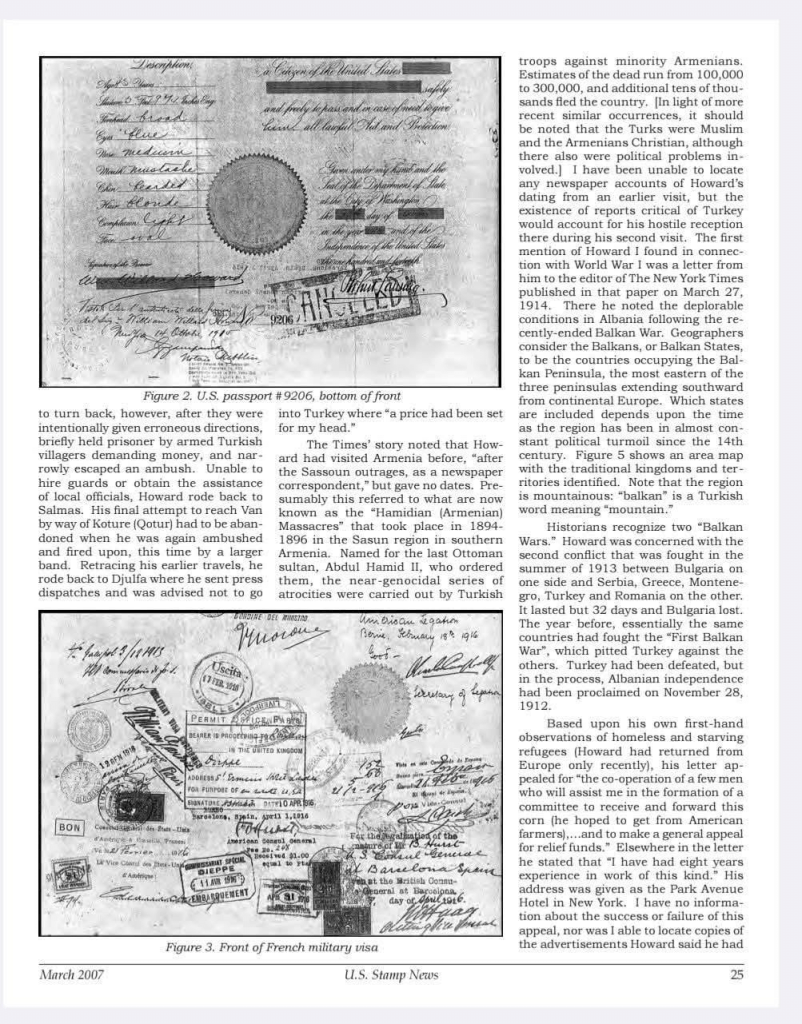
Figure 1 shows the front of U.S. passport numbered 9206 (reduced). It was issued on October 13, 1915. Valid for six months (but renewable as noted at upper right), it approved the bearer’s declared intention to visit “Italy en route to Albania” to do “Relief Work.” Below the photograph is the amendment approved on Feb. 15, 1916, by the American Ambassador to Italy in Rome allowing him to visit Switzerland and Spain on his return trip.
To the right (above the $1 fee stamp) is the typewritten notation added by the American Consul General at Barcelona, Spain, on April 1, 1916, that extended the passport’s validity for six months. The photograph of the man to whom the passport was issued is tied by his signature—Wm. Willard Howard—in addition to the impressed seals of the Department of State of the United States.
Elsewhere, Howard is described as being 45 years old. His home address was neither requested nor stated, but the notary’s authentication (lower left) was done in Bronx County, New York, the day after the passport was issued in Washington, D.C.
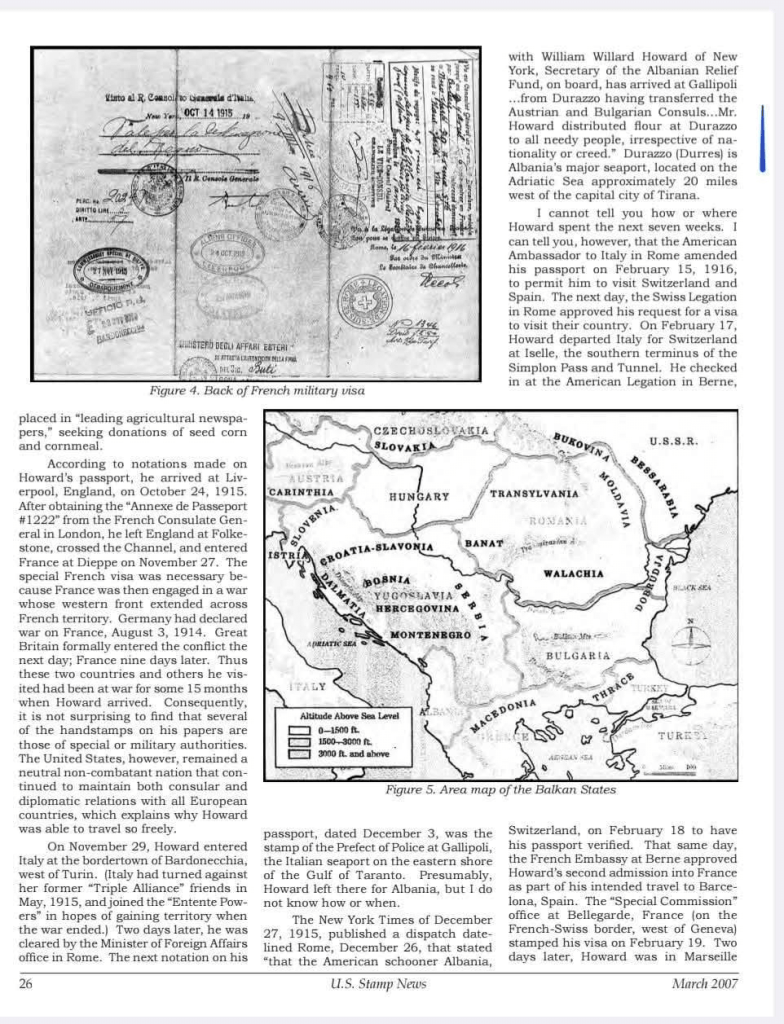
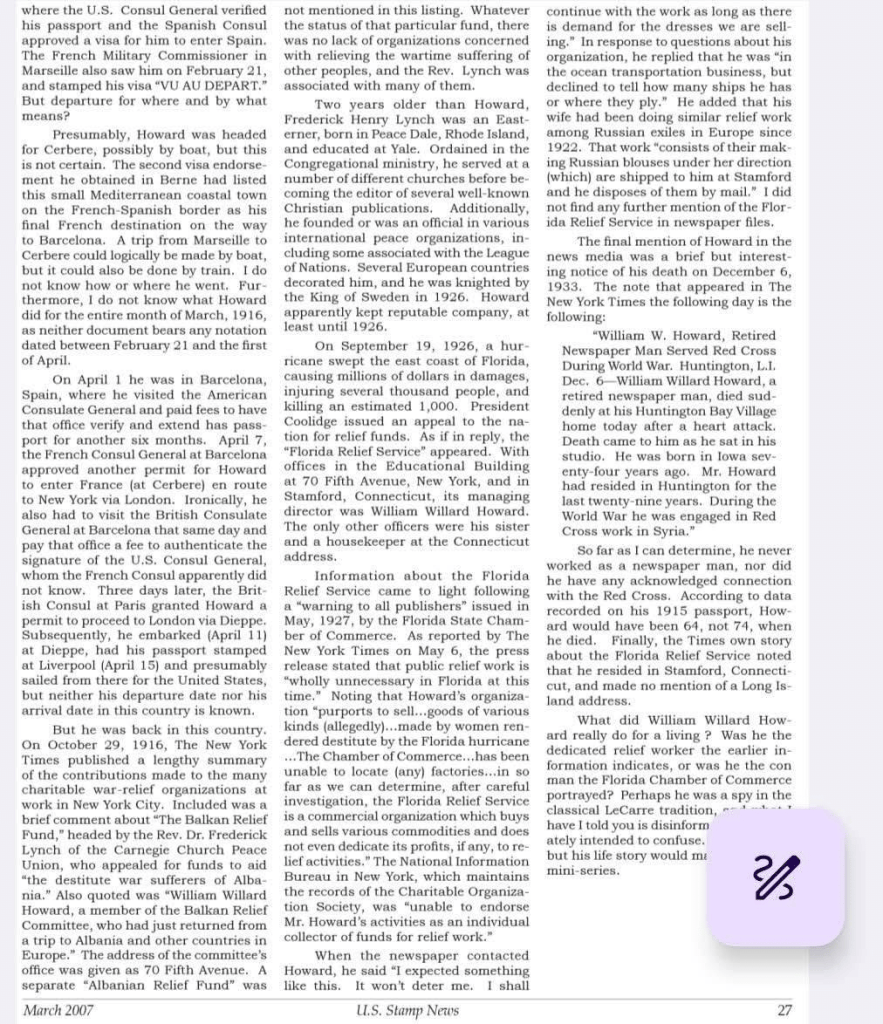
Figure 2, page 25, shows the bottom of the same document (slightly reduced). Readily visible are numerous dated handstamps, both British and American consular stamps (a total of five), and an assortment of notations. Note particularly the notation “MILITARY VISA CONFIRMED” stamped at an angle in black and signed in Paris (above the two fee stamps at lower left).
Consisting of a separate two-sided form, this visa is shown in Figures 3 (page 25) and 4 (page 26). When the locations recorded on the passport and military visa are considered together in chronological order, you should be able to reconstruct Mr. Howard’s European travels. Before I attempted to do that, however, I wanted to know more about the man.
Web sites yielded several citations of Howard’s early published works, none of which had anything to do with relief work, but did apparently confirm that he had worked as a writer. [Harper’s Weekly published two articles by him in May 1889 that had to do with the settlement of Oklahoma; Outing Magazine published a short paper on “Ice Yachting” in 1890; and The Century magazine listed him as the author of two different reports, “Hunting the Jaguar in Venezuela,” in July 1897, and “The Cuban as a Labor Problem,” in August 1899.]
The first mention of W.W. Howard I found that had to do with relief work was a report in The New York Times of March 19, 1896 of his return to New York City the day before aboard the White Star Line’s steamship, Teutonic, following an aborted attempt to distribute relief supplies in Armenia. Interviewed at the Astor House the night of his arrival, Howard recounted a tale that could have come directly from Burton’s Arabian Nights.
After leaving New York on September 28, 1895, he had traveled through London, Paris, Berlin and Warsaw to Odessa where he took a steamer across the Black Sea to Batoum. From there he went by train to Tiflis (Tbilisi) and Akstafa where he hired a four-horse carriage and followed the Russian post road 250 miles south to Djulfa (Dzhulfa). By changing horses every 15 miles, Howard completed that leg of his journey in two days.
The remainder of his trip was on horseback—southeast approximately 80 miles to Tabriz (Persia; now Iran) and another 100 miles west to Salmas, near the Turkish border. From Tabriz to Salmas, Howard was accompanied by a Nestorian servant and a Persian dragoman he had hired locally. He intended to ride on to Van (in Turkish Armenia) to complete the journey. He decided to turn back, however, after they were intentionally given erroneous directions, briefly held prisoner by armed Turkish villagers demanding money, and narrowly escaped an ambush. Unable to hire guards or obtain the assistance of local officials, Howard rode back to Salmas.
His final attempt to reach Van by way of Koture (Qotur) had to be abandoned when he was again ambushed and fired upon, this time by a larger band. Retracing his earlier travels, he rode back to Djulfa where he sent press dispatches and was advised not to go into Turkey where “a price had been set for my head.”
The Times’ story noted that Howard had visited Armenia before, “after the Sassoun outrages, as a newspaper correspondent,” but gave no dates. Presumably this referred to what are now known as the “Hamidian (Armenian) Massacres” that took place in 1894–1896 in the Sasun region in southern Armenia.
Named for the last Ottoman sultan, Abdul Hamid II, who ordered them, the near-genocidal series of atrocities were carried out by Turkish troops against minority Armenians. Estimates of the dead run from 100,000 to 300,000, and additional tens of thousands fled the country. [In light of more recent similar occurrences, it should be noted that the Turks were Muslim and the Armenians Christian, although there also were political problems involved.]
I have been unable to locate any newspaper accounts of Howard’s dating from an earlier visit, but the existence of reports critical of Turkey would account for his hostile reception there during his second visit. The first mention of Howard I found in connection with World War I was a letter from him to the editor of The New York Times published in that paper on March 27, 1914. There he noted the deplorable conditions in Albania following the recently-ended Balkan War.
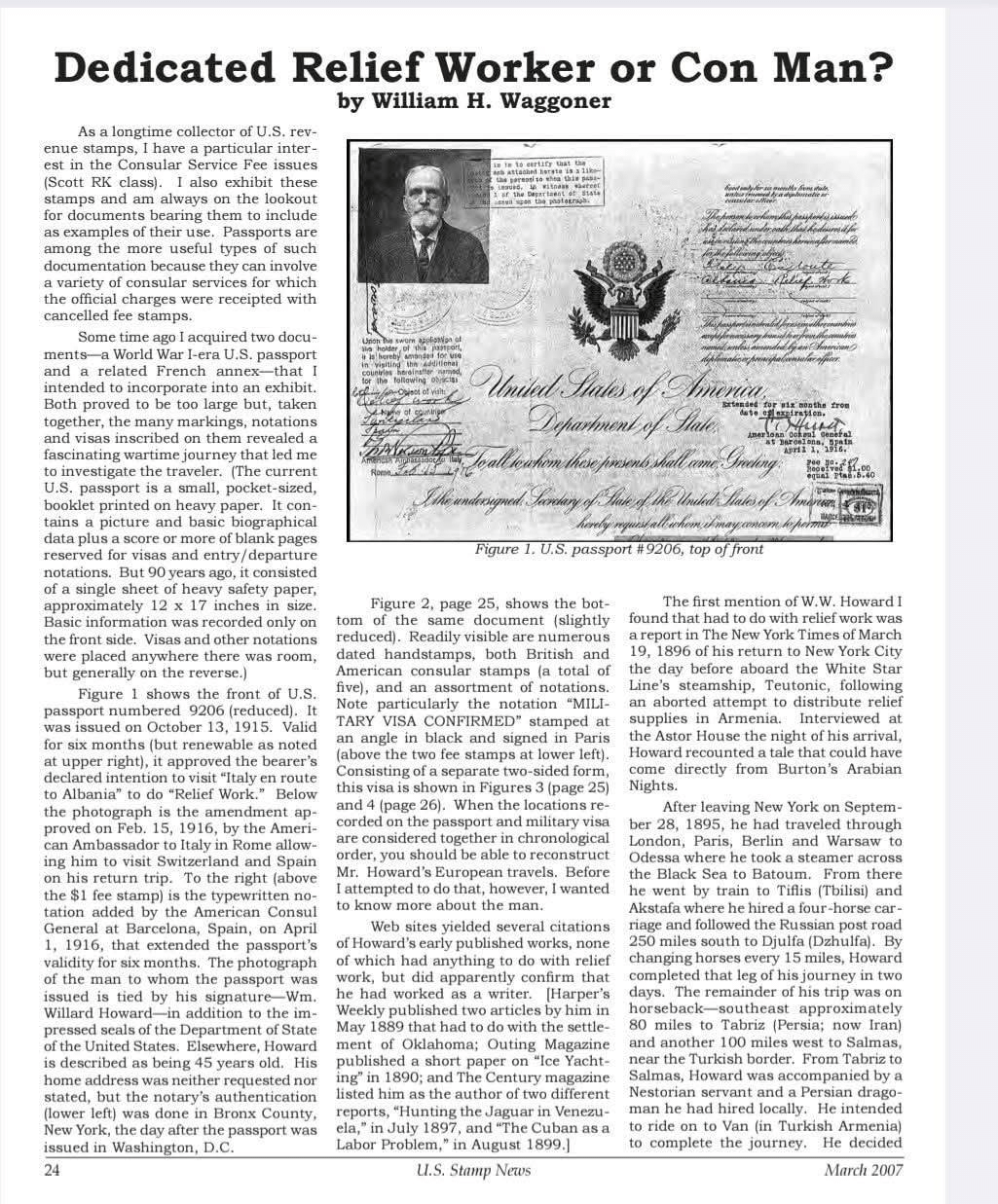
Geographers consider the Balkans, or Balkan States, to be the countries occupying the Balkan Peninsula, the most eastern of the three peninsulas extending southward from continental Europe. Which states are included depends upon the time as the region has been in almost constant political turmoil since the 14th century. Figure 5 shows an area map with the traditional kingdoms and territories identified. Note that the region is mountainous: “balkan” is a Turkish word meaning “mountain.”
Historians recognize two “Balkan Wars.” Howard was concerned with the second conflict that was fought in the summer of 1913 between Bulgaria on one side and Serbia, Greece, Montenegro, Turkey and Romania on the other. It lasted but 32 days and Bulgaria lost. The year before, essentially the same countries had fought the “First Balkan War”, which pitted Turkey against the others. Turkey had been defeated, but in the process, Albanian independence had been proclaimed on November 28, 1912.
Based upon his own first-hand observations of homeless and starving refugees (Howard had returned from Europe only recently), his letter appealed for “the co-operation of a few men who will assist me in the formation of a committee to receive and forward this corn [he hoped to get from American farmers],…and to make a general appeal for relief funds.” Elsewhere in the letter he stated that “I have had eight years experience in work of this kind.”
His address was given as the Park Avenue Hotel in New York. I have no information about the success or failure of this appeal, nor was I able to locate copies of the advertisements Howard said he had placed in “leading agricultural newspapers,” seeking donations of seed corn and cornmeal.
According to notations made on Howard’s passport, he arrived at Liverpool, England, on October 24, 1915. After obtaining the “Annexe de Passeport #1222” from the French Consulate General in London, he left England at Folkestone, crossed the Channel, and entered France at Dieppe on November 27. The special French visa was necessary because France was then engaged in a war whose western front extended across French territory. Germany had declared war on France, August 3, 1914. Great Britain formally entered the conflict the next day; France nine days later.
Thus these two countries and others he visited had been at war for some 15 months when Howard arrived. Consequently, it is not surprising to find that several of the handstamps on his papers are those of special or military authorities. The United States, however, remained a neutral non-combatant nation that continued to maintain both consular and diplomatic relations with all European countries, which explains why Howard was able to travel so freely.
On November 29, Howard entered Italy at the bordertown of Bardonecchia, west of Turin. (Italy had turned against her former “Triple Alliance” friends in May, 1915, and joined the “Entente Powers” in hopes of gaining territory when the war ended.) Two days later, he was cleared by the Minister of Foreign Affairs office in Rome. The next notation on his passport, dated December 3, was the stamp of the Prefect of Police at Gallipoli, the Italian seaport on the eastern shore of the Gulf of Taranto. Presumably, Howard left there for Albania, but I do not know how or when.
The New York Times of December 27, 1915, published a dispatch datelined Rome, December 26, that stated “that the American schooner Albania, with William Willard Howard of New York, Secretary of the Albanian Relief Fund, on board, has arrived at Gallipoli…from Durazzo having transferred the Austrian and Bulgarian Consuls…Mr. Howard distributed flour at Durazzo to all needy people, irrespective of nationality or creed.” Durazzo (Durres) is Albania’s major seaport, located on the Adriatic Sea approximately 20 miles west of the capital city of Tirana.
I cannot tell you how or where Howard spent the next seven weeks. I can tell you, however, that the American Ambassador to Italy in Rome amended his passport on February 15, 1916, to permit him to visit Switzerland and Spain. The next day, the Swiss Legation in Rome approved his request for a visa to visit their country. On February 17, Howard departed Italy for Switzerland at Iselle, the southern terminus of the Simplon Pass and Tunnel.
He checked in at the American Legation in Berne, Switzerland, on February 18 to have his passport verified. That same day, the French Embassy at Berne approved Howard’s second admission into France as part of his intended travel to Barcelona, Spain. The “Special Commission” office at Bellegarde, France (on the French-Swiss border, west of Geneva) stamped his visa on February 19.
Two days later, Howard was in Marseille where the U.S. Consul General verified his passport and the Spanish Consul approved a visa for him to enter Spain. The French Military Commissioner in Marseille also saw him on February 21, and stamped his visa “VU AU DEPART.” But departure for where and by what means?
Presumably, Howard was headed for Cerbere, possibly by boat, but this is not certain. The second visa endorsement he obtained in Berne had listed this small Mediterranean coastal town on the French-Spanish border as his final French destination on the way to Barcelona. A trip from Marseille to Cerbere could logically be made by boat, but it could also be done by train. I do not know how or where he went. Furthermore, I do not know what Howard did for the entire month of March, 1916, as neither document bears any notation dated between February 21 and the first of April.
On April 1 he was in Barcelona, Spain, where he visited the American Consulate General and paid fees to have that office verify and extend his passport for another six months. April 7, the French Consul General at Barcelona approved another permit for Howard to enter France (at Cerbere) en route to New York via London. Ironically, he also had to visit the British Consulate General at Barcelona that same day and pay that office a fee to authenticate the signature of the U.S. Consul General, whom the French Consul apparently did not know.
Three days later, the British Consul at Paris granted Howard a permit to proceed to London via Dieppe. Subsequently, he embarked (April 11) at Dieppe, had his passport stamped at Liverpool (April 15) and presumably sailed from there for the United States, but neither his departure date nor his arrival date in this country is known.
But he was back in this country. On October 29, 1916, The New York Times published a lengthy summary of the contributions made to the many charitable war-relief organizations at work in New York City. Included was a brief comment about “The Balkan Relief Fund,” headed by the Rev. Dr. Frederick Lynch of the Carnegie Church Peace Union, who appealed for funds to aid “the destitute war sufferers of Albania.”
Also quoted was “William Willard Howard, a member of the Balkan Relief Committee, who had just returned from a trip to Albania and other countries in Europe.” The address of the committee’s office was given as 70 Fifth Avenue. A separate “Albanian Relief Fund” was not mentioned in this listing. Whatever the status of that particular fund, there was no lack of organizations concerned with relieving the wartime suffering of other peoples, and the Rev. Lynch was associated with many of them.
Two years older than Howard, Frederick Henry Lynch was an Easterner, born in Peace Dale, Rhode Island, and educated at Yale. Ordained in the Congregational ministry, he served at a number of different churches before becoming the editor of several well-known Christian publications. Additionally, he founded or was an official in various international peace organizations, including some associated with the League of Nations. Several European countries decorated him, and he was knighted by the King of Sweden in 1926. Howard apparently kept reputable company, at least until 1926.
On September 19, 1926, a hurricane swept the east coast of Florida, causing millions of dollars in damages, injuring several thousand people, and killing an estimated 1,000. President Coolidge issued an appeal to the nation for relief funds.
As if in reply, the “Florida Relief Service” appeared. With offices in the Educational Building at 70 Fifth Avenue, New York, and in Stamford, Connecticut, its managing director was William Willard Howard. The only other officers were his sister and a housekeeper at the Connecticut address.
Information about the Florida Relief Service came to light following a “warning to all publishers” issued in May, 1927, by the Florida State Chamber of Commerce. As reported by The New York Times on May 6, the press release stated that public relief work is “wholly unnecessary in Florida at this time.” Noting that Howard’s organization “purports to sell…goods of various kinds (allegedly)…made by women rendered destitute by the Florida hurricane…The Chamber of Commerce…has been unable to locate (any) factories…in so far as we can determine, after careful investigation, the Florida Relief Service is a commercial organization which buys and sells various commodities and does not even dedicate its profits, if any, to relief activities.”
The National Information Bureau in New York, which maintains the records of the Charitable Organization Society, was “unable to endorse Mr. Howard’s activities as an individual collector of funds for relief work.”
When the newspaper contacted Howard, he said “I expected something like this. It won’t deter me. I shall continue with the work as long as there is demand for the dresses we are selling.” In response to questions about his organization, he replied that he was “in the ocean transportation business, but declined to tell how many ships he has or where they ply.”
He added that his wife had been doing similar relief work among Russian exiles in Europe since 1922. That work “consists of their making Russian blouses under her direction (which) are shipped to him at Stamford and he disposes of them by mail.” I did not find any further mention of the Florida Relief Service in newspaper files.
The final mention of Howard in the news media was a brief but interesting notice of his death on December 6, 1933. The note that appeared in The New York Times the following day is the following:
“William W. Howard, Retired Newspaper Man Served Red Cross During World War. Huntington, L.I. Dec. 6—William Willard Howard, a retired newspaper man, died suddenly at his Huntington Bay Village home today after a heart attack. Death came to him as he sat in his studio. He was born in Iowa seventy-four years ago. Mr. Howard had resided in Huntington for the last twenty-nine years. During the World War he was engaged in Red Cross work in Syria.”
So far as I can determine, he never worked as a newspaper man, nor did he have any acknowledged connection with the Red Cross. According to data recorded on his 1915 passport, Howard would have been 64, not 74, when he died. Finally, the Times own story about the Florida Relief Service noted that he resided in Stamford, Connecticut, and made no mention of a Long Island address.
What did William Willard Howard really do for a living? Was he the dedicated relief worker the earlier information indicates, or was he the con man the Florida Chamber of Commerce portrayed? Perhaps he was a spy in the classical LeCarre tradition, and what I have told you is disinformation deliberately intended to confuse. But his life story would make a good mini-series.
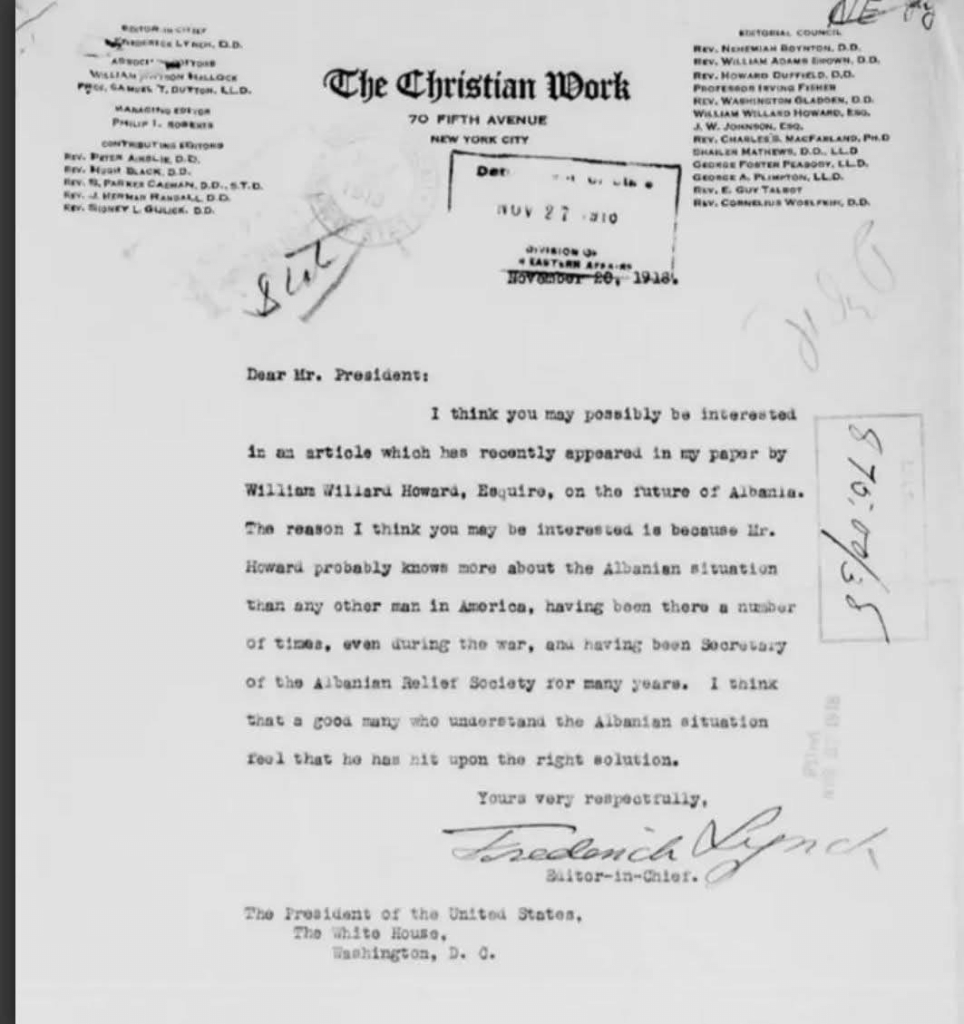
“Transcription of the letter:
The Christian Work
70 Fifth Avenue
New York City
November 26, 1918
Dear Mr. President:
I think you may possibly be interested in an article which has recently appeared in my paper by William Willard Howard, Esquire, on the future of Albania. The reason I think you may be interested is because Mr. Howard probably knows more about the Albanian situation than any other man in America, having been there a number of times, even during the war, and having been Secretary of the Albanian Relief Society for many years. I think that a good many who understand the Albanian situation feel that he has hit upon the right solution.
Yours very respectfully,
Frederick Lynch
Editor-in-Chief.
The President of the United States,
The White House,
Washington, D. C.”