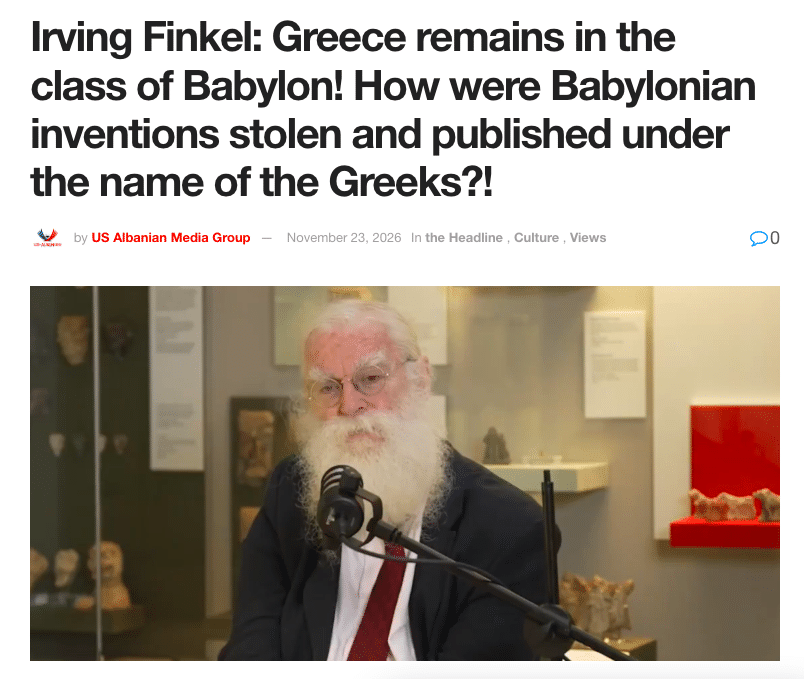

A clay tablet, a Greek transcription, and an age-old question: who owes what to whom?
A bold claim is circulating on social media: that the Greeks “stole Babylonian inventions and published them under their own names.” This is often attributed to Irving Finkel, an Assyriologist at the British Museum. Yet, when you listen to what he actually says, the story proves more nuanced—and far more interesting—than such slogans suggest.
What Finkel Says
In an interview that has circulated widely on video, Finkel describes a process of learning followed by appropriation. According to him, scholars from Greece traveled to Babylon, met with their counterparts—some of whom were astronomers—and studied alongside them. The draw was the data: Babylon possessed tablets containing lists of astronomical observations, including the dates of the first and last appearances of various phenomena, organized into columns of numbers. The Greeks, he notes, were exceptionally skilled at synthesizing data—and they were eager to acquire it.
They learned enough cuneiform to understand the numbers, the days of the week, and the concepts of light and darkness, subsequently transcribing this information into the Greek script. The part alleged to be “theft” can be interpreted in a much more benign way based on his account: the Babylonians did not tell anyone, “This is our knowledge—this is our copyright.” According to Finkel, they opened the door and shared the information. Yet, this clearly points to the source of that knowledge.
Material evidence
His argument relies on artifacts excavated in Babylon and now housed in the British Museum: small exercise tablets used for learning grammar, featuring Babylonian signs on one side and Greek letters on the other. The idea is that the transcription served as a mnemonic device for remembering the signs. Finkel summarizes it this way: we can essentially see the Greeks “in the classroom” through these fragments.
In academic literature, these artifacts are known as Graeco-Babyloniaca and date from a later period—roughly the 1st century BC to the 1st century AD. They serve as rare, tangible evidence of linguistic contact between the two worlds.
Where fact ends and interpretation begins
The scholarly debate remains open:
Did they “steal,” or did they borrow? The transcript itself contains no claim of theft. Furthermore, the ancient world—for both Greeks and Babylonians—had no concept of copyright law. To speak of “intellectual property” in this context is an anachronism.
Recognition of the source.
Greek astronomers of the Hellenistic period, such as Hipparchus, utilized Babylonian data and parameters derived from them—information that Ptolemy later preserved in his own work. Historians of science view this as an open transmission, rather than an instance of anonymous publication.
Finkel’s remarks point to an idea more significant than the accusation itself: in those times, knowledge moved differently than it does today. It passed from teacher to student, from one language to another, unencumbered by contracts or patents. Greece did not invent mathematical astronomy from scratch, yet it did not consign Babylon to oblivion either; instead, it synthesized, modeled, and further developed that knowledge. It is no coincidence that, in Finkel’s own words, this transmission “continued its beautiful history within the Greek mind and beyond.”
Many great “strokes of genius” are built upon the unknown labor of others. A civilization that shares its knowledge may endure for millennia—provided that its name is not erased from, obscured, or supplanted within those brilliant achievements.
Article