
Discovery by Artur Vrekaj
by GELCU MAKSUTOVICI
Summary
Gelcu Maksutovici’s article examines the long-standing relations between the Romanian and Albanian Orthodox Churches, interrupted for nearly five decades by World War II and communist rule, and resumed after 1989–1991.
It traces multi-secular ties: both peoples received Christianity early (Romanians via St. Andrew, Albanians via St. Paul), with Albanian settlement in the Romanian Principalities beginning in 1595 under Michael the Brave. Romania later supported Albanian national rebirth and independence (proclaimed 1912).
In the early 20th century, Albanian cultural and Orthodox societies flourished in Bucharest. The Albanian Orthodox Community (founded 1909) sought services in Albanian. With strong Romanian state and Church support, the historic Church “Dintr-o zi” was granted for their use from 1911 until after World War II.
A central figure is Fan S. Noli, the Albanian priest-nationalist who arrived in Romania in 1911. He received official and ecclesiastical backing, held services, and advanced the cause of Albanian ecclesiastical independence. Romanian politicians (e.g., Take Ionescu) and hierarchs aided the printing of Albanian liturgical books and broader national efforts.
The article details the Albanian struggle for autocephaly: the 1922 Berat Congress proclamation, formation of a Holy Synod in 1929 under Archbishop Visarion, conflict with the Ecumenical Patriarchate, and final recognition in 1937 (facilitated in part by Romanian Patriarch Miron). Many Albanian priests trained in Romania.
After decades of interruption, ties revived post-communism through refugee aid, scholarships for Albanian theology students, and renewed cooperation. The study positions itself as the first major post-totalitarian contribution to this shared Orthodox history.
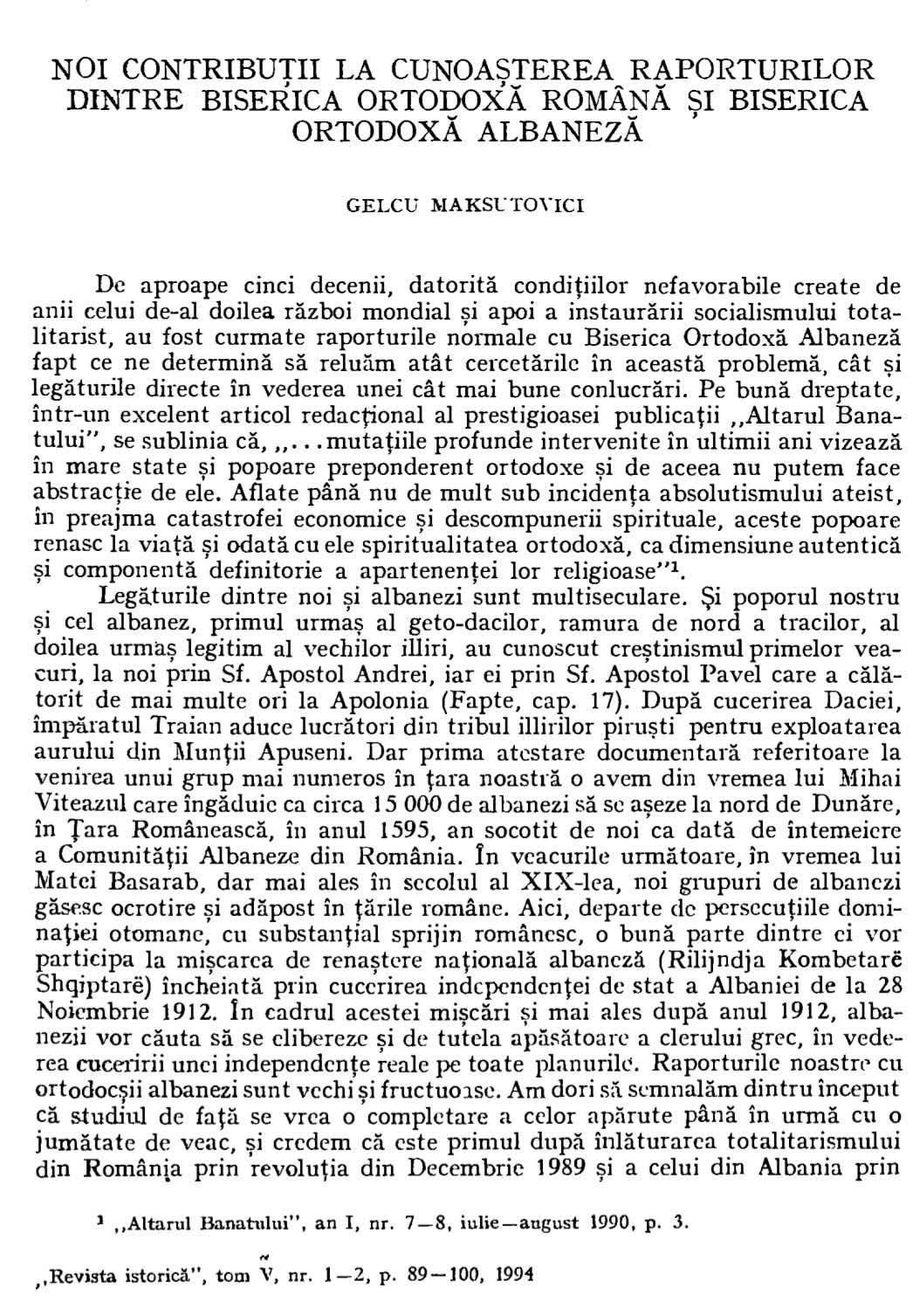
For nearly five decades, due to the unfavourable conditions created by the years of the Second World War and then by the establishment of totalitarian socialism, normal relations with the Albanian Orthodox Church were interrupted, a fact that determines us to resume both research on this problem and direct ties with a view to ever better cooperation.
Rightly, in an excellent editorial article of the prestigious publication Altarul Banatului, it was stressed that “…the profound changes that have intervened in recent years concern above all states and peoples that are predominantly Orthodox and therefore we cannot disregard them. Until not long ago under the incidence of atheist absolutism, on the brink of economic catastrophe and spiritual disintegration, these peoples are being reborn to life and, together with them, Orthodox spirituality, as an authentic dimension and a defining component of their religious affiliation.”¹
The ties between us and the Albanians are multi-secular. Both our people and the Albanian people—the former the successor of the Getae-Dacians, the northern branch of the Thracians, the latter the legitimate successor of the ancient Illyrians—came to know Christianity in the first centuries: we through St. Apostle Andrew, and they through St. Apostle Paul, who travelled several times to Apollonia (Acts, ch. 17). After the conquest of Dacia, Emperor Trajan brought workers from the Pirusti Illyrian tribe for the exploitation of gold in the Apuseni Mountains.
But the first documentary attestation referring to the arrival of a more numerous group in our country we have from the time of Michael the Brave, who allowed about 15,000 Albanians to settle north of the Danube, in Wallachia, in the year 1595, a year regarded by us as the foundation date of the Albanian Community in Romania. In the following centuries, in the time of Matei Basarab, but especially in the 19th century, new groups of Albanians found protection and shelter in the Romanian Principalities.
Here, far from the persecutions of Ottoman domination, with substantial Romanian support, a good part of them would participate in the Albanian national rebirth movement (Rilindja Kombëtare Shqiptare), concluded by the proclamation of the independence of the Albanian state on 28 November 1912.
Within the framework of this movement and especially after 1912, the Albanians would seek to free themselves from the oppressive tutelage of the Greek clergy, with a view to winning a real independence in all spheres.
Our relations with the Albanian Orthodox are old and fruitful. We should emphasise from the outset that the present study is intended as a completion of those published up to half a century ago, and we believe it is the first after the removal of totalitarianism from Romania by the December 1989 revolution and from Albania by the mass movements of 1990–1991, thus resuming research on Romanian-Albanian relations also under the aspect of those between the fraternal Orthodox Churches, traditional as they are in many respects.
We need only recall the numerous donations of Romanian voivodes to the monasteries in southern Albania in the Middle Ages², mutual aid in the modern period, and Romanian support for the autocephaly of the Albanian Orthodox Church in the contemporary era.
From the confessional point of view, the Albanians belong to the Muslim, Orthodox and Catholic cults, each having its own traditions and particularities according to certain zones of influence. In the northern regions and on the Adriatic coast Catholicism predominated, with its main centre in the town of Shkodra; in central Albania the Muslims, with mosques of rare beauty in Tirana or Elbasan; and in the south the Orthodox, spread in the regions around the towns of Korça and Gjirokastra, as far as the Ionian Sea.
We have of course given only a general sketch, for interminglings and mixed cohabitation are everywhere, in all the zones inhabited by Albanians, including their extensive diaspora, whether one speaks of Kosovo and Yugoslav Macedonia, Greece, southern Italy, Turkey, Romania or America.
Then, in a future study, we shall refer to the cohabitation of Albanians with Aromanians, to the ties and collaboration between them not only in Albania but throughout the Balkan Peninsula, from which we shall cite for the moment only a single document, from 1896, which is not to be disregarded and in which we find the following:
“Near Metropolitan Antim of Mesembria, who has declared anew that he remains undetached from the Romanian cause, Mărgărit has further won over the Metropolitan of Durazzo and the Albanian-Romanian Gora of origin, who, after two years of participation in the patriarchal Synod in Constantinople, is preparing to return to his eparchy.
This Metropolitan has also bound himself by letter to Mărgărit to introduce the Romanian language into the churches of his Eparchy, where the Romanians form the majority of the population. He has spoken of this to the Grand Vizier and, decorated without the knowledge of the Patriarch with the Grand Officer of the Order of Osmanie, has set out for Durazzo with vizirial letters so that he may be supported in his action by the Pashas of the provinces. He will pass through Salonika, Bitola, Ioannina and everywhere will seek to warm the Romanians for their national cause.”³
Both the Albanians and the Romanians in the Balkans looked with confidence and hope to Romania, regarding it as the most devoted defender of their rights and liberties, and also of the national being through Orthodoxy of those belonging to this faith, against the interference of certain clerics who, even through Orthodoxy, sought to denationalise them.
Moreover, in the public opinion of the time, some political men of the Ottoman Empire, among diplomats, considered both Albanians and Aromanians of Orthodox religion as “Greeks”. Hence also the important role of the Romanian state and of the Romanian Orthodox Church in supporting the schools and churches of the Romanians in the Balkans, as well as the autocephaly of the Albanian Orthodox Church, the efforts of those who wished it to be a national, independent Church, freed from the domination of foreign clergy.
In this sense there existed numerous direct, moral and material actions, both in the second half of the 19th century and in the first half of the 20th century, with which we deal in a special manner in the present study. In 1903, after the brutal suppression by the Turkish authorities of the uprising in Macedonia, the Romanian government took a series of measures for the reconstruction of the destroyed schools and churches.
The Romanian Ministry of Foreign Affairs stated that on 14 August 1903 money had been sent by telegraph for the aid of the population of Kruševo, which had been the centre of this popular movement, specifying that the aid had not been limited only to Romanians but that other nationalities had also been helped.
In the sitting of the Chamber of 28 November 1903 a fund of 600,000 lei was created for the construction of churches and schools, a sum voted in the Romanian Parliament by 98 of the 99 deputies present, and Deputy N. Dimancea proposed that the sum be raised to 1 million.⁴ At the same time, I. I. C. Brătianu underlined Romania’s position of maintaining the best relations with all the peoples of the Balkans: “we wish to maintain the most cordial relations with the neighbouring states… to put our respective interests in agreement.”⁵
At the beginning of our century several Albanian cultural societies were functioning in Bucharest, for example “Dituria” (Culture), “Drita” (Light), “Shpresa” (Hope), “Bashkimi” (Union), which also had a very strong branch in Constanța; they published school manuals, books, newspapers and magazines that were distributed in the territories inhabited by Albanians in the Balkans and even among those in the diaspora.⁶
The Orthodox Albanians in Bucharest also organised themselves in religious societies: at first the Orthodox women, and on 6 December 1909, in a General Assembly held in the Hall of the Eforie Baths, the Statute of the Albanian Orthodox Community in Bucharest was voted.⁷ From an article entitled The Election of the Epitropia of the Albanian Church, published in the newspaper Minerva of 8 December 1909, we learn that: “Messrs Hristea Zapa, president; Eraclie Duro, Toma Ciami, Ianache Cocio, Pandele Vanghele, Vasile Zografi, Nic. Ionescu, Gh. Tico and Vasile Tarpo, members; Achile Eftimiu and Spiro Arabi, censors, were elected.”⁸
After this date the problem of also having a church of their own, in which services might be held in the Albanian language, is posed with ever greater acuteness. In a document dated 19 March 1911 it is related: “Following the general assembly of the Albanian Community which took place on the 13th of this month regarding the question of the Albanian church and for this purpose a subscription list was also made on the same day, on which list the sum of 5,000 lei was collected… some of the Albanians are of the opinion that the sum collected for the building of the Albanian church is much better and more praiseworthy for the Albanian colony in Romania that this sum was to be sent as aid to the Albanian rebels who are fighting for the Albanian national cause…”⁹
The problem of a church of their own is also found in the article An Albanian Church in the Capital, published in the newspaper “Scara”, no. 419 of 13 March 1911, in which it was written: “Following the steps taken by the Albanian eforo-epitropia, the metropolitan has granted the Albanian Orthodox community in the capital the official authorisation to have its own place of prayer, in which Albanian priests are to officiate the entire divine service in the Albanian language”…, showing in conclusion that “…
For this purpose, the community appeals to all its members to take part in a national assembly which will take place next Sunday 13 March, in the Eforie hall, at 2 p.m., in order to decide upon the first place of prayer of this community”¹⁰.
From another document referring to this meeting it is shown that “…it was decided to send 600 lei to America to Fan Noli, the Albanian nationalist and theologian, so that he may come to Bucharest and bring all the church books translated into Albanian by him, and coming to Bucharest, the Albanian colony hopes that the presence of the theologian Fan Noli will be of great use for the progress of the Albanian church question…”¹¹.
Other information is linked to the fact that Fan Noli went from Rotterdam directly to Petersburg and then will come to Romania. An invitation addressed to the Albanian compatriots has the following text: “The Albanian Orthodox Community makes a warm appeal to all Albanians in Bucharest to come in as large a number as possible on 3 September at 8 o’clock in the morning to the North Station for the reception of His Holiness the Priest Fan S. Nolli, the pioneer of the Albanian religious cause, who is coming to visit us”¹².
Indeed, from a note of the Directorate of Police and General Security dated 3 September 1911 we learn detailed news: “Today there arrived in the Capital coming from Russia the Albanian priest Fan S. Noli, one of the most principal fighters of the Albanian cause… He will stay here for a longer time, finding the freest country from which to conduct the interests and the Albanian movement;…
The Albanian colony here is grateful to this priest who has now through his merits been raised to the rank of protopope by the Russian clergy in Petersburg on account of the development he brings to the Orthodox nation and his energetic struggle in the matter of the present uprisings in Turkey. To him is owed the intervention that Russia should help materially the rebels who stand on Montenegrin territory, a fact accomplished by the sum of 100,000 roubles which Russia gave to Montenegro”¹³.
Now one of the most interesting chapters of Romanian-Albanian relations on the state line is opened, in connection with the support of the struggle for the independence of the Albanian people, doubled by the support of Orthodoxy by the Romanian Orthodox Church through granting for the use of the Albanian Orthodox Community in Bucharest one of the most beautiful churches, a monument of art and architecture, the Church Dintr-o zi in Academiei Street, and indirectly, through the intermediary of Fan Noli and the helping of the Christian peoples of the Balkans in their complete liberation from under the multi-secular domination of the Ottoman Empire.
Before opening this chapter, a few words about the personality of Fan S. Noli (Theofan Stilian Noli), born in 1882 in the village of Ibrik Tepe, near Adrianople (European Turkey) from a family of Albanian emigrants, deceased in 1965 in Florida (United States of America) as bishop of the Albanian Orthodox.
Fighter for the national independence of Albania, he entered the priesthood in 1908 with the intention of militating also on this path for the autocephaly of the Albanian Orthodox Church, of freeing it from under the influence of the Greek clergy which sought to assimilate the Albanians with the Greeks through the intermediary of belonging to Orthodoxy, at the ecclesiastical forums of Greece. A talented writer, he imposes himself both in Albanian literature and in universal literature. In 1924, for a few months, he will be prime minister of Albania, leader of the bourgeois-democratic revolution in Albania.
In 1907 he publishes the drama Israelites and Philistines, on various biblical themes combating the roots of the feudal system; in 1913 he prints in Boston the Small Triodion, in the Albanian language, translated by him from Greek; between the years 1922–1924 he publishes The Way of the Cross, Jesus Scourged, Moses on Mount Sinai, translates from universal literature numerous masterpieces, among which Othello, Macbeth, Julius Caesar and Hamlet by Shakespeare, An Enemy of the People and The Lady from the Sea by Ibsen, Quatrains of Omar Khayyam, The Return of Skanderbeg to Kruja by H. Longfellow, The Raven and Annabel Lee by Edgar Allan Poe and others. On his qualities as high hierarch of the Albanian Orthodox Church we shall return later in the course of the study.
Arrived in Romania, received with love and respect by his compatriots, but also by the state and ecclesiastical authorities, by Romanian public opinion, he gives interviews to the press, holds a conference at the Romanian Athenaeum (October 1911), goes to Brăila and Constanța where powerful Albanian communities were to be found, discusses with Romanian political men and with high hierarchs of the Romanian Orthodox Church receiving the support of these, sends through the intermediary of the Albanian Colony a letter of thanks to H.B. Metropolitan Pimen of Moldavia, encourages the Albanians in Romania in the struggle for the winning of national independence etc.
His presence in Bucharest will impel the entire Albanian Community, not only the Orthodox one, to new actions on the line of the struggle for national liberation, being received in equal measure also by Muslim or Catholic Albanians, as a patriot and fighter for the emancipation of all. It is interesting to note also the fact that, translating from the Greek language into Albanian the Small Triodion, which he prints in Boston in 1913, Fan Noli writes on the first page the dedication “To His Excellency Take Ionescu, as a sign of gratitude and esteem, the translator”, which makes us believe that he received substantial material support also from the Romanian political man, otherwise known for his position as supporter both of the Romanians in the Balkans and of the struggle for the independence of Albania¹⁴.
As we showed earlier, the Albanian Orthodox Community already from the years 1909–1910 had made various steps to have a church with service in the Albanian language, but with the arrival in Bucharest of Fan Noli they intensified and became concrete. The Community had previously solicited the provisional obtaining of the Church Dintr-o zi, a filial of the Enei Church, both from the state authorities and from the ecclesiastical ones.
On 8 April 1911 the Town Hall of the city of Bucharest by address no. 20158/8808 B. communicated to the epitropia of the Enei Church that it had been approved for the Albanian Community to hold services in the Church Dintr-o zi, but the epitropia was not in agreement. With the coming of Fan Noli the Community addresses the Holy Metropolitanate which, on 12 September 1911, approves that the priest Fan Noli may serve at the Doamnei Church until 16 October 1911, after which the Holy Synod will approve the “provisional cession” of the Church Dintro zi, to which the initial leadership of the Enei Church had consented only for the Christmas holidays, but on 19 December 1911, by a Verbal Process concluded between the Enei Church and the Albanian Orthodox Community it is shown that “the holy place of the filial church Dintr-o zi is ceded temporarily”, a “temporariness” which was to last until after the end of the Second World War.
Thus, having the direct support of the Romanian Orthodox Church and of the Romanian state authorities, the Albanian Orthodox Community in Bucharest will benefit for over 35 years from one of the most beautiful places of worship of the Capital, a historical monument, of art and architecture, in the centre of the city. For the less informed we recall that the holy place, with the dedication of St. Nicholas, is situated in Academiei Street no. 22, in the perimeter between the Institute of Architecture and the former Enei Church demolished, under dubious conditions, after the earthquake of 1977, under the pretext of the impossibility of reconsolidation.
It is worth noting the fact that here, in the 17th century, there existed a small wooden church, “built by Neagul”, the place was then to pass into the possession of his younger brother Antonie, vornic of Popești, lord of Wallachia (1669–1672), after which it will pass to his son Neagul Postelnicul Negoiescu also called Popescu, then to the latter’s daughter Marica together with her marriage to Constantin Brâncoveanu. In the year 1702 Lady Marica “raised that small wooden church and raised another of stone in its place”.
The church was to be rebuilt in the years 1826–1827, under the reign of Grigorie Ghica Vodă, after which the inscription was placed: “This Holy Church which is called Dintr-o zi with the dedication of the Holy Hierarch Nicholas was first made of wood and ageing the enlightened Lady Marica of His Highness Constantin Basarab Brâncoveanu V.V. in the year 1702 from the birth of Our Lord Jesus Christ, being moved she made it entirely of wall and adorned it with all the ornaments for the remembrance of His Highness, the trustee being the late Enache Văcărescu, grand logothete, later in the year 1825 in the time of His Highness Grigore Ghica V.V. of the fourth, it happened that it burned, it was renewed and adorned, as is seen with the help of His Highness Grigore Ghica and of other Orthodox through the insistence of the late grand stolnic Stanciu the epitrop of this Holy church, being renewed in 1827”.
As Father M. Popescu Cernea records in the short history of the church, displayed at the entrance, “…From 1911 until 1945 this church served as a place of worship for the Albanian community in Bucharest”. According to our knowledge, the last serving priest of the Albanian Community in Bucharest was the distinguished and regretted Piru Buchiu, deceased in 1991, in the commune of Corbu, Olt county, a man of chosen civic and spiritual standing, devoted servant of the foreign altar, who, to all his four sons, urged them to follow theological studies, so that among them there should also be worthy servants of the Orthodox Church. From a letter of soul of the Most Reverend Father Piru Buchiu addressed to the author of this study on 27 February 1991, he specifies that: “The five years, 1942–1947, of holy service at the Church Saint Nicholas ‘Dintr-o zi”, of the Albanian Community in Romania, were the most beautiful years of our youth…”¹⁵
On 28 November 1912, in the small town of Vlora, on the Adriatic coast, the independence of the Albanian state was proclaimed, a crucial date in the history of the Albanian people. With the liberation from under the oppressive yoke of Ottoman domination of nearly five centuries, the Albanian people desired independence also in other domains, for example that of the Albanian Orthodox Church, in the sense of having a broad autonomy, its own hierarchs and servants of the altar. In the struggle of the Albanian Orthodox for the autocephaly of their Church, the Albanians from the diaspora were also involved, among them those from Romania, who in their turn had substantial support also from the Romanian authorities, from political men such as Take Ionescu or Nicolae Iorga. About the activity of the Albanian Community linked to the Church Dintr-o zi and especially of the priest Fan S. Noli, we shall further note a few documents. In the newspaper “Universul”, no. 57 of 28 February 1912, the article The Meeting of the Albanians from the Capital was published, for “…constituting a society for the maintenance of the church and of the Albanian schools”, after which it is recorded: “It is decided that the society should bear the name of ‘Albanian Orthodox Union’…”, enumerating also the members of the Administrative Council: Eraclie Duro, Petre Tarpo, Toma Ciami, Pandele Evanghele, Vasile Zografi, Vanghele Dumitru, Dr. Sp. Shunda, Sotir Filip, Mihail Kiriţa, Alexe Drenova, Victor Eftimiu, Athanas Cantili, Dum. Beratti, Cristea Cotadi, Visarion Dodani, Vanghele Atanasiu, Filip Papaiani, Grigore Goda, Gheorghe Ţico, Ioan Danga, Pandele Durmişi, I. Costuri, C. Naumescu, N. Cristea and Teodor Emanoil¹⁶. In the following year, in the notes of the Police and Security, we find again noted the presence of Fan Noli in Romania, thus: “With today’s train (23 April 1913, n.n.) the Albanian priest Fan Stelian Noli entered, accompanied by Dumitru Ciufecu and is going to Bucharest, Hotel Central…”¹⁷, and in another note, of 2 May 1913, it is related: “This morning at the Church Dintr-o zi in Academiei Street a memorial service is held for the deceased Albanian nationalist N. Naciu (it is about the patriot Nicola Nacio, founder of the Albanian cultural society ‘Drita’ (Light) in Bucharest, in the year 1884, of an Albano-Romanian Institute, of a normal school with Albanian and Aromanian pupils, he edited several publications etc.—n.n.) and the divine service will be performed in the Albanian language by the Albanian priests Fan Noli and Papa Haralambie and at this memorial service the Albanian Colony will take part and it is said that the Macedo-Romanians will also take part…”¹⁸.
In the following notes (of 3 May 1913) it is specified: “In the Albanian circle the declaration of the Albanian priest Fan S. Noli before the Albanians brought great joy and enthusiasm, about the result of the audience which the said priest had with Mr. Minister Take Ionescu, the conversation including among other things also the promise of the Minister that shortly a significant number of church books will be printed here in Bucharest in the Albanian language and which books when they are printed and ready he will send them to Albania through the said priest”¹⁹, and in the note dated 9 May 1913 it is announced: “On the occasion of the departure of the Albanian priest Fan Noli to Albania, the Albanians from Bucharest gave a banquet in the Carpaţi restaurant… the said priest left the Capital going to Albania on the 8th of this month exiting through the Predeal point…”²⁰.
The documents of the time speak at length about the Romanian support. At the Albano-Romanian Congress in Trieste, of March 1913, Dr. Shunde speaking about the relations between Romanians and Albanians, underlines: “Strengthening the Albanian nation, Romania strengthens itself, for it sees clearly that Albania is threatened by the same danger as itself, for it knows only too well that the fate of the Romanian people and of the Albanian people is forever common”, concluding: “Well then! Romania wishes insistently and sincerely a strong and prosperous Albania”²¹.
At the end of the First World War, when at the Paris Peace Conference the problem of the independence and sovereignty of the Albanian state was again taken into discussion, Nicolae Iorga will draft and publish in Bucharest the work Brève histoire de l’albanie et du peuple albanais, used as a historical argument by the Albanian delegation in support of its interests, a work which implicitly also includes the support of the autocephaly of the Albanian Orthodox Church, a problem which will enter even more into actuality in this period²².
But in this regard the most complete and objective work known to us until now remains the licence thesis The Foundation and Organisation of the Albanian Orthodox Church, Bucharest, 1941, signed by Buchiu I. Piru, from which we shall cite large extracts²³. After which, in the first chapter Christianity in Albania, Albania and the Albanians are presented to us, concluding that: “All the time that it was under the jurisdiction of the patriarchate of Constantinople, the church life of the Albanians received an almost exclusively Greek character: the language of the cult was the Greek one, the clergy — especially the superior one — was Greek.
The Greeks and the Ecumenical Patriarchate had become accustomed to regard the Albanian Orthodox as Greek ‘Albanophones’”²⁴; in chapter II, the Autocephaly of the Albanian Orthodox Church is presented to us at length, in its entire complexity.
Having in view the data, valid also today, contained in the cited work, we wish to render a few of them, in order to bring back into the memory and knowledge of the readers the national-church struggle of the Albanians for the winning of autocephaly.
Although, as we have already shown, the problem was posed earlier, especially after the proclamation of the independence of the Albanian state of November 1912, the conflict between the Albanian Orthodox and the Greek Church was to break out into the open when, “In 1921, at Coritza (Korça, a town in southern Albania, n.n.), the Albanian priests and youth decided to sing the prohod on Great Friday, in the cathedral of the town, in the Albanian language”²⁵.
The Greeks are furious and start a campaign of reprisals against the intentions of the Albanians to introduce the national language also into the church, considering that “the Orthodox of Albania are proper Greeks who speak Albanian”. In the year 1922 a great national-church Congress is convened in the town of Berat, in which the decision is taken to proclaim the Autocephaly of the Albanian Orthodox Church, the Albanian archimandrite Visarion Giovani being elected as bishop.
A “provisional synod” was formed, and a delegation, headed by the Albanian priest Vasil Marcu, was sent to the Patriarchate of Constantinople to present the complaints of the Albanian clergy and faithful. Here they do not find the due understanding, the problems are delayed, conditions of all kinds are set, unacceptable for a people that wishes to be free also in its spirituality.
The Albanians enter into contact with the Serbian Church, which in 1925 will ordain the archimandrite Visarion, but other unresolved questions still remained. The Albanians are forced to enter again into negotiations with the Ecumenical Patriarchate of Constantinople, which, in April 1926, sends to Albania Metropolitan Hrisant of Trapezunt who will hold discussions with an Albanian Commission at the head of which was the political and state man Pandeli Vangheli (he came from the Albanian Community in Bucharest, former merchant in Calea Victoriei 112, with a great role in the leadership and organisation of this community, in the events linked to the proclamation of the independence of Albania, who immediately after 1912 received a series of requests to be prefect of Korça or minister in the Albanian national government.).
Although some compromises were reached on both sides, Metropolitan Hrisant, who had also signed a Verbal Process on 6 June 1926 regarding the agreement realised, instead of leaving for the Ecumenical Patriarchate, goes to Athens, and after a few months returns “not with the ratification of the protocol and with the patriarchal tomos”, but with another protocol, which proved a disregard of the desire of the Albanians.
Nevertheless the Patriarchate will send to Albania two provisional hierarchs, who constituted a “Supreme Church Council” of the mentioned hierarchs, two priests and four laymen. The activity of the two hierarchs was visibly hostile to the movement for autocephaly, a fact which determined the Albanians to abandon the attempts to reach an agreement with the Patriarchate of Constantinople, seeking other solutions, entering again into contact with the Serbian Church.
In February 1929 the Albanian bishop Visarion together with the Serbian bishop Victor ordain the archimandrite Agatanghel of Korça, the widowed priests Eutimie of Gjirokastra and Atanasie of Elbasan as eparchial bishops of the Albanian Orthodox Church, thus constituting the “Holy Synod” whose president, as Archbishop of Albania and Metropolitan of the Eparchy of Durrës was elected Visarion. On 26 February 1929 the members of the Synod were received in solemn audience by King Ahmet Zogu I of Albania, who handed them the investiture according to the old traditions.
The Patriarchate of Constantinople reacted very harshly with depositions and threats, protested before the Albanian king in its quality of “supreme legal authority of the Orthodox faithful in Albania”, invoked the “agreement of Tirana” which until then it had ignored, sent an epistle to the “Albanian Orthodox flock”, another to the Orthodox churches not to enter into communion with the Albanian bishops etc.
The situation will be accepted only in March 1937 when an Albanian delegation, empowered even by King Zogu, formed of Bishop Hristofor and Iosif Kedis, former minister of justice of Albania, will discuss with Metropolitans Ioachim of Dercos and Ghenadie of Heliopolis, as representatives of the Patriarchate.
The conversations concluded with a new “agreement” by which the autocephaly of the Albanian Orthodox Church was recognised, the obligation of the Albanian state to ensure all the conditions of free development of the Orthodox Church and of its school and religious establishments and others.
On 12 April the Ecumenical Patriarch proclaimed before the patriarchal synod the Autocephaly of the Albanian Orthodox Church, establishing that it enters into the rank of the autocephalous churches, according to the established order, immediately after the Orthodox Church of Poland²⁶. An important role in the smoothing of the conflict with the Albanians was played by Patriarch Miron of Romania, who intervened energetically with the Ecumenical Patriarch²⁷.
It should also be recalled that a good part of the Albanian priests were prepared in the theological institutes of Romania until the years of the Second World War, when, due to the political conjuncture, the good relations were interrupted for almost half a century. Before the war in Albania the review “Kisha ortodokse shqiptare” (The Albanian Orthodox Church) appeared with frequent references to this Romanian support.
In conclusion, we wish to make the precision that, in the Statute of the Autocephalous Albanian Orthodox Church, published in Korça in 1929, it is specified that: “The entire clergy and people of the Albanian Kingdom, represented through the empowered delegates, gathered at the Second Congress which was held in Korça vote unanimously the definitive statute of the Albanian Orthodox Church, proclaimed as autocephalous at the Congress of Berat with the date of 12 September 1922”²⁸.
Before closing this study selective from the multitude of data and documents referring to the Romanian-Albanian relations also on the plane of Orthodox spirituality, at the present moment when also in Albania the old ties are being re-established, religious life is being remade after a long period of total interdiction, the Albanian Orthodox have need of the effective support of those who were their friends in all times. Between us and them there have always existed relations of collaboration, of mutual aid, in which the Romanian support was evident. It manifests itself also today.
In the days of the Nativity of the Lord 1990, His Beatitude Father Patriarch Teoctist visited some families of Albanian refugees, as once their ancestors, on the hospitable soil of Romania. Beginning with the school year 1991–1992 the tradition of the coming of some young people from Albania to studies in Romania was resumed, among them also some for theological education.
In this sense we note a first group of three persons at the Orthodox Theological Seminary in Craiova, under the protection of H.B. Nestor, and according to our knowledge the resolution of other scholarships is also under discussion, thus contributing to the covering of some stringent needs linked to the rebirth and revitalisation of the Albanian Orthodox Church, for the benefit of its Albanian and Aromanian faithful.
“We were those who helped morally and materially the great fighter Fan S. Noli in the years 1911–1913, as the first servant in the Albanian language from the diaspora of this ethnicity, who will militate both for the independence of the Albanian state and of his church, the future bishop of the Albanians in America, deceased in
Notes
¹ Altarul Banatului, year I, nos. 7–8, July–August 1990, p. 3.
² See Virgil Cândea, Mărturii românești peste hotare, Small Encyclopaedia I, Albania–Greece, Encyclopaedic Publishing House, Bucharest, 1991; Nicolae Iorga, Vasile Lupu as follower of the Emperors of the East in the tutelage of the Patriarchate of Constantinople and of the Orthodox Church, in Annals of the Romanian Academy, Series II, Memoirs of the Historical Section, vol. 36, 1913–1914, pp. 207–236; idem, Foundations of the Romanian rulers in Epirus, in the same, pp. 881, 916; Marcu Beza, Romanian traces in the Orthodox East, Bucharest, 1935; Teodor Bodogae, Romanian aid to the monasteries of Mount Athos, Sibiu, 1914; A. Camarino-Cioran, L’Épire et les Pays Roumains, Ioannina, 1989, etc.
³ Report signed by D. A. Sturdza, Minister of Foreign Affairs, addressed to King Carol I, document dated 1896, August 3/15, found in the Central Historical Archive, Royal House Fund, file 10/1896, sheets 1–2 (After the review Annals of History, no. 3, 1975, p. 99).
⁴ Debates of the Chamber of Deputies, 1903–1904, p. 25.
⁵ Ibidem, p. 141.
⁶ For details see Gelcu Maksutovici, chapter Albania, in The Affirmation of Independent National States in Central and South-Eastern Europe 1821–1923, Academy Publishing House, Bucharest, 1979, pp. 129–145.
⁷ Central Historical Archive, Ministry of the Interior, Directorate of Police and General Security, File 54; 1910, f. 2 (Further references to this fund will be: A.C.I., Min. Int., …).
⁸ Ibidem, file 129, 1909, f. 6.
(Source: “Revista istorică”, vol. V, nos. 1–2, pp. 89–100, 1994 – pages 89–91)
⁹ Ibidem, f. 25.
¹⁰ Ibidem, f. 24.
¹¹ Ibidem, f. 26.
¹² Ibidem, f. 39.
¹³ Document no. 230, from: The Romanian People and the Struggle for the Liberation of the Peoples of the Balkans, volume of documents, edited by the General Directorate of State Archives, Bucharest, 1986, pp. 596–597.
¹⁴ See Gelcu Maksutovici, The Ideal of Albanian Independence Becomes Reality, in “Historical Magazine”, year XXI 1987, no. 12, p. 57.
¹⁵ Letter of Fr. Piru Buchiu, dated 27 February 1991, sent from the commune of Corbu, Olt county, to Gelcu Maksutovici, found in the Archive of the Cultural Union of the Albanians in Romania, p. 1.
¹⁶ A. C. Ist., Min. Int. Dir. Police and Security, file 54, f. 95.
¹⁷ Ibidem, f. 117.
¹⁸ Ibidem, f. 120.
¹⁹ Ibidem, f. 121.
²⁰ Ibidem, f. 122.
²¹ Document 234, from: The Romanian People and the Struggle for the Liberation of the Peoples of the Balkans, Bucharest, 1986, p. 602.
²² See Gelcu Maksutovici, The History of the Ancient Balkans, in “Dacia literară”, year I, 1990, no. 5, p. 12.
²³ We also bring thanks on this path to the Most Reverend Priest Laurenţiu Buchiu of the Parish of Poiana Câmpina, Prahova county, for the kindness with which he placed at our disposal the excellent licence thesis of his father Piru Buchiu, so useful to the present study, to the more profound knowledge of the relations between the Romanian and Albanian Orthodox Churches, with many unpublished data even today.
²⁴ Buchiu I. Piru, The Foundation and Organisation of the Albanian Orthodox Church, Licence Thesis, Bucharest, 1941, pp. 14–15; manuscript work, found in the possession of Fr. Buchiu Laurenţiu. Having in view the special importance of this work, we consider it especially useful to print it even in its present form, eventually completed with an explanatory preface on the new information that has appeared in the last decades.
²⁵ Buchiu Piru, op. cit. p. 16.
²⁶ Buchiu Piru, op. cit. p. 42.
²⁷ Ibidem, p. 43.
²⁸ Ibidem, p. 66 (the translation of the Statute into the Romanian language was carried out by Fr. Buchiu Piru, in the year 1941, n.n.).