
Summary
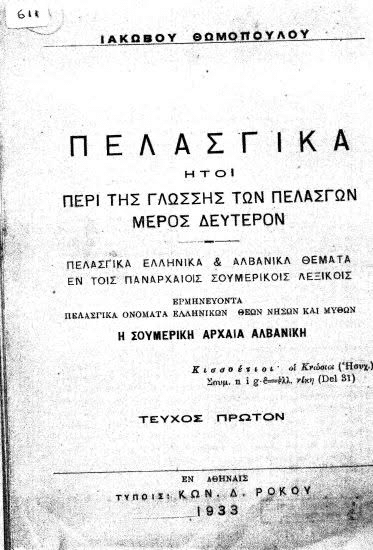
In the second volume of his work Pelasgika (1933), Greek scholar Iakovos Thomopoulos expanded his earlier claim that Albanian is the direct descendant of ancient Pelasgian. He went further and argued that Sumerian, one of the world’s oldest written languages, was essentially an archaic form of Albanian/Pelasgian.
He based this on three main ideas:
- Albanian survived almost unchanged as a “living fossil” because of the isolation of Albanian-speaking mountain communities.
- Similarities between Sumerian word lists and modern Albanian vocabulary allegedly prove a common origin.
- This “Sumerian–Old Albanian” key could supposedly explain otherwise obscure names in Greek mythology.
Introduction
When the Greek scholar Iakovos Thomopoulos published the first volume of his monumental work Πελασγικά: Ήτοι περί της γλώσσης των Πελασγών (Pelasgika: On the Language of the Pelasgians) in 1912, he already caused a sensation: In it he advanced the thesis that Albanian is the direct modern continuation of the ancient Pelasgian language. But when, more than twenty years later, in 1933, the second volume (Μέρος Β’) appeared in Athens, Thomopoulos went a giant step further — and shifted the origin of this language family all the way to Mesopotamia.
The Core Thesis: Sumerian = Old Albanian
The long subtitle of the second volume already reveals the author’s ambitious programme:
“Pelasgian, Greek and Albanian Themes in the Ancient Sumerian Lexicons, which Explain Pelasgian Names of Greek Gods, Islands and Myths: Sumerian as Old Albanian.”
Thomopoulos claimed that the language of the ancient Sumerians — one of the oldest known advanced civilizations of humanity — was essentially an archaic form of Albanian (or rather Pelasgian).
How did Thomopoulos justify this connection?
Albanian as a “living fossil”: According to Thomopoulos, the Albanians, due to their geographical isolation in the inaccessible mountain regions of the Balkans, had preserved their original language largely unchanged over millennia. While Greek had developed strongly, Albanian had remained “present-day Pelasgian.”
Sumerian cuneiform lexicons as the key: Thomopoulos compared word lists from Sumerian clay tablets with the Albanian vocabulary of his time. From phonetic and supposed semantic similarities he concluded a direct linguistic identity.
Decipherment of Greek mythology: With the help of this “Sumerian–Old Albanian” key he attempted to translate the names of Greek gods, islands, rivers and heroes that seemed inexplicable from classical Greek. For him the proof was obvious: The pre-Greek original population of the Mediterranean region (the Pelasgians) and the Sumerians had spoken the same idiom — and its living heir was Albanian.