
by Muhamet Nikqi – Buxhovi
Summary
This text presents the Albanian translation of an 1880 Ottoman document describing the border line between Montenegro and the Kosovo Vilayet in the Gucia/Plava area. It details the demarcation starting from Plamanica, passing through specific hills and peaks (Borava Glava, Ilina Glava, Jahova Tepesi, Slieva-Glava, Baliasta-Glava, Mount Golesin), following the Lim River, and allocating villages such as Morina/Pepiq, Maşniçe, Rjenica, and Velika between Montenegro and the Ottoman Empire. Muslim villages were generally retained by the Ottomans. The final precise line was to be fixed on the ground. The text also explains related archival footnotes from the Ottoman Archives (BOA), referencing a 1884 agreement and secondary sources on Ottoman-Montenegrin border and institutional history.
Full English Translation
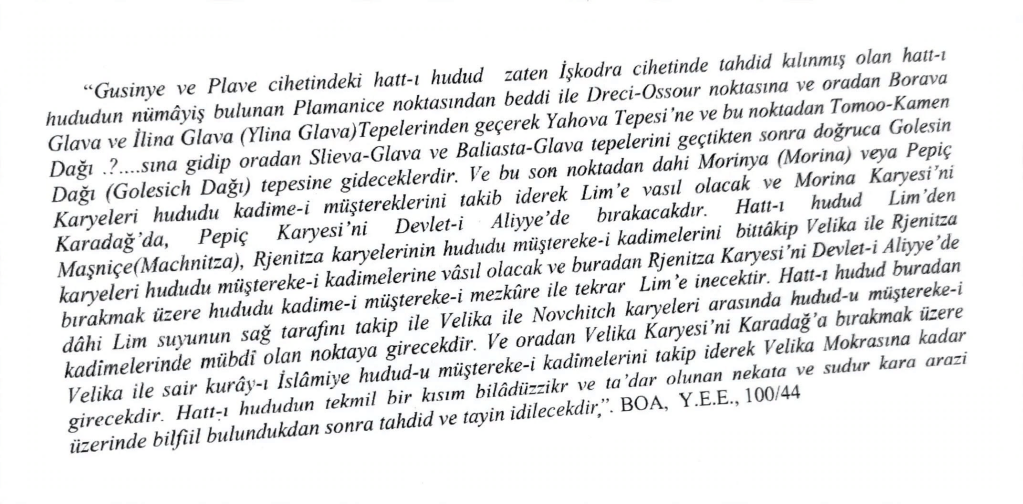
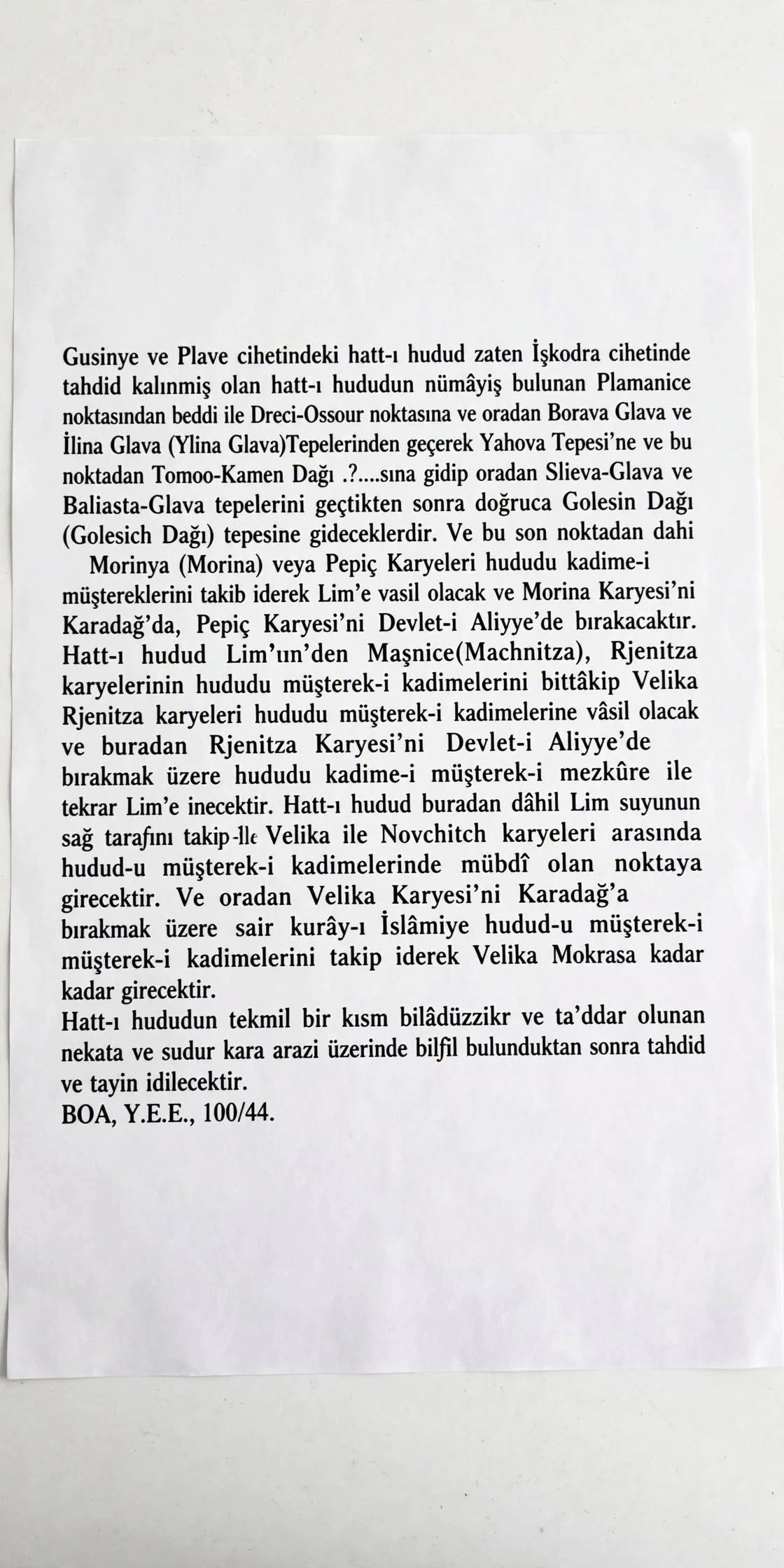
“The border line on the side of Gucia and Plava [starting] from the point Plamanica, which appears as the already determined border on the side of Shkodra, up to the point Dreci-Ossour and from there, passing through the hills Borava Glava and Ilina Glava (Ylina Glava) [it will go] to the peak Jahova Tepesi, and from this point, after passing the hills Slieva-Glava and Baliasta-Glava, it will go directly to …?… of Mount Golesin (Golesich Dağı) and from there it will go to the peak of Mount Golesin (Golesich Dağı). And also from this last point, following their old common border, it will reach the Lim River and will leave the village of Morina (Morina) or Pepiq to Montenegro, while leaving the village of Pepiq to the Ottoman Empire (Devlet-i Aliyye). The border line, following the old common borders of the villages Maşniçe (Machnitza) and Rjenica, will reach their old common borders and from there will descend again to the Lim, with the aim of leaving the village of Rjenica to the Ottoman Empire. The border line also from here, following the right side of the water of the Lim through the above-mentioned old common border, will enter the point where the old common borders between Velika and the village of Novçiq (Novchitch) begin. And from there, following the old common borders, it will enter up to Velika Mokra, with the aim of leaving the village of Velika to Montenegro, while the other Muslim villages (kurâ-yı İslâmiye) [remain within the borders of the Ottoman Empire]. The complete part of the border line will be determined and fixed after we are on the spot (bilfiil) on the unmentioned points and the determined land and water borders.”
– BOA, Y.E.E., 100/44
Short notes for clarity
- Devlet-i Aliyye: the official Ottoman name for the Ottoman Empire.
- Hatt-ı hudud: border line / geographical boundary.
- Karye / kurâ: village / villages.
- BOA, Y.E.E., 100/44: archival reference from the Ottoman Archives of Istanbul (Başbakanlık Osmanlı Arşivi, Yıldız Esas Evrakı fund).
- The part with the question mark (…?….sına) in the photo has unclear/damaged lettering in the original or on the screen.
Yes, these footnotes are archival and historiographical references from the late Ottoman period (end of the 19th century), which mainly relate to the diplomatic and border relations between the Ottoman Empire and Montenegro (Karadağ), as well as the organisation of Ottoman institutions.
Here is what each footnote indicates, together with its translation and explanation:
Translation and explanation of the footnotes
- [13] “Antlaşmanın tam metni için bkz. Ali Fuat Türkgeldi, str. 353-356”
Translation: For the full text of the agreement (treaty) see: Ali Fuat Türkgeldi, pp. 353–356.
Explanation: Ali Fuat Türkgeldi was a high-ranking Ottoman official and historian, known for publishing diplomatic documents and treaties of the Ottoman Empire. - [14] “Derviş İbrahim, Rıza Paşa, Nusret Paşa ile Karadağ Dersaadet Maslahtgüzarı G. Voucović (Gavro Vukoviç) arasındaki bu mukavele 12 Aralık 1884 te tanzim olunmuştur. BOA, Y.E.E., 100/44”
Translation: This agreement (convention) between Derviş İbrahim, Rıza Paşa, Nusret Paşa and the chargé d’affaires of Montenegro in Istanbul (Dersaadet), G. Voucović (Gavro Vukoviç), was drawn up on 12 December 1884. BOA, Y.E.E., 100/44.
Explanation: This refers to an official act of December 1884 between Ottoman representatives and the Montenegrin representative Gavro Vuković (noted in the text as G. Voucović). The word Dersaadet is a traditional Ottoman name for Istanbul. - [15] “BOA(BOA=Başbakanlık Osmanlı Arşivi, tj. Državni arhiv Turske), Y.E.E. 100/44”
Translation: BOA (BOA = Ottoman Archives of the Prime Ministry, i.e. the State Archives of Turkey), Y.E.E. 100/44.
Explanation: Explains the acronym BOA and gives the exact archival reference Y.E.E. 100/44 (Yıldız Esas Evrakı – files from the Yıldız Palace/administration archive). - [16] “Izvor: BOA, Y.E.E, 46/11”
Translation: Source: BOA, Y.E.E, 46/11.
Explanation: Another archival unit from the Yıldız Esas Evrakı fund in the Ottoman Archives. - [17] “Detaljnije o ovim podacima u knjizi: Mehmet Ali Ünal, Osmanlı-Istorija osmanskih institucija, Isparta 1997, str. 230-231”
Translation: In more detail about these data in the book: Mehmet Ali Ünal, Osmanlı – History of Ottoman Institutions, Isparta 1997, pp. 230–231.
Explanation: Refers to a synthetic work on Ottoman institutions by the Turkish historian Mehmet Ali Ünal, translated/used here in the Bosnian/Montenegrin/Serbian language (Istorija osmanskih institucija). - [18] “Izvor: BOA Y.E.E, br. 46/11”
Translation: Source: BOA Y.E.E, no. 46/11.
Explanation: Repeats or completes the archival reference Y.E.E. 46/11 (with the abbreviation br. = broj / number). - [19] “Izvor: BOA DH.MKT, br. 1426/24”
Translation: Source: BOA DH.MKT, no. 1426/24.
Explanation: Here appears the archival fund DH.MKT (Dahiliye Nezareti Mektubi Kalemi – Correspondence Office of the Ottoman Ministry of Internal Affairs), which contains administrative letters and official internal and inter-provincial correspondence.