
by Agim Morina
Summary
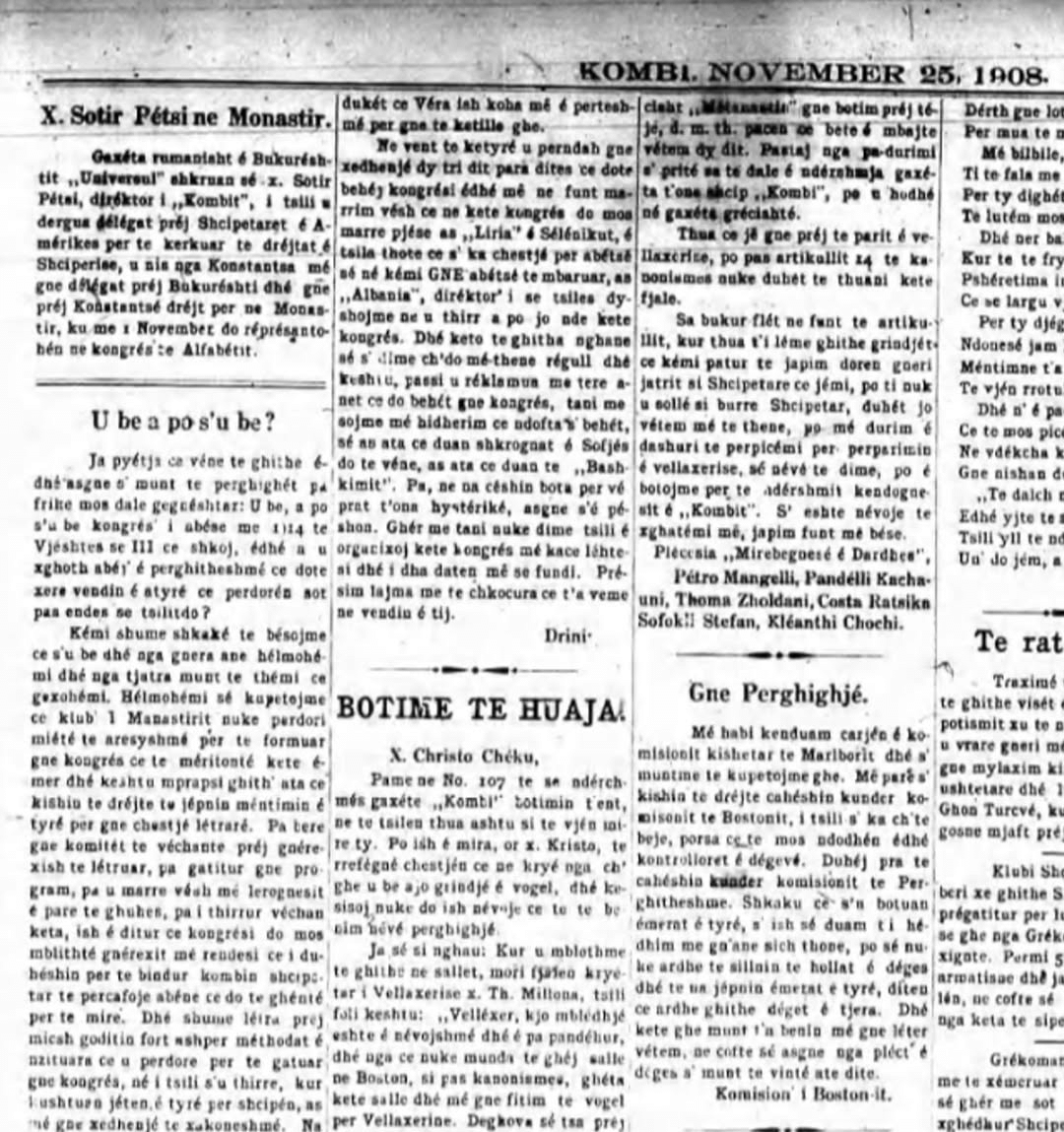
In two articles published in the Albanian newspaper Kombi (Boston, 25 November 1908), editor Sotir Peci sharply criticises the organisation and outcome of the Congress of Manastir (14–22 November 1908), which was meant to decide on a unified Albanian alphabet.
The first article (“Was it held or was it not held?”) expresses strong scepticism about whether a proper congress even took place. Peci argues that the Manastir Club organised it hastily and unprofessionally: without a preparatory committee of educated people, without a proper programme, without consulting leading language scholars or older literary societies, and with only last-minute invitations. As a result, important voices (including the newspapers Liria of Salonika and Albania) stayed away. He proposes a more orderly, civilised method for future gatherings and ends by saying clearer information is still needed.
The second article (“The Alphabet Congress”) is openly satirical. It notes with irony that, instead of producing one common alphabet, the congress produced two, guaranteeing future conflict. Peci mocks the congress programme by inventing absurd agenda items (loyalty to the Young Turks, teaching Albanian only one hour a year, counting heroes who died for the Ottoman Empire, demands for government salaries, etc.) and invents a fictional “Prince of Silence from Afghanistan” who proposes burning everything. The piece ends with a comic scene of dancing and the curtain falling “to rise again after two years.”
Overall, the articles reflect disappointment and sarcasm toward what the author saw as a poorly prepared and politically compromised gathering.
Was it held or was it not held?
This is the question that everyone asks, and no one can answer without fear of turning out to be a liar: Was the alphabet congress held on 1/14 of the past Third Autumn, and was a general alphabet chosen that will take the place of those used today according to each person’s preference?
We have many reasons to believe that it was not held, and on the one hand we are embittered, while on the other we can say that we are glad. We are embittered because we understand that the Club of Manastir did not use reasonable means to form a congress worthy of the name, and thus excluded all those who had the right to give their opinion on a literary question. Without a special committee of educated men, without preparing a programme, without consulting the foremost cultivators of the language, without inviting them specially, it was clear that the congress would not gather the important people needed to convince the Albanian nation to adopt the alphabet it would find best. And many letters from friends strike very harshly at the hasty methods used to put together a congress to which those who had dedicated their lives to the Albanian language were not even invited with an ordinary announcement. It therefore grieves us deeply to see that we have not yet gathered our wits, but rush into a dance for which we are not ready, only to advertise ourselves. And we were rightly astonished when we saw that in the announcement of the congress there was no mention at all of any agreement with the other, older literary societies.
On the other hand we are glad, because in this way we shall come to our senses and hold the congress as the whole civilised world does. These societies should each choose one man, and these men should form a committee. “This committee should draw up a list of Albanians capable of giving their opinion on settling the alphabet question; these Albanians should be asked by letter about the best way of resolving the question, and after this exchange of views a programme of discussion should be drawn up; finally, those persons should be officially invited to a congress to work along the lines of the prepared programme.” This is a method that befits well-bred people for holding a congress, as a friend writes to us, and it seems to us that he is entirely right. The committee mentioned above could then choose the city where the congress would be held, the time and the day, and it seems to us that summer would be the most suitable season for such a thing.
Instead of this, an announcement was distributed two or three days before the day on which the congress was to be held, and in the end we learn that neither “Liria” of Salonika, which says there is no alphabet question because we already have ONE finished alphabet, nor “Albania,” whose director we doubt was even invited to this congress, will take part. And all this happened because we do not know what order means, and thus, after it was advertised everywhere that a congress would be held, we now learn with sorrow that perhaps it will not be held, because neither those who want the Sofia letters nor those who want those of the “Bashkimi” will go. Well, if the world laughs at our hysterical actions, no one cares. Up to now we do not know who organised this congress with such ease and finally fixed the date. We await clearer news so that we may put it in its proper place.
Drini.
The Alphabet Congress.
It was finally held, and its results astonished all Albanians. The whole world expected one alphabet from the congress, but to everyone’s surprise it produced two. No one can believe for a moment that these two alphabets will both endure. One of the two will kill the other, and thus we shall have another congress again after a short time.
The programme of the congress was astonishing. Here are a few points: Anyone who did not like the Sofia alphabet was to be called a traitor to the Albanian nation. On Thursday evening everyone was free to speak on these two questions:
- Our interests are one with those of the Committee of the Young Turks, and the benefit of working together with them is immeasurable.
- The need we have to civilise Albania by also opening other Turkish and Greek schools. Anyone was free to be called a traitor if he did not share this opinion.
On Friday evening everyone could take part in these two questions:
I. That an official petition be made to the Honourable Government for Albanian to be taught one hour a year in the Turkish schools.
II. That the brave men who have shed their blood for the Ottoman Kingdom be counted, and that a petition be made to the Committee of Union and Progress that only Albanians should clean its boots.
On Saturday evening these questions were placed before the orators:
I. The wealth and the gold and silver mines of Albania.
II. The duty of every Albanian, Tosk or Gheg, Muslim or Christian, to take a salary from the Honourable Government.
On Sunday everyone was free to speak on any question and in any language. This freedom was also enjoyed by the delegate of the Albanians of Afghanistan, His Highness the Prince of Silence from the district of Speak-Not, who spoke in the Viëilan dialect of ancient Zend on the question: “The duty of the wise Albanians to dissolve the congress, the congressmen, the two alphabets and set them on fire.”
Afterwards Çeço and Grameno danced a dance and the curtain fell, to be raised again after two years.
(Newspaper “Kombi”, 25 November 1908, Boston, USA.
Editor and publisher Sotir Peci.)