
Greek identity wasn’t determined by using the same ethnic criteria as we use them today, but what the ancient meant by a Hellene, was strictly an individual, part of the same religious group, and the Epirotes were seen as the opposite of it calling them barbarians which was the term back then for non-Hellenes
Long answer will be based on the modern criteria we determine the ethnicity today applying it in antiquity. But for this we can’t avoid what constitutes the definition of the term “Hellene”, which is explained above. Even during the Medieval times the term “Hellene” was used to define the pagans in contrast to the Greeks(back then called Romans) who were the Orthodox Christians of the Byzantium rite, called shortly Eastern Romans.
So the very definition of either terms, doesn’t involve ethnic qualities like language and race. Both Ancient Greek and following Koine, have never been proven to be vernacular languages, they otherwise have been proven to be vehicular ones, created and cultivated for religious purposes, administration and interracial communication as lingua sacra. So both versions don’t represent an ethnic marker, to distinguish an ethnic race, not even in the so called Ancient Greece, let alone in Epirus, whose ethnic identity has always been distinguished from that of the Hellenes.
During Medieval times, this region emerged as Albania, and its inhabitants as Albanians. If we suppose that these Albanians were newcomers in Epirus, then whoever supporting this hypothesis, owe us an explanation when and how this replacement happened, which means the Greek speakers were replaced by the Albanians. Most importantly how come no historian recorded this event, meanwhile its magnitude would’ve never gone unnoticed.
Many scholars hypnotized by the Greek name because they believed the Greeks were a nation with ethnic traits, tried to explain the supposed change of Epirus identity, because of these beliefs, but the ones who managed to look at the case objectively put side by side, the Epirotic language and the Greek one, when they could track them realistically. The result was this:
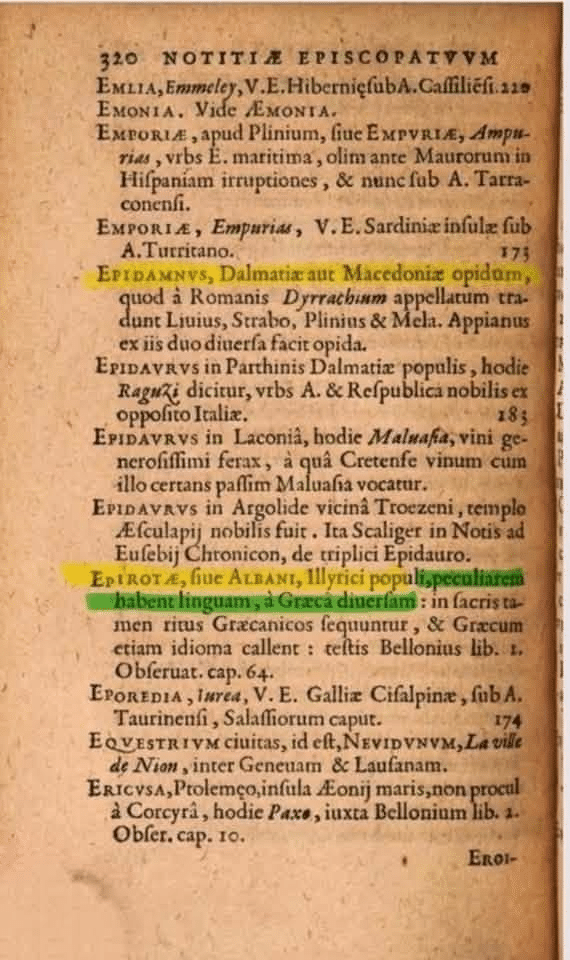
Greek was a variant of the Biblical Koine, therefore a religious language, Epirotic was Albanian, therefore an ethnic language. Many medieval and post- medieval texts identify it as such different from Greek
along with the Epirotes widely recognized as Albanians
After all this explanation, the question if Epirotes were Greek(in antiquity) is completely senseless, not only because they weren’t, no indication leads to such suggestive conclusions but the terms “Greek” or “Hellene” needs thorough clarifications in order that it qualifies as distinct ethnic marker, like the question suggests.
The final answer is No, Epirotes were not Greeks, at least ethnically, the word Greek doesn’t hold any historical ethnic quality.
Epirotes equates one of the names for Albanians, the other name being Macedonians, whose language is an Albanian dialect:
Albanian language was called a Greek Dialect, because they are the real inhabitants of the so called Greece, which has never been a state-nation, until 19th century when the Great Christian Powers created it following such European model.