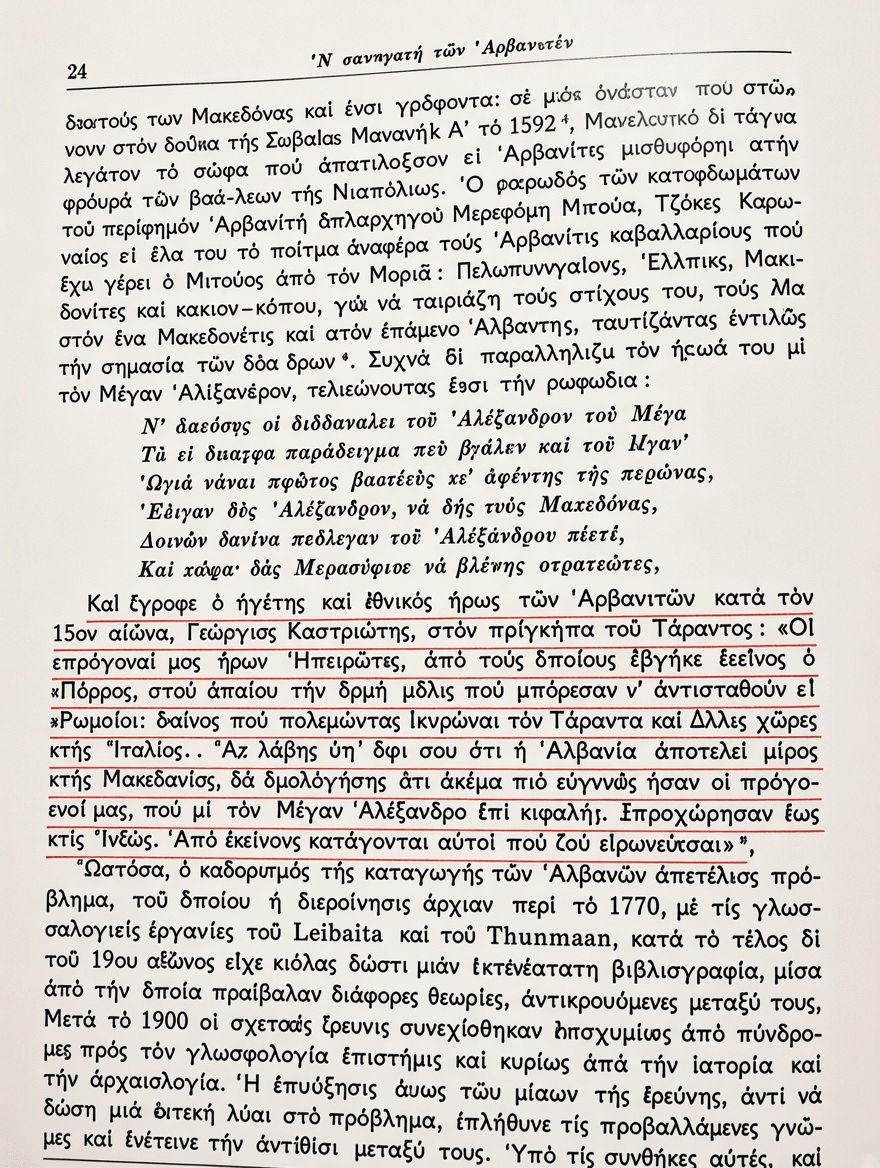

…the Macedonians themselves—as they are referred to in a report addressed to the Duke of Savoy, Emmanuel I, in 1592. The Macedonians are also mentioned in connection with the unit sent to the fortress of the Royal Palace in Naples. The commander of this Arvanite unit, Captain Mertos Tzanes Koronaios, speaks throughout his poem of the “Arvanites of the Galleys” (Karavellaroi), who brought Mertos from the Morea. He refers to them as “Peloponnesians, Macedonians, and Arvanites,” and—for the sake of rhyme—at times simply calls them “Arvanites,” treating the two terms as entirely interchangeable.
He also frequently invokes Alexander the Great, concluding the poem with these verses:
““N’ akousis oi didaskaloi tou ’Alexandrou tou Mega
To ti omorfo paradegma pou vgalan kai tou legan
‘Oyan vanei protos vasileus ki’ afentis tis kosmos,
Eleyan dos ’Alexandron, va dis tous Makedonas.
Loi pon ekeino poileyan tou ’Alexandrou fourre-tout,
Kai tora dos Mertsion va vlefti stratiotes.”
English:
“If the tutors of Alexander the Great were to hear
of the fine example they set for him—
that when a man becomes the supreme king and master of the world,
they would say: ‘Look at Alexander, and you shall see the Macedonians.’
Just as they spoke of Alexander’s men in those days,
so now, look at Mertos and behold his soldiers.”
The national poet of the Arvanites, Georgios Kastriotis, wrote in the 15th century about the exploits of Skanderbeg:
“Our ancestors were Epirotes—such as Pyrrhus, against whose onslaught the Romans could barely stand—who, through their conquests, took control of Taranto and other regions of Italy… If you accept that Albania is part of Macedonia, then you must acknowledge that our ancestors were even more noble: those who, alongside Alexander the Great, achieved renown and reached as far as India. From them descend those who are known today as Arvanites.”
Nevertheless, the question of the origin of the Albanians remained a problem, the resolution of which began to be addressed around 1770 through the linguistic studies of Leibniz and Thunmann. By the end of the 19th century, various—often contradictory—theories had already emerged. After 1900, research continued, enriched by contributions from linguistics and, especially, history and archaeology. However, the development of these disciplines, rather than providing a clear solution to the problem, rendered it even more complex and deepened the controversy.
Source
«Ἡ καταγωγὴ τῶν Ἀρβανιτῶν»(“The Origin of the Arvanites”).