
Summary
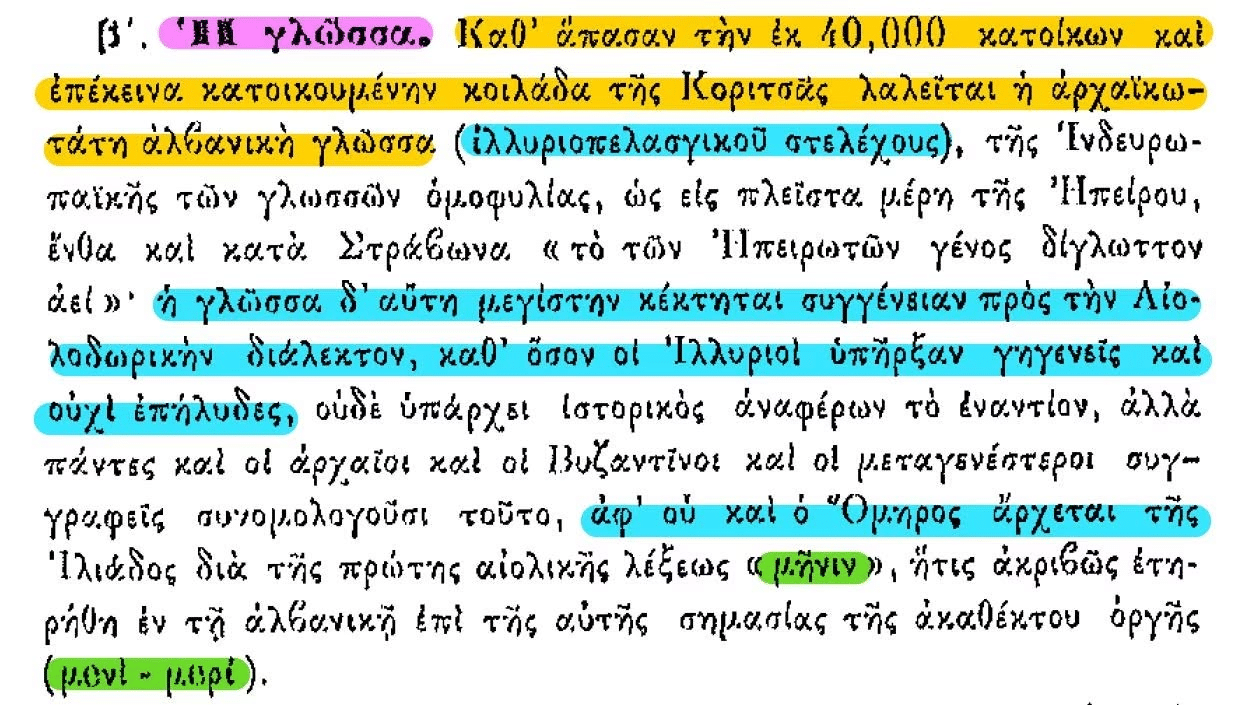
In 1900, the Bulletin of the Historical and Ethnological Society of Greece claimed that archaic Albanian, of Illyro-Pelasgian origin and spoken in the Korça valley, preserved deep links to Homeric Greek. Citing the indigenous status of the Illyrians, Strabo’s bilingual Epirotes, and affinities with the Aeolic-Doric dialect, the text highlighted that Homer’s opening word mēnin (“wrath”) survives in Albanian as mëni/mëri with the same meaning. This lexical continuity, it argued, positioned Albanian as a living remnant of the ancient linguistic world that produced the Iliad, underscoring its extreme antiquity in the Balkans.
In 1900, the Bulletin of the Historical and Ethnological Society of Greece (Volume 5) recorded a striking observation about the Albanian language. In the valley of Korça, home to some 40,000 inhabitants at the time, an archaic form of Albanian was spoken—an Indo-European tongue of Illyro-Pelasgian origin. This language, the Bulletin noted, stood in close relation to the Aeolic-Doric dialect of ancient Greek. The observation carried a deeper implication: that Albanian preserved elements of the linguistic world in which Homer composed the Iliad.
The argument rested on several interconnected theories. First, the Illyrians were indigenous to the western Balkans. No ancient, Byzantine, or later historian presented them as latecomers; they belonged to the oldest stratum of the region’s population. Second, Strabo recorded that the Epirote race was bilingual. This bilingualism pointed to a long coexistence and interpenetration of related speech forms in the area stretching from Epirus into the Albanian highlands. Third, the Albanian of the Korça region retained a clear affinity with the Aeolic-Doric dialect—the very dialectal sphere from which Homeric diction drew heavily.
The most vivid illustration offered by the Bulletin concerned the opening word of the Iliad. Homer begins: Mēnin aeide, thea… (“Sing, goddess, of the wrath…”). The word mēnin (μῆνιν)—the accusative of mēnis, denoting a deep, unrelenting, almost sacred anger—appears in Albanian as mëni or mëri, carrying the same essential meaning: a profound, unrepentant resentment or rancor. The phonetic and semantic correspondence was presented not as coincidence but as survival. An archaic Albanian form had preserved, across millennia, the very term with which the greatest poem of antiquity opens.
This theory positioned Albanian as more than a later Balkan language. Because the Illyrians were regarded as autochthonous and because their speech was linked to the Aeolic-Doric continuum, Albanian could be understood as a living continuation of the linguistic environment that produced Homeric epic. The Pelasgian element in the formulation reinforced the idea of extreme antiquity: the Pelasgians were remembered in Greek tradition as a pre-Hellenic people of the Aegean and Balkan world. By describing Albanian as Illyro-Pelasgian, the 1900 notice placed it among the oldest Indo-European idioms of the peninsula.
The geographical focus on the Korça valley was significant. Situated in a region of historical contact between Albanian-speaking and Greek-speaking populations, the area offered a natural laboratory for observing archaic features. The survival of a form so close to Homeric mēnis suggested that certain strata of Albanian had remained relatively conservative, retaining lexical items that mainstream Greek dialects had either transformed or lost in everyday use.
The broader implication was civilizational. If the language of Homer contained elements still audible in the Albanian of 1900, then Albanian was not a peripheral or recent arrival in the Balkans but a key to understanding the deep linguistic prehistory of the region. The bilingual Epirotes of Strabo, the indigenous Illyrians affirmed by the historical record, and the Aeolic-Doric affinities all converged on the same conclusion: the speech of the Albanians carried forward an ancient inheritance that reached back to the world of the Trojan War itself.
Thus the Bulletin of the Historical and Ethnological Society of Greece in 1900 offered a concise yet powerful thesis. The archaic Albanian of Korça, rooted in Illyro-Pelasgian soil and linked to the dialects of early Greek epic, preserved in living form the word with which Homer began his song of wrath. In that single lexical survival—mēnin / mëni—lay a claim to profound continuity between the language of the Iliad and the Albanian tongue.