
Abstract
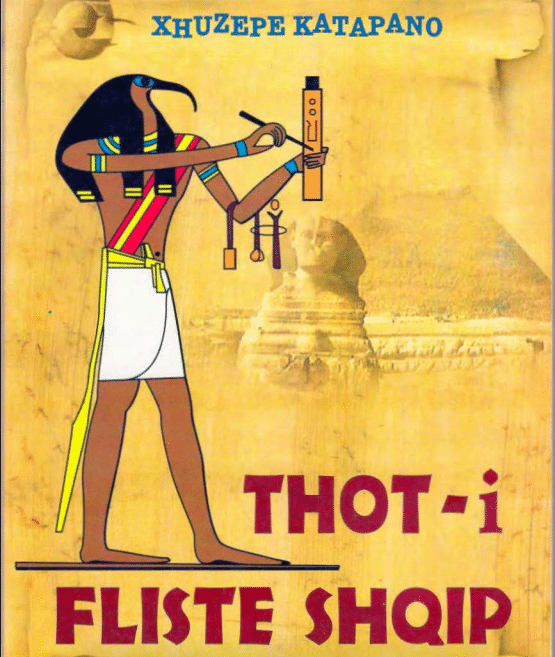
Thoth Spoke Albanian by Giuseppe Katapano presents an unconventional interpretation of ancient Egyptian hieroglyphic writing through comparison with the Albanian (Illyrian) language. The work argues that the forms and phonetic values of Egyptian hieroglyphs can be better understood by examining Albanian words, their initial sounds, and the symbolic meanings associated with them. Through examples involving letters and concepts such as the eagle, light, life, creation and the divine, Katapano proposes that the language preserves elements of a much older linguistic tradition.
The author extends this interpretation into a broader historical argument, suggesting that Illyrian civilization and language have roots reaching back approximately 12,000 years, and that Thoth—the Egyptian figure associated with writing, knowledge and divine wisdom—was of Illyrian rather than Egyptian origin. He further connects this proposed ancient civilization with Atlantis and with the historical and cultural development of peoples around the Mediterranean. These are the author’s central hypotheses and interpretations.
The work combines comparative linguistic observations, interpretations of hieroglyphic symbols, references to ancient writers and civilizations, and philosophical and esoteric reflections. Its poetic section, written in Arbëresh, gives literary expression to the author’s ideas and celebrates Albanian cultural identity, historical memory and intellectual heritage. An accompanying critical discussion situates the work within the traditions of Albanian and Arbëresh literature, acknowledging its interdisciplinary ambition and its effort to bring poetry into dialogue with historical and linguistic inquiry.
Ultimately, Thoth Spoke Albanian is an ambitious attempt to reinterpret the relationship between ancient Egypt and the Albanian linguistic tradition. It invites readers to consider questions about the origins of language, the transmission of cultural knowledge and the interpretation of ancient symbols, while presenting a distinctive and strongly argued vision of Albanian antiquity.