
by Aleksander Hasanas
Summary
The post highlights the ancient Oracle of Dodona in Epirus as one of the oldest sanctuaries of the classical world, emphasizing its deeper Illyrian (and by extension Proto-Albanian) roots that are often overlooked.
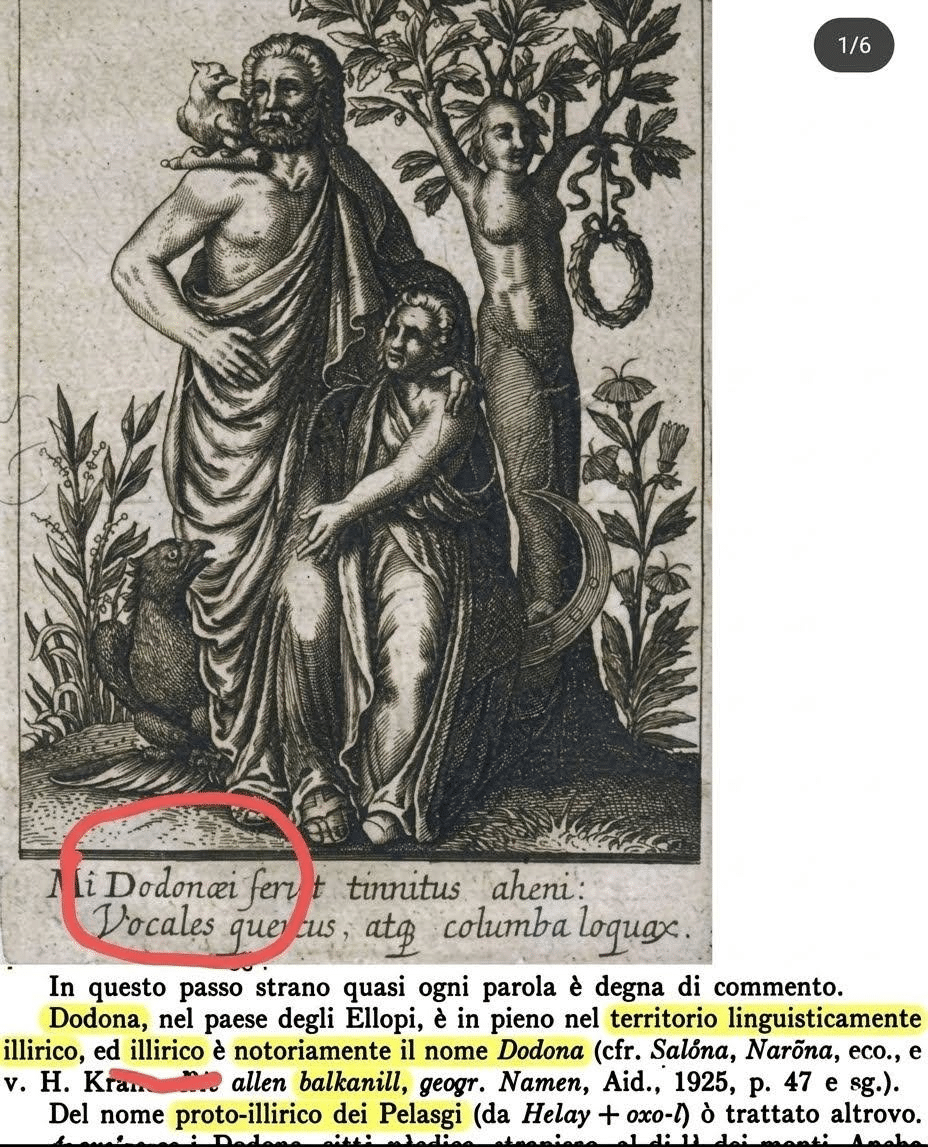
It describes a 17th-century engraving by Jean-Jacques Boissard showing the deity of Dodona with her three sacred symbols:
- The speaking oak (prophecies interpreted from the rustling of its leaves)
- Bronze cauldrons that resonated in the wind
- The talking dove that, according to legend, founded the sanctuary
The Latin inscription under the engraving is translated as: “For me the bronze of Dodona resounds: the speaking oaks and the talking dove.”
The author cites Italian linguist Giuliano Bonfante (1968), who argued that Dodona lies fully within the Illyrian linguistic territory and that the name “Dodona” itself is Illyrian (comparable to names like Salona and Narona).
The message concludes by asserting that the Illyrian language and land form the living foundation of Albanian civilization and that the Albanian language has survived for millennia, with every place name still echoing the speech of the ancestors.
Many people know the famous Oracle of Dodona in ancient Epirus as one of the oldest sanctuaries of the ancient world, but its true roots are often forgotten.
In this 17th-century engraving (from the work of the French antiquarian Jean-Jacques Boissard), the deity of Dodona is depicted together with her three sacred symbols: the speaking oak (through the rustling of its leaves the prophecies were interpreted), the bronze cauldrons that resounded in the wind, and the speaking dove which, according to legend, founded the sanctuary.
Deciphering of the Latin inscription under the engraving:
“Mi Dodonæi fervit tinnitus aheni: Vocales quercus, atq[ue] columba loquax.”
English: “For me the bronze of Dodona resounds: the speaking oaks and the talking dove.”
Deciphering of the scholarly text (in Italian) below the engraving:
“Dodona, in the land of the Ellopes, is located entirely within the Illyrian linguistic territory, and the name Dodona is undoubtedly Illyrian (cf. Salona, Narona, etc., and see H. Krahe, Die alten balkanillyrischen geographischen Namen, 1925). The Proto-Illyrian name of the Pelasgians is discussed elsewhere.” — writes the well-known Italian linguist Giuliano Bonfante in his study “Illyrian Elements in Greek Mythology” (1968).
The Illyrian language and land are not merely dusty memories in history books, but the living foundation upon which our civilization was built and the Albanian language has survived for millennia. Every stone and every place name of this land still speaks the language of our ancestors.
Reference
https://www.ocnal.com/2017/07/the-italian-linguist-bonfante-shows.html?