
Abstract
This article examines a longstanding Albanian cultural phenomenon: a pragmatic skepticism toward religious clergy—whether Orthodox priests or Muslim imams—when their teachings prioritize confessional or irredentist agendas over national identity, language, and communal cohesion. Drawing on the 1924 photograph of a Muslim cleric (hoxha) kissing the hand of Serbian Patriarch Dimitrije in Vushtrri, under the Kingdom of Yugoslavia, the analysis situates this gesture within broader patterns of ecclesiastical subordination and Albanian resistance to religious instrumentalization.
It connects this historical episode to the folkloric proverb warning against “black-bearded priests,” seventeenth-century Catholic reports of Orthodox pressures, and contemporary concerns over radicalizing imams. The phenomenon reveals a consistent Albanian prioritization of Shqiptaria (Albanianism) over religious irredentism, underscoring an enduring awareness that ethnic and linguistic bonds cannot be supplanted by confessional loyalties.
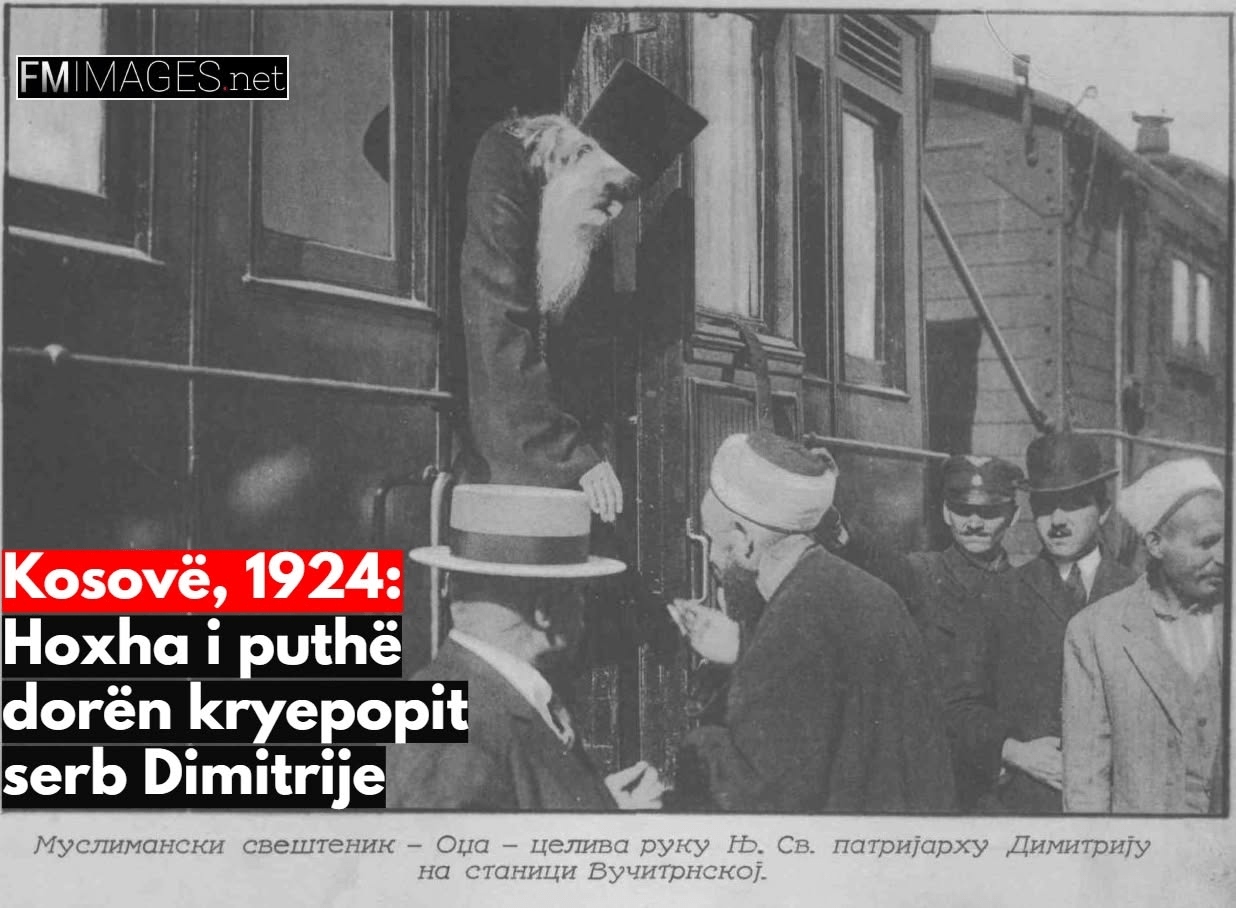
In 1924, at the railway station in Vushtrri, a Muslim cleric—referred to as a hoxha or odža—was photographed kissing the hand of Serbian Orthodox Patriarch Dimitrije.
The accompanying Serbian caption identifies the scene as a Muslim priest paying respects to His Holiness the Patriarch at the Vushtrri station. This image, circulating in historical collections such as those of FM Images Albania, captures a moment of formal deference under the Kingdom of Yugoslavia’s administration of Kosovo.
Far from an isolated curiosity, the gesture illustrates a broader historical dynamic: the subordination of local Muslim religious structures to Serbian Orthodox and state authority during periods of occupation, and the Albanian response of cultural wariness toward clergy who advanced external or radical agendas at the expense of national solidarity.
Albanian historical consciousness has long distinguished between ordinary religious practice and the politicization of faith. A well-attested folkloric proverb, “Mus i besoni popave mjekërzez” (Do not believe the lies of the black-bearded priests), circulates among Albanians and communities as a pointed caution against Serbian Orthodox clergy.
The black beard and traditional robes serve as visual markers of the clergy associated, in popular memory, with narratives of perpetual Serbian victimhood, anti-Albanian mobilization, and the intertwining of church and nationalist irredentism. The proverb does not reject Orthodoxy per se; rather, it warns against clerical influence when it seeks to replace linguistic and ethnic bonds with confessional loyalty or territorial claims.
This skepticism finds an early documentary parallel in the seventeenth century. In 1664, Andrea (Ndre) Bogdani, Archbishop of Skopje (Shkup) and a prominent Albanian Catholic prelate, reported to Rome that Albanians suffered greater persecution from the Orthodox Church than from the Ottoman Turks. Bogdani’s observation, preserved in correspondence and later cited by scholars such as Mark Krasniqi, reflects the pressures exerted by Orthodox hierarchies—often aligned with Slavic or Greek ecclesiastical centers—upon Albanian Catholic and Muslim populations in the region.
These pressures included linguistic Hellenization or Slavization efforts, restrictions on Albanian-language liturgy, and attempts to erode distinct Albanian identity under the umbrella of Orthodox millet structures.
The Albanian national awakening of the nineteenth century crystallized this prioritization of nation over confession. Pashko Vasa’s famous lines—“The religion of the Albanian is Albanianism”—encapsulated a deliberate rejection of the divisive potential of mosque and church. In a society divided among Sunni Muslims, Bektashis, Catholics, and Orthodox, the Rilindja (National Renaissance) insisted that language, custom, and shared ancestry constituted the primary bonds.
Clergy of any stripe who subordinated these bonds to external religious or imperial interests were viewed with suspicion. This stance was not anti-religious; it was anti-irredentist. Albanians historically practiced their faiths with notable intercommunal tolerance, yet remained alert to the danger that radical or politically instrumentalized clergy posed to communal cohesion.
The 1924 scene in Vushtrri must be read against this background. Under the Kingdom of Serbs, Croats and Slovenes (later Yugoslavia) Albanian Muslim institutions operated within a framework of Serbian state and ecclesiastical dominance. Many local Muslim clerics found themselves integrated into administrative and ceremonial structures that required public displays of deference to Orthodox hierarchy.
The hand-kissing gesture, while consistent with traditional Balkan expressions of respect toward high religious authority, also symbolized the asymmetrical power relations of occupation. Contemporary Albanian commentary notes that at a time when Yugoslav authorities suppressed Albanian political expression and literacy efforts, representatives of compliant Islamic associations participated in such receptions for the Serbian patriarch. The photograph thus stands as visual evidence of institutional control rather than spontaneous interfaith harmony.
The same cultural logic extends into the present. Just as earlier generations cautioned against black-bearded Orthodox priests whose sermons advanced Serbian nationalist narratives, many Albanians today express wariness toward certain bearded imams—often influenced by external Salafi or Wahhabi currents—who seek to radicalize youth and subordinate national identity to a transnational Islamist framework.
In both cases, the threat is perceived not in the beard or the robe themselves, but in the attempt to replace Shqiptaria with religious irredentism. Albanian society’s historical resilience has rested on the capacity to practice Islam, Catholicism, or Orthodoxy without allowing any of them to erase the primacy of language and nation.
This continuity reveals a remarkable consistency. From Bogdani’s seventeenth-century reports through the folkloric proverb and the constrained gestures of 1924 to contemporary critiques of radical preaching, Albanians have demonstrated an acute awareness that religious institutions, when captured by external or extremist agendas, can become instruments of division. The enduring preference for national and linguistic solidarity over confessional maximalism has served as a protective cultural mechanism—one that continues to shape Albanian responses to clerical overreach, whether Orthodox or Islamist.
Bibliography
Bogdani, Andrea. Correspondence to Rome, 1664. Cited in Mark Krasniqi, “Les Albanais dans l’oeuvre d’un diplomate russe.” In Gjurmë e Gjurmime, 291–391. Prishtinë, 1979.
Krasniqi, Mark. “Les Albanais dans l’oeuvre d’un diplomate russe.” Gjurmë e Gjurmime. Prishtinë, 1979.
Latifi, Petrit. “The Albanian Proverb for Serbs and Serbia: Do Not Believe the Lies of Your Black-Bearded Priests.” Balkan Academia, July 18, 2026. https://balkanacademia.com/2026/07/18/the-albanian-proverb-for-serbs-and-serbia-do-not-believe-the-lies-of-your-black-bearded-priests/.
Periscopes. “Latifi Publishes a Photo from 1924 of the Hoxha Kissing the Hand of the Serbian Pope Dimitrije.” February 22, [year]. https://www.periskopi.com/en/Latifi-publishes-a-photo-from-1924-of-the-hoxha-kissing-the-hand-of-the-Serbian-pope-Dimitrije/.
Vasa, Pashko. “O moj Shqipni” (c. 1878). Translated by Robert Elsie. In various anthologies of Albanian national literature.
Additional visual source: Photograph, Vushtrri railway station, 1924. FM Images Albania / FMIMAGES.net.

