
Abstract
The Serbian conquest of Kosovo and other Albanian-populated territories during the Balkan Wars of 1912–1913 was accompanied by extensive violence against the civilian population. Contemporary diplomatic reports, journalistic accounts, eyewitness testimony, religious reports, and later historical investigations describe killings of civilians, including children and infants, rape and other forms of sexual violence, torture, the killing of pregnant women, attacks on unborn children, village destruction, executions, and mutilation of corpses. Although individual reports vary in reliability and detail, the cumulative documentary record indicates that a substantial proportion of the contemporary allegations were grounded in real events rather than being merely products of wartime propaganda.
This article examines the evidence concerning Serbian military violence against Albanian civilians, with particular attention to child killing, sexual violence, torture, attacks on pregnant women, mutilation, and reports concerning blood collection and consumption. The analysis places particular weight on contemporary sources such as Leo Freundlich’s Albania’s Golgotha, the writings of Edith Durham, British diplomatic correspondence, Albanian newspapers, Serbian newspapers, and consular reports. The evidence suggests that the violence was not restricted to isolated battlefield incidents but affected civilian communities across areas occupied by Serbian forces.
Similar crimes occurred in 1919, in the 1940s and in 1999 among Serbian soldiers.
Rivista d’Italia in 1913: Serbian soldiers would stab Albanian pregnant women, impale fetuses, bayonet civilians, and rape women in front of their husbands
“Serbs-rather monsters than men” – quote from the publication.
Cited from the Rivista d’Italia in 1913:
“Moreover, through this conquest, the Serbs dishonored their own name; the atrocities they committed against peaceful, unarmed populations surpassed those committed twenty years earlier by the Turks against the Armenians—atrocities for which Sultan Abdul Hamid was deservedly branded by Gladstone as the “Great Assassin.”
Peaceful citizens in Pristina, Usküb, Gjakova, and many other places were struck down by Serbian bayonets in the public streets; others were slaughtered in their own homes while seeking refuge from Serbian savagery or begging for mercy; others still were falsely accused of colluding with the Turks and were publicly butchered without even the semblance of a trial.
Women were raped before their husbands’ eyes. Brothers and fathers were shackled and forced to witness the slaughter of their loved ones, unable to defend them; pregnant women were disemboweled and fetuses impaled on spear-points; children were run through with bayonets; villages were burned and destroyed. Twenty-five thousand Albanians were massacred by the rabble of Serbian soldiery.
Anyone reading the Reichspost report recoils in horror at the savage atrocities committed by the Serbs—monsters rather than men, brutes rather than conquerors, unworthy of the human community. Moreover, the right of conquest cannot be invoked here: at the time of the conquest, Albania was no longer a Turkish province but an autonomous state—a status granted by the Sublime Porte with the concurrence of the Great Powers.
By asserting rights of conquest over it, the Serbs violate the law of nations. Their economic arguments for possessing Durrës are invalid, as they would set a precedent that all the ravenous bitches of Europe would exploit by fair means or foul. They do not have the right to seize territory simply because they need access to the sea to boost their trade and foster their nation’s prosperity.”
Source
Rivista d’Italia 1913. Società editrice dante alighieri. University of California. ANNO XVI. FASC. I.Proprietà letteraria e artistica. ROMA 17. PIAZZA CAVOUR. P.372
When Serbs would pierce pregnant Albanian women and kill the fetus, kill the children, drink wine and collect the blood in cups in 1912-1913
In 1912-1913, when Serbia invaded Albanian territories in Kosovo, Macedonia and Albania, as the Ottomans withdrew, Serbian soldiers would commit some of the most grotesque and horrifying crimes that the world has ever heard of; everything from burning women and children to haystacks, bayoneting babies on the ground, throwing babies into burning houses, piercing little boys with bayonets, strangeling children to death, and even cutting up pregnant women and tossing the fetus. The same kind of crimes were carried out by the Serbs in 1998-1999 in Kosovo.
Serbs bayonetting Albanian babies in 1912
A Franciscan priest who visited Luma reported seeing “poor bayonetted babies” on the streets.
Source: Edith, Durham (1920). Twenty Years of the Balkan Weave. p. 246. Accessed March 29, 2020.
Serbian Vojvoda leader Milic Krstic, in the years of 1919-1938, was also reported to have bayonetted Albanian babies in their cradles
Serbian atrocities against Albanian women and children during the Balkan War of 1912-1913
“The greatest tortures were suffered by Albanian women, who were raped, then tied up, made into hoods, covered with straw and burned alive. If they were pregnant, their stomachs were opened with a bayonet and after the child was taken out of their womb, they were placed on the tip of the bayonet or the stake. After the massacre, the Serbs drank wine, sang and danced. There were cases that during the slaughter they collected the blood in cups and opened the feast with it.”
Source: Albanian Golgotha, Wien, 1913. Leo Freundlich. Carried out from mid-October 1912 (when the First Balkan War began) to March 1913.)
Serbian soldiers killed infants in cradles in 1919
“Robberies and bribery were part of the tragic scenes, as were rapes. It has reached the point where they have taken women’s rings by force, breaking their fingers, taken their earrings, tearing their ears, and even robbed children in their cradles of their clothes, shooting them with bayonets from their cradles..“ (p.272)
Source: The following information is taken from the book “GENOCIDI SËRBOMADH DHE QËNDRESA E SHQIPTARËVET” written by Shaban Braha. These sections are saxed from Gjokë Dabajs articles on Pashtriku.org
Serbo-Montenegrin soldiers killing Albanian babies in World War 2
“One of the Montenegrin terrorists lifted the cradle of a 7-month-old baby vertically and shot the baby with an automatic rifle.” (p. 463) “In the Gjilan region, murders increased, but not graves, because many victims were shot in the same grave. In one case, the number of massacred people, thrown into a pit, reached 96 people.” (p. 463)”
Source: The following information is taken from the book “GENOCIDI SËRBOMADH DHE QËNDRESA E SHQIPTARËVET” written by Shaban Braha. These sections are saxed from Gjokë Dabajs articles on Pashtriku.org
Serbian soldiers killing babies in cradles in 1943 in Sanxhak region
Some of the names of babies in cradles killed by Yugoslav Chetniks Pavle Đurišić in Pljevlja in 1943:
HASOVIĆ A. JUSUF, born in 1942 (one year old)
MUSIC M. BEGIJA, born 1943 (baby)
SHLJIVO M. HAJRIJA, born 1943 (baby)
SNAIL S. EMA, born 1943 (baby)
MOĆEVIĆ J. SIMBULA, born 1943 (baby)
MOĆEVIĆ M. ĐUZIDA, born 1943 (baby)
CHORBO L. LATIFA, born 1943 (baby)
MUSIC S. HAJRO, born 1943 (baby)
MAŠOVIĆ A. ELMASA, born 1943 (baby)
KELEMIS J. RASHID, born 1943 (baby)
SIJAMIC R. ZUMRA, born 1943 (baby)
MAŠOVIĆ D. HAZBIJA, born 1943 (baby)
SHATARA M. NURA, born 1943 (baby)
HEKALO M. MURADIF, born 1943 (baby)
KUBUR M. HAMDO, born 1942 (one year old)
ŠLJUKA M. ZADA, born in 1942 .
PLAKALO R. NURA, born in 1942 (one year old)
SIJAMIC A. ZIZO, born in 1942 (one year old)
GEC P. RABIJA, born 1942 (one year old)
PRLJAČA R. ADILA, born in 1942 (age one year)
MOĆEVIĆ A. ZLATIJA, born in 1942 (one year old)
DRKENDA DZH. RASIM, born in 1942 .
KORORA R. SAFIJA, born 1942 (one year old)
KLAPUH S. FATIMA, born in 1942 (one year old)
RIFLE M. NAZA, born in 1942 (one year old)
KADRIĆ D. MEVLA, born 1942 (one year old)
KISELICA M. HASHIM, born in 1942 .
KISELICA M. SABIT, born in 1942 (one year old)
PUCAR J. HAJIRA, born 1942 (one year old)
Source
Rare book “Screaming accusations” says “Serbs collected the blood of dead Albanians”
Leo Freundlichs rare book “Screaming accusations” contains information stating that in 1912 the Serbian soldiers would collect the blood of dead Albanians before feasting. Brunilda Ternova writes:
“The only copy of Freundlih’s book “Screaming Accusations”, contains the protest against Europe that did not react in defense of Albanians during the mass extinction of most of the Albanian people in the Balkans. The book was found in the library of Harvard University in the USA, in 1982 by the researcher Safete Juka, living in America.”Hundreds and thousands of massacred corpses floated in the rivers.
Those who could escape disease, hunger, infantry rifle bullets and Serbian artillery shells were collected in designated places and received a bullet in the head. Those who hid in their homes suffered the most. After the fine searches that were made for loot and gold, they were easily found and slaughtered like lambs. The greatest tortures were suffered by Albanian women, who were raped, then tied up, hooded, covered with straw and burned alive.
If they were pregnant, their wombs were opened with a bayonet and, after the baby was brought out of the womb, they put it on the tip of the bayonet or on poles. After the slaughter, the Serbs drank wine, sang and danced. There were cases when during the slaughter they collected the blood in cups and opened the feast with it.”
When Serbs would tie Albanian corpses to trees, slit the throats of Albanians and decapitate others in 1912
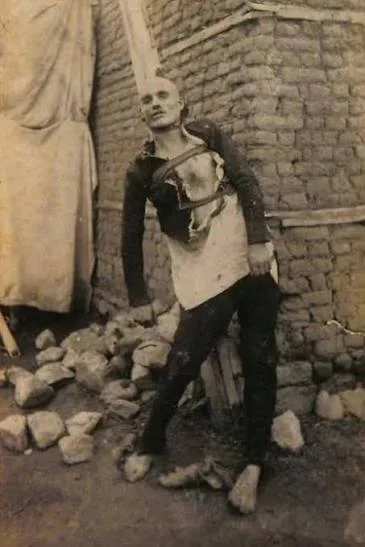
Left: Kadri Reka: Killed and tied to a tree, where he remained like that for a week, with the intention that his mother, wife and children would see him.
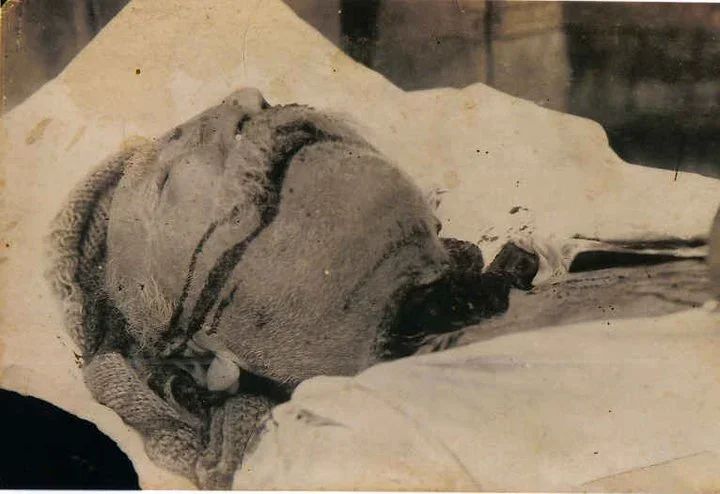
Right: Hazir Kuka with a cut throat. These photographs and notes from the German language were deciphered by Shyrete Avdiu.
Sources
The Terror of Serbian Occupier Over Albanians 1844-1999 by Nusret Pllana (2012)
Bibliography
Primary and Contemporary Sources
British Foreign Office. Correspondence Respecting the Affairs of South-Eastern Europe. FO 424/2351.
Durham, M. Edith. The Struggle for Scutari, 1912–1913. London: Edward Arnold, 1914.
Durham, M. Edith. Twenty Years of Balkan Tangle. London: George Allen & Unwin, 1920.
Freundlich, Leo. Albania’s Golgotha: Indictment of the Exterminators of the Albanian People. Vienna, 1913.
Përlindja Shqiptare. No. 14. 1913.
Politika. Belgrade. November 3 and November 16, 1913.
Radničke Novine. 1912–1913.
Der Krieg 1914/17 in Wort und Bild: Geschichte des Weltkrieges. 1916.
Later Historical Sources
Braha, Šaban. Serbian Genocide and Albanian Resistance (1844–1990). Tirana: Lumi-T, 1991.
Shala, Xheladin. Albanian-Serbian Relations 1912–1918

