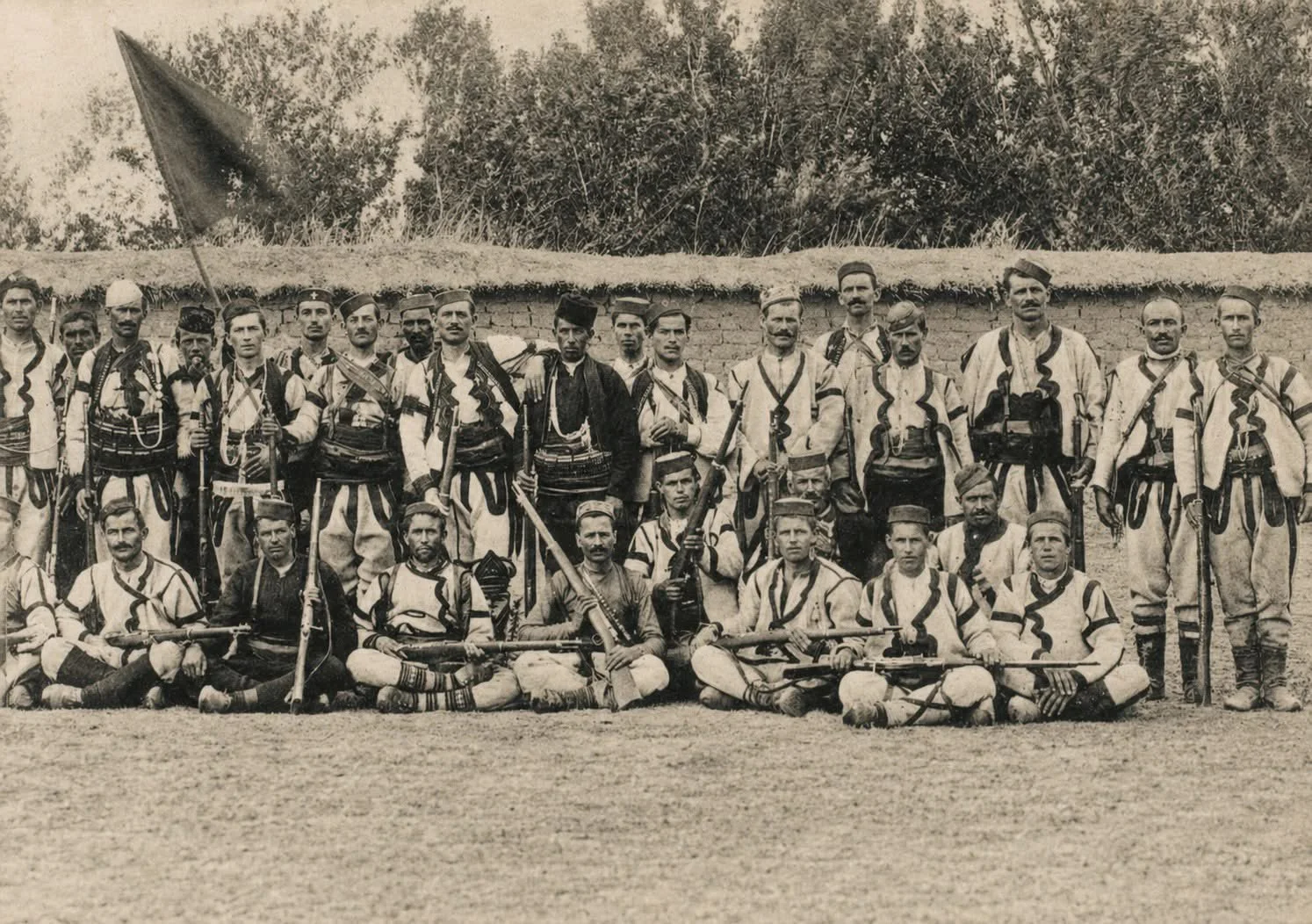

The image, titled “Serbian Dukes: The leaders of the Serbian gangs” or “Les chefs des bandes Serbes” in French tries to depict Albanians wearing plis and tirqi (Albanian wool costume) as Serbs.
This widely circulated colorized or restored group photograph, featuring a large band of armed men in traditional Balkan highland attire posing with rifles under a red flag, is frequently captioned as “Српске војводе” (“Serbian Voivodes” or chiefs) and “Les chefs des bandes Serbes” (“The chiefs of the Serbian bands”). It is presented in Serbian nationalist contexts as evidence of early 20th-century Serbian Chetnik (komitadji) fighters or guerrilla leaders. This labeling is misleading and constitutes a clear case of historical misattribution and cultural appropriation.
Key Visual Evidence: Distinctly Albanian Attire
The most glaring inconsistency is the presence of men wearing the plis (or qeleshe) — the iconic white, brimless felt wool skullcap that is a longstanding ethnic marker of Albanian identity, particularly among Gheg highlanders in northern Albania, Kosovo, and surrounding regions.
The plis/qeleshe is traditionally handmade from wool (lesh in Albanian), with regional variations in height and shape. It has deep roots in Illyrian-era Balkan material culture and was widely documented in 19th- and early 20th-century photographs of Albanian subjects by ethnographers and travelers. It is not part of core Serbian folk costumes (which more typically feature items like the šajkača cap in many regions).
Multiple individuals in the photo wear this hat alongside layered wool vests, braided elements, sashes, and overall silhouettes consistent with traditional Albanian male highland dress (tirqe or similar wool costumes). These are practical garments for mountainous guerrilla warfare in the Ottoman-era Balkans.
Serbian Chetnik fighters operating in contested border areas (Kosovo, Macedonia) during the late Ottoman period and Balkan Wars sometimes adopted local highland practical attire for tactical reasons. However, this does not make the clothing “Serbian,” nor does it erase the ethnic markers visible here.
The attire, combined with the group’s appearance, aligns far more closely with Albanian highlanders or mixed irregular bands from Albanian-inhabited regions than with typical depictions of Serbian Chetnik voivodes from central Serbia or elsewhere.
Context
This image appears to originate from early 20th-century French or Western European photography of the Balkans (possibly during the Balkan Wars era, ~1912–1913), when “bands” (irregular fighters/komitadjis) of various ethnicities — Serbian, Bulgarian, Albanian, Greek — clashed in Ottoman Macedonia and Kosovo. French photographers documented the region extensively.
Such photos were sometimes generically labeled by publishers or later propagandists. In modern circulation, Serbian nationalist accounts have repurposed it to bolster narratives of Serbian guerrilla heroism while downplaying or erasing Albanian presence and cultural elements in the same regions. Similar patterns occur with individual portraits (e.g., Chetnik fighters in Albanian-style dress being claimed as purely “southern Serbian costume”).
The red flag and armed pose are common in revolutionary/insurgent imagery of the era but do not override the ethnographic details of the clothing.
No Credible Chicago or Primary Sources Support the “Serbian Chiefs” Claim
Searches for origins tied to “Chicago” (possibly referencing Serbian-American diaspora publications or archives) yield no verifiable primary documentation linking this specific group photo to named Serbian voivodes as a unified “Serbian band.” Instead, it surfaces in online discussions (often Albanian or critical Balkan history groups) highlighting the mismatch.
Reputable ethnographic and historical sources on Balkan traditional dress consistently identify the plis/qeleshe and associated wool costumes as Albanian. Claims otherwise rely on selective interpretation rather than evidence.
Why This Matters
This is a textbook example of nationalist photo misuse: take a historical image from a multi-ethnic, contested borderland, apply a desired ethnic label, and ignore contradictory visual and cultural evidence. In reality, the early 20th-century Balkans featured complex overlapping identities, alliances, and practical cultural exchanges among highland communities — but the plis remains a clear Albanian identifier.
The photo depicts fighters from the turbulent pre-WWI Balkans, very likely including Albanians or those in Albanian traditional dress, not a pure assembly of “Serbian chiefs.” Mislabeling it distorts history for contemporary political points.
Sources

